
Brand Engagement Network Advances Conversational AI Deployment Amid Financial and Legal Challenges
Recent quarterly filings reveal Brand Engagement Network's strategic investments and commercial expansion in AI solutions despite liquidity pressures and ongoing litigation.
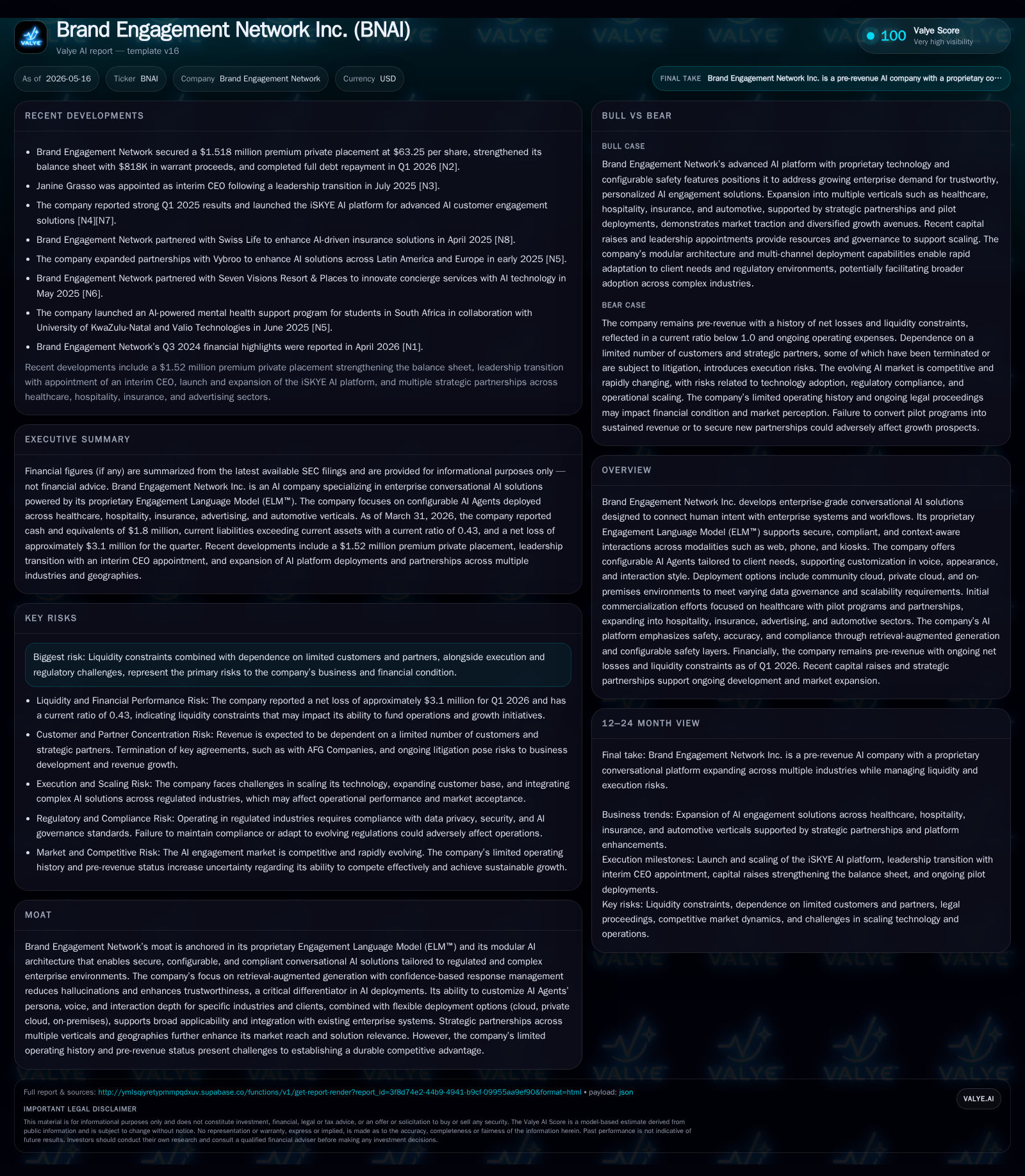
Brand Engagement Network Inc. (BNAI) reported in its latest 10-Q a strengthening of its cash position through financing activities, even as its current ratio remains weak at 0.43, indicating liquidity constraints. The company focuses on secure, enterprise-grade conversational AI powered by its proprietary Engagement Language Model (ELM™), with flexible deployment options tailored to regulated industries such as healthcare and insurance. While expanding geographically and diversifying vertically via strategic partnerships and an investment in Accelevate, BNAI faces execution risks compounded by ongoing litigation with former partners and concentrated customer exposure. Continued platform development, regulatory compliance focus, and go-to-market scaling remain critical to achieving sustainable growth.
Recent Operating Update
Brand Engagement Network’s most recent quarterly filing dated May 15, 2026 (10-Q) highlights capital improvements through financing activities that increased the company’s cash balance to roughly $1.8 million as of March 31, 2026. However, this liquidity figure stands against current liabilities exceeding $8.3 million for a current ratio of only 0.43, underscoring ongoing short-term funding strains [F1][S2]. The company reports minimal total debt around $319 thousand resulting in a net cash positive position adjusted for debt [F1].
Additionally, an earlier May 11, 2026 event filing (8-K) disclosed a strategic investment commitment totaling $1 million into Accelevate Solutions with governance rights including board representation and warrant coverage designed to foster technology collaboration and market expansion [S3]. This move aligns with Brand Engagement Network's broader strategy to deepen vertical market penetration.
Business Model
Brand Engagement Network Inc. creates enterprise-grade conversational artificial intelligence solutions aimed at integrating human intent directly into complex organizational workflows across industries requiring stringent security and compliance controls [S1][S10]. Central to its technology is the proprietary Engagement Language Model (ELM™), which leverages advanced modules for perception, natural language processing (NLP), multisensory input analysis, sentiment recognition, and real-time contextual personalization.
The company offers multiple deployment tiers: community cloud for scalable but standardized environments; private cloud for enhanced data control; and on-premises for clients demanding isolated infrastructure due to regulatory or security reasons [S10]. Revenue flows primarily from software licensing fees structured around custom configurations of its AI Agents — configurable in persona voice/appearance and depth of interaction — deployed across modalities like web portals, telephony systems, kiosks, or embedded vehicle interfaces.
Commercialization began with healthcare pilots but has expanded actively into insurance (with Swiss Life Global Solutions), hospitality (Seven Visions Resort & Places), advertising/media platforms (Vybroo), automotive services integrating live inventory data (via Dealer.com), among others. Distribution includes both direct enterprise sales teams targeting large/mid-market customers and channel partnerships that localize deployments internationally emphasizing compliance adaptation and workflow integration [S1][S10][S22].
Industry Structure and Competitive Position
Brand Engagement Network operates within the growing market for enterprise conversational AI platforms tailored to regulated industries—where accuracy, safety, data compliance, and customer trust are paramount. Its moat is anchored in ELM™, providing retrieval-augmented generation with confidence-based response management reducing hallucination risks—a crucial differentiator amid proliferation of generative AI competitors lacking domain-specific safeguards.
Flexible deployment options addressing varying client infrastructure policies add competitive advantage by enabling organizations with strict data governance requirements to retain control either via private cloud or on-premises modalities—something more commoditized SaaS AI offerings cannot adequately handle.
Strategic partnerships spanning international regions enable localized solution adaptations generating network effects—supporting integration with regional digital ecosystems typically underserved by global tech giants pushing one-size-fits-all AI models [S10][S22]. Nonetheless, the company’s relatively limited operating history tempers confidence versus larger incumbents.
Growth Drivers
- Regulated Sector Demand: Healthcare's labor shortages coupled with cost pressures incentivize AI automation augmented engagement tools; similar drivers exist in insurance underwriting claims processing and automotive digital retail experience enhancements.
- Customization & Security Needs: Enterprises increasingly demand tailored AI solutions amid rising concerns over privacy regulations (HIPAA, GDPR) positioning BNAI’s modular architecture as relevant.
- Geographic Expansion: Partnerships in Latin America and Africa provide footholds tapping developing markets where digital transformation meets untapped demand for specialized conversational agents.
- Strategic Investments: The $1 million equity stake in Accelevate is poised to amplify go-to-market capabilities through commercial collaboration while possibly enhancing technical synergies.
- Platform Scalability: Ongoing R&D investments aimed at increasing concurrency thresholds support pursuing large-scale deployments with complex integrations into existing enterprise systems.
Growth depends critically on converting pilots into scalable contracts within targeted verticals and demonstrating clear ROI benefits amid cautious buyer behavior characteristic of regulated sectors.
Risks / Watchpoints / Growth Constraints
- Liquidity Constraints: The low current ratio signals dependence on near-term capital raises or operational improvements to meet obligations without distress [F1][S2].
- Customer Concentration: Revenue reliance on a handful of major customers exposes earnings volatility risk if renewals do not materialize or contracts are lost [S1][S19].
- Litigation Exposure: Disputes with former partner AFG over unpaid contract sums introduce legal uncertainty that may divert management focus or result in unforeseen costs [S24][S1].
- Execution Complexity: Scaling customized AI deployments across different regulatory regimes requires significant ongoing engineering resources plus skilled sales specialization increasing time-to-market.
- Competitive Environment: Larger AI platform vendors could leverage scale disadvantages against BNAI especially if BNAI cannot fast-track feature maturity or pricing competitiveness.
- Capital Raising Dependency: Previous termination of a standby equity purchase facility necessitates new funding mechanisms; continued access to capital markets remains critical for sustained R&D spend and operational expansion [S21].[S26]
What to Watch Next
Key upcoming catalysts include:
- Closing the planned June 30, 2026 acquisition valued at approximately $19.5 million combining cash payment and stock issuance expected to expand product portfolio capabilities [S27].
- Monitoring quarterly revenue growth trends amid expanding international deployments particularly conversion rates from trials/pilots to recurring contracts.
- Updates on resolution or progression in legal proceedings relating to AFG including damages assessment impacting earnings visibility.
- Announcements regarding finalized definitive agreements following the initial letter agreement for investment projects such as with Accelevate that might reveal deeper partnership scope or pipeline impact.
- Any revised guidance or commentary on capital raise efforts addressing working capital sufficiency given near-term liquidity constraints.
- Product releases or technical milestones enhancing ELM™ modular capabilities potentially influencing customer retention or upselling opportunities.
Financial Profile Summary
Latest financial snapshot
| Metric | Value | Period |
|---|---|---|
| Cash & equivalents | $1801011 | |
| 2026-03-31 | ||
| Total debt | $318521 | |
| 2026-03-31 | ||
| Net debt | $-1482490 | |
| 2026-03-31 | ||
| Current assets | $4mm | |
| 2026-03-31 | ||
| Current liabilities | $8mm | |
| 2026-03-31 | ||
| Current ratio | 0.43x | |
| 2026-03-31 |
Source: SEC companyfacts cache [F1].
As of Q1 2026 close:
- Cash & equivalents: $1.8 million
- Total debt: $319 thousand
- Current assets vs liabilities imply a liquidity crunch with current ratio at 0.43
- Negative operating income of approximately -$12.6 million (latest FY) signaling ongoing investments outweigh near-term revenues
- Net income loss also around -$8.6 million illustrating continued development phase economics [F1]
While BNAI has improved capitalization via warrant exercises ($4.47M proceeds) and favorable debt-to-equity conversions during early 2026—the path to positive cash flow remains dependent on execution success in commercial scaling alongside cost discipline [S7][S26].
This report is prepared solely for informational purposes without any recommendation regarding buying or selling securities. It reflects data available as of May 16, 2026. Investors should conduct their own due diligence before making financial decisions.
Disclaimer: This is research-only, informational analysis and not investment advice. It may include AI-generated interpretation and general industry context. Always verify important details using primary sources.

Comments