
HAWKINS INC Strengthens Specialty Chemical Footprint Despite Earnings Miss
Q4 fiscal 2026 saw Hawkins surpass $1 billion in revenue amid margin pressures and elevated input costs.
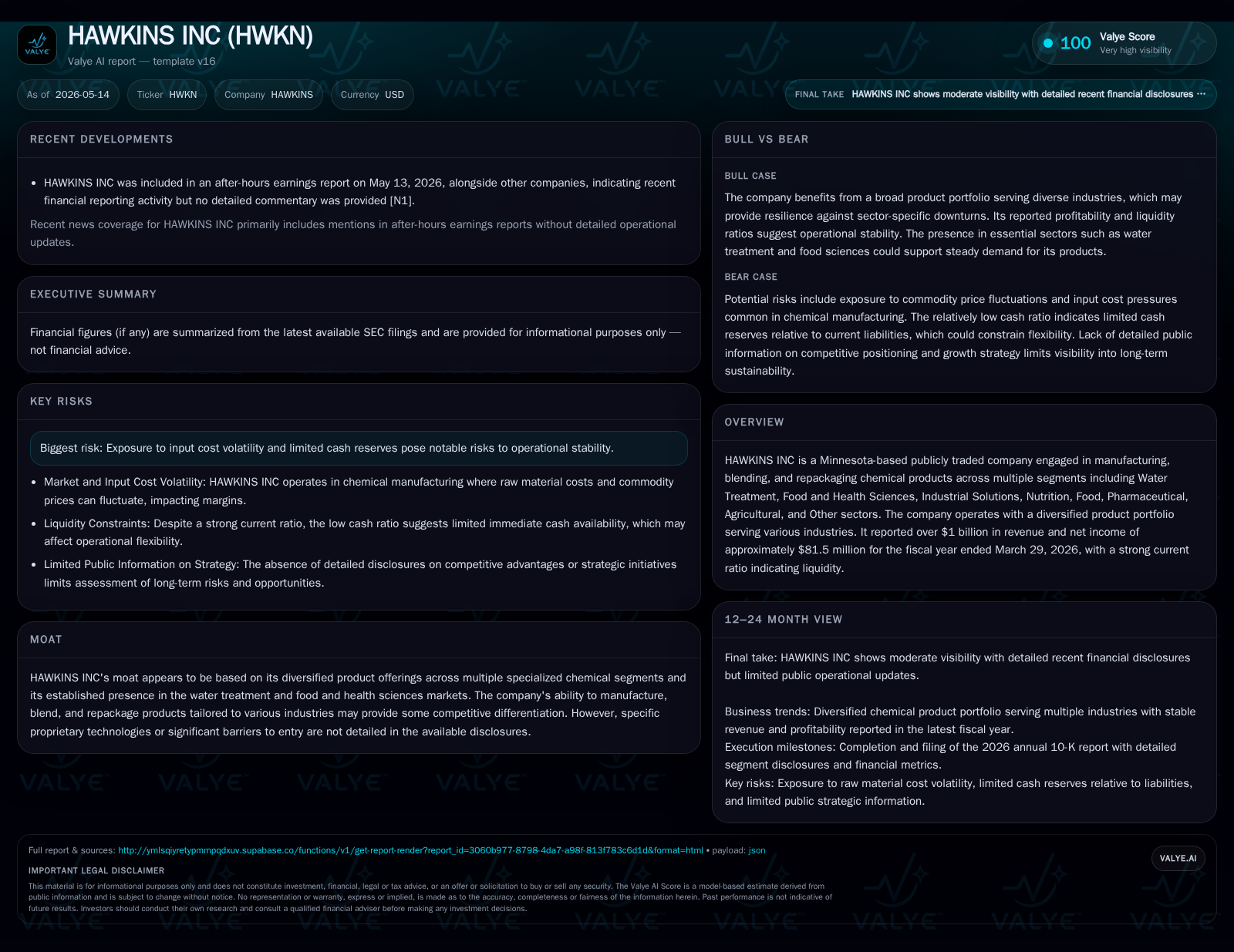
Hawkins Inc reported fiscal 2026 year-end revenues exceeding $1 billion, but earnings per share fell short of expectations due to volatile input costs and inflationary pressures. The company's diversified specialty chemical business, segmented into Water Treatment, Food & Health Sciences, and Industrial Solutions, benefits from broad product offerings and tailored solutions, which underpin its competitive positioning. However, margin compression and limited cash reserves pose operational risks. Growth drivers include regulatory demand in Water Treatment and expanded specialty formulations in food and health sectors. Near-term focus centers on price pass-through effectiveness and maintaining liquidity amid cost fluctuations.
Latest Quarterly Operating Update: What Changed?
Hawkins Inc reported results for the fiscal quarter ending December 28, 2025 (Q4 FY2026) revealing revenue growth above $1 billion annually but highlighting a notable earnings miss relative to market expectations [S2][N1]. Total revenue for the fiscal year was reported at approximately $1.08 billion with net income of $81.5 million [F1], yet diluted earnings per share came in below consensus guidance driven primarily by margin headwinds.
Management attributed these pressures largely to volatile raw material input costs that have tightened operating margins amidst persistent inflationary trends across chemical feedstocks. Furthermore, changes in U.S. tax law under the “One Big Beautiful Bill Act” have provided accelerated deductions; however, these resulted only in insignificant cash tax benefits impacting near-term profitability [S2].
Adding complexity to the financial profile was an increase in interest expense related to borrowings taken primarily to finance acquisitions expanding Hawkins’ footprint in Water Treatment [S2][S3]. The revolving credit facility commitment stands at $400 million. Meanwhile, liquidity remains moderate with cash and equivalents totaling approximately $3.9 million at fiscal year end resulting in a current ratio of 2.21 — adequate but reflective of working capital intensity due to inventory purchases and receivables dynamics typical in bulk chemical operations [F1][S8].
HAWKINS’ Business Model and Product Portfolio Quality
Hawkins operates under a blended manufacturing business model focused on specialty chemicals tailored through formulation expertise for diverse industries spanning Water Treatment, Food & Health Sciences, and Industrial Solutions [S1]. The company sources, blends, manufactures, repackages, and distributes a wide array of chemical products customized to client specifications addressing applications from municipal water purification to nutrition supplements and pharmaceutical ingredients.
This segmentation reflects strategic strengths:
- Water Treatment: A core segment delivering bulk chemicals critical for industrial and municipal water management. This area benefits from regulatory mandates driving consistent demand despite cyclical industry conditions.
- Food & Health Sciences: Hawkins provides ingredient blends supporting nutritional products, pharmaceuticals, and food processing needs where formulation complexity enables differentiation.
- Industrial Solutions: Serving broader industrial clients requiring a variety of specialty chemicals tied closely to economic activity cycles.
The value Hawkins creates lies not solely in commodity supply but through its technical service capabilities including application support which fosters customer loyalty. However, the complexity inherent in managing specialized formulations across many segments requires operational discipline.
Industry Context and Competitive Positioning
Hawkins competes within the specialty chemicals sector characterized by fragmented competitors frequently offering overlapping product lines without exclusive technology ownership [S1]. Larger competitors may possess deeper resources but no single player dominates all served markets.
In this space:
- Pricing power is constrained by both market competition and high raw material cost sensitivity since clients often can switch suppliers when cost advantages are present.
- Customer relationships benefit from service-oriented approaches emphasizing customization which can build switching costs over time.
- Supply chain complexity arises from sourcing raw materials globally subject to tariffs, import/export restrictions, or disruption risks.
- Regulatory compliance especially in environmental safety and product certifications significantly influences operational costs.
Demand itself exhibits structural elements (such as regulatory drivers for water purification) combined with cyclicality influenced by broader economic conditions impacting industrial end-users.
Growth Drivers: Segment Outlook and Market Opportunities
Growth near- and medium-term levers include:
- Water Treatment: Regulatory pressure for cleaner water standards provides defensive growth potential insulated somewhat from economic downturns. Hawkins has invested in expanding its distribution footprint here through acquisitions like WaterSurplus enhancing scale and local reach [S3][S25].
- Food & Health Sciences: This segment offers margin expansion prospects via specialty formulations addressing nutrition trends (e.g., plant-based proteins) and pharmaceutical intermediates where value-added blending commands premium pricing [S1].
- Industrial Solutions: Opportunities track economic recovery cycles with industrial production rebounds translating into higher demand for chemical inputs.
Strategic acquisitions totaling approximately $167 million in FY2025/26 have gradually broadened Hawkins’ customer base and product breadth supporting incremental revenue streams while also increasing SG&A expenses tied to integration efforts [S2][S25]. Innovation around formulation technologies aimed at meeting evolving health standards also underpins long-term relevance.
Risk Factors and Constraints: Input Costs and Economic Sensitivity
Significant risks temper growth outlook:
- Input Cost Volatility: Rapid fluctuations in raw material prices compress margins since passing costs immediately through contracts or spot sales is challenging given competitive pressures [S2][N1].
- Liquidity Constraints: With net debt approximately $240 million against a lean cash position near $3.9 million at fiscal year-end and working capital demands elevated by bulk purchases, Hawkins faces limited cushion for adverse shocks or unexpected expenditures potentially pressuring credit agreement covenants [F1][S8].
- Economic Cyclicality: End market sensitivity means downturns could reduce volumes especially within Industrial Solutions affecting consolidated earnings.
- Regulatory Risk: Changing compliance requirements related to storage, handling or environmental impacts could increase costs or restrict operations if not managed proactively [S1].
Near-Term Watchpoints: Guidance, Execution, and Demand Signals
Investors should monitor:
- Management’s updated guidance around price pass-through success to mitigate inflationary cost drag indicated during recent conference call disclosures accompanying the latest event filing on May 13, 2026 [S3][N1].
- Integration progress on recently acquired distributors supporting Water Treatment expansion including actual synergies realization which materializes into improved profitability over time [S25]
- Quarterly revenue trends across segments reflecting supply chain normalization or disruption events that influence volume stability.
- Raw material cost trajectory especially key commodities feeding into bulk chemical blends.
- Compliance with revolving credit financial covenants considering leverage levels given debt outstanding stretches till 2030 with ongoing principal payments governed by operational cash flow generation capacity [S8].
Condensed Financial Snapshot
Latest financial snapshot
| Metric | Value | Period |
|---|---|---|
| Cash & equivalents | $4mm | |
| 2026-03-29 | ||
| Total debt | $244mm | |
| 2026-03-29 | ||
| Net debt | $240mm | |
| 2026-03-29 | ||
| Current assets | $231mm | |
| 2026-03-29 | ||
| Current liabilities | $105mm | |
| 2026-03-29 | ||
| Current ratio | 2.21x | |
| 2026-03-29 |
Source: SEC companyfacts cache [F1].
This snapshot encapsulates Hawkins’ robust top-line scale offset by modest cash balances relative to significant debt obligations highlighting liquidity risk considerations even as operating income maintains a positive trajectory supporting debt service capacity [F1][S2][S8].
Hawkins Inc exemplifies a mid-tier specialty chemical operator balancing diversified product exposure with operational complexities inherent in volatile input markets and working capital intensity. Its segmented approach combining essential water treatment services alongside targeted food-health specialty ingredients bolsters its moat but cannot insulate fully against inflation-driven margin squeezes or leverage headwinds visible at fiscal year-end 2026. Focused execution on price recovery mechanisms alongside strategic acquisition integration will be critical in defining its trajectory going forward.
This analysis reflects data available as of May 2026 from SEC filings including Forms 10-Q (01/28/2026), Form 10-K (05/13/2026), Form 8-K (05/13/2026), supplemented by public news reports without issuing investment advice or recommendations.
Disclaimer: This is research-only, informational analysis and not investment advice. It may include AI-generated interpretation and general industry context. Always verify important details using primary sources.

Comments