
Antero Midstream's Q1 2026 Update Highlights Operational Reliance on Antero Resources and Regulatory Navigations
Latest quarterly disclosure underscores fee-based midstream services tethered to strategic contracts and evolving regulatory risks.
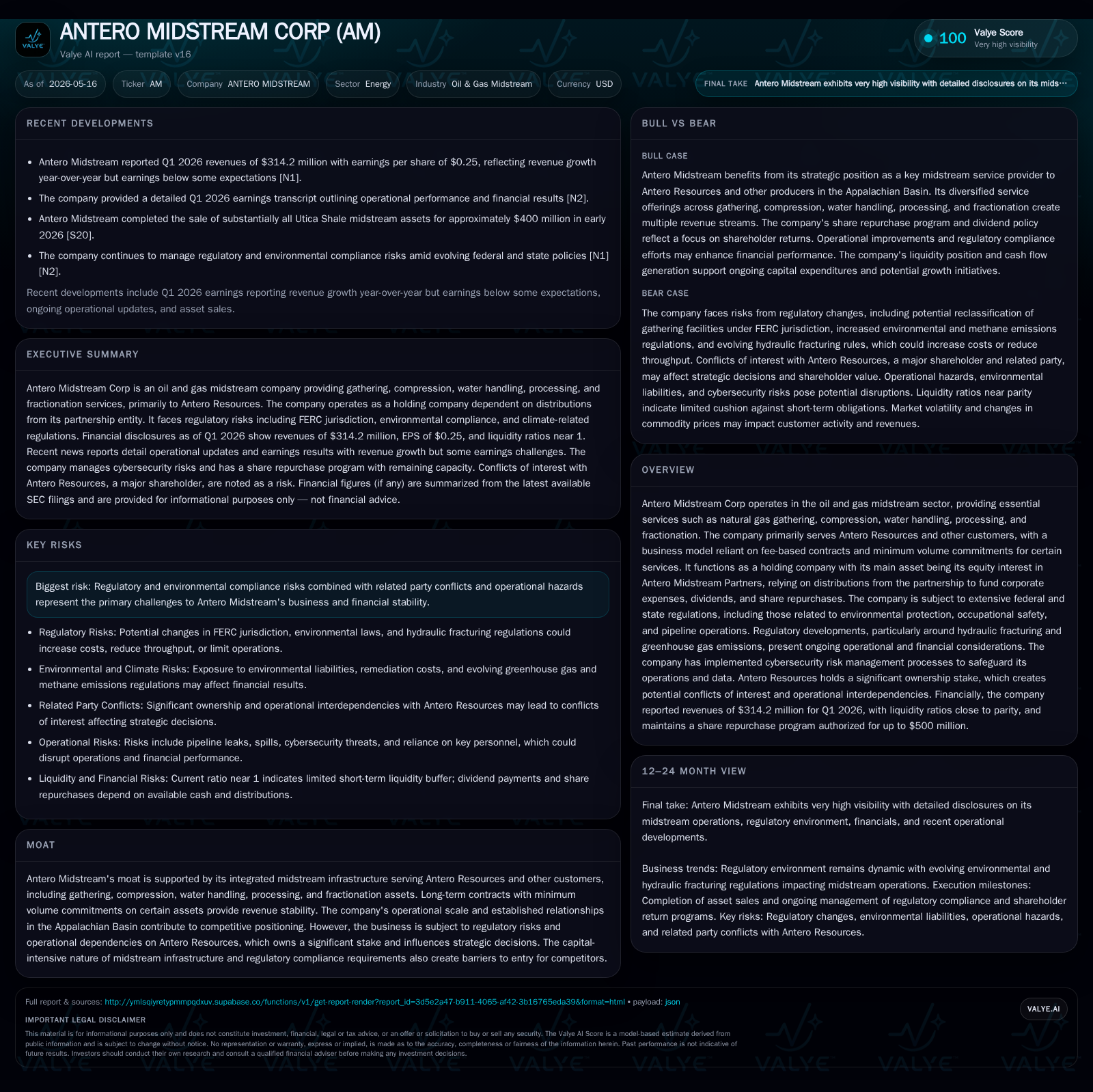
Antero Midstream Corp’s latest 10-Q for Q1 2026 reveals sustained revenue growth but operational dependency on Antero Resources remains critical. The company functions as a holding entity predominantly dependent on distributions from Antero Midstream Partners, with its midstream infrastructure anchored in natural gas gathering, compression, and processing primarily in the Appalachian Basin. Long-term fee-based contracts with minimum volume commitments provide revenue stability; however, regulatory risks and related-party dynamics pose ongoing challenges. Capital allocation focuses prioritize dividends and share repurchases, balanced against the capital-intensive nature of its assets.
Recent Operating Update
In its latest Form 10-Q filed April 29, 2026 [S2], Antero Midstream Corporation reported operational continuity within its oil and gas midstream business focused on natural gas gathering, compression, water handling, processing, and fractionation services primarily in the Appalachian Basin. The report highlights that the company remains wholly reliant on distributions from its equity interest in Antero Midstream Partners to fund taxes, dividends, share repurchases, and overhead costs — consistent with prior disclosures [S1][S25]. Revenue trends reflect year-over-year increases consistent with volume growth underpinned by contractual minimum volume commitments [N1][N2]. However, earnings missed some estimates signaling potential margin pressures or expense upticks.
On May 12, 2026, the company updated its investor presentation reaffirming strategic alignment and revising guidance around capital allocation timing [S3][S12]. There were no material changes reported in risk factors since the previous year-end filing [S15], yet regulatory risk retains prominence given federal and state scrutiny of fracking-related emissions and pipeline safety programs.
Business Model
Antero Midstream operates as a holding entity without direct operating assets aside from its equity interest in Antero Midstream Partners [S1][S25]. The Partners own and operate an integrated midstream system that serves primarily Antero Resources’ upstream production alongside third-party customers. Key services encompass gathering raw natural gas via extensive pipeline networks exempt from Federal Energy Regulatory Commission (FERC) regulation under traditional gathering exemptions but remain subject to potential future classification shifts [S29]. Additional offerings include high-pressure compression stations enhancing throughput capacity; water sourcing, treatment, and disposal essential for hydraulic fracturing operations; plus downstream gas processing and fractionation facilities converting raw gas into marketable products.
The company’s revenue is largely fee-based with defined minimum volume commitments on certain high-pressure gathering pipelines and compressor stations constructed at Antero Resources’ behest, providing a degree of cash flow stability even amidst commodity price volatility [S26]. Processing and fractionation segments are supported by long-term minimum take-or-pay agreements ensuring steady utilization rates. This structure insulates Antero Midstream from direct commodity price exposure but links growth prospects closely to the upstream development strategies of key customers.
The business model features substantial fixed asset investments necessitating capital-intensive maintenance and expansion cycles to sustain capacity aligned with production growth forecasts in the Appalachian shale plays. As a holding company proxying through partnership distributions to shareholders via dividends or buybacks, liquidity depends on operating cash flow generated downstream.
Industry Structure and Competitive Position
Operating within the oil & gas midstream sector focused on Appalachian basin resources places Antero Midstream amidst a competitive landscape characterized by scale advantages in pipeline infrastructure and integrated service offerings. The company benefits from a defensible moat built on:
- Direct pipeline connectivity branching from prolific natural gas production zones,
- Established compression assets critical for pressure maintenance,
- Water management services tailored specifically for hydraulic fracturing,
- Extensive processing capabilities including fractionation to tap product markets,
- Long-term contractual relationships reducing volume variability risks.
Competition arises from regional midstream operators vying for acreage dedication contracts as well as larger diversified midstream players with complementary pipelines extending beyond the basin into transcoastal or LNG export terminals [N3]. However, barriers such as significant upfront capital costs for new infrastructure expansions combined with regulatory approvals limit immediate entry threats.
Notably, related party dynamics involving Antero Resources – holding a nearly 29% stake as of early February 2026 [S1] – introduce strategic complexities. While collaborative advantages ensue through aligned interests in infrastructure development, potential conflicts of interest require careful governance oversight to balance third-party customer access against internal upstream priorities.
Growth Drivers
Upstream Production Growth
Growth in Appalachian natural gas production remains the primary driver of volume increases across gathering and compression systems. Expansion of shale drilling activities directly feeds demand for midstream capacity. While Antero Resources remains a cornerstone producer fueling this growth [S26], emerging developments from other operators diversify revenue streams.
Contract Renewals & Extensions
Renewal of long-term agreements incorporating minimum volume commitments ensures ongoing revenue visibility. The right of first offer extending to 2038 for processing/fractionation indicates long planning horizons supporting capacity investments [S26].
Infrastructure Expansion Projects
Capital projects geared toward expanding pipeline networks or enhancing compression stations support incremental throughput capacity enabling additional volumes handled. These initiatives are subject to capital availability balancing shareholder returns versus reinvestment needs.
Water Handling Services Growth
Water sourcing and treatment represent increasingly vital services given fracking intensity trends. Enhanced water handling capabilities can serve as incremental revenue segments linked to operational efficiencies sought by producers.
Market Demand for Processed Gas & Liquids
Expansion into value-added processing including fractionation allows capture of premium pricing spreads tied to natural gas liquids (NGLs), which drive improved margins relative to pure volumetric tolling fees.
Risks / Watchpoints / Growth Constraints
Regulatory Environment & Compliance Costs
Regulatory risks pervade especially if FERC reclassifies gathering pipelines as transmission facilities subject to rate regulation impacting revenues negatively [S29]. Environmental compliance related to methane emissions or water disposal could inflate operating expenses or capex requirements.
Dependency on Key Customer: Antero Resources
Heavy operational dependence creates concentration risk where upstream cutbacks or changed development strategies might reduce contracted volumes adversely affecting throughput utilization [S26]. Conflicts of interest inherent in shareholder overlap may constrain autonomous decision-making favoring minority stockholders’ interests.
Pipeline Integrity & Safety Liabilities
Pipeline safety laws mandate rigorous integrity management programs; failure could result in hefty fines or remediation costs aggregating millions annually under PHMSA rules enforced since December 2024 [S23][S24].
Commodity Price Cyclicality Indirect Effects
Though structurally insulated from commodity prices by fee-based contracts, upstream producers’ capital expenditure decisions driven by price environments indirectly affect volumes passing through midstream systems.
Limited Independent Revenue Generation Capability
As a holding company without direct operations generating cash flows apart from partnership distributions; any constraints on partner payout frequency or amount can impair liquidity flexibility [S1][S25].
What to Watch Next
- Quarterly updates on distributable cash flow levels from Antero Midstream Partners evidencing dividend sustainability.
- Renewal status or amendments of critical long-term contracts including expansions or terminations affecting volume commitments.
- Any formal or informal indicators regarding FERC’s stance on pipeline classification that could materially impact pricing structures.
- Capital expenditure announcements related to infrastructure expansions supporting future growth trajectories.
- Legal proceedings or regulatory fines related to pipeline safety incidents influencing operating expense volatility.
- Shareholder communications detailing adjustments in capital return plans—dividends or share repurchase pacing.
- Changes in ownership percentages or governance influencing corporate strategic direction.
Financial Profile (Latest Snapshot)
Latest financial snapshot
| Metric | Value | Period |
|---|---|---|
| Cash & equivalents | $180mm | |
| 2025-12-31 | ||
| Total debt | $3.7bn | |
| 2026-03-31 | ||
| Net debt | $3.5bn | |
| 2026-03-31 | ||
| Current assets | $155mm | |
| 2026-03-31 | ||
| Current liabilities | $157mm | |
| 2026-03-31 | ||
| Current ratio | 0.99x | |
| 2026-03-31 |
Source: SEC companyfacts cache [F1].
| Metric | Value (USD) | Period Ending |
|---|---|---|
| Cash & Equivalents | 180,435,000 | |
| 2025-12-31 | ||
| Total Debt | 3,692,400,000 | |
| 2026-03-31 | ||
| Current Assets | 154,942,000 | |
| 2026-03-31 | ||
| Current Liabilities | 157,250,000 | |
| 2026-03-31 | ||
| Current Ratio | 0.99 | |
| 2026-03-31 | ||
| Net Debt (Est.) | ~3,511,965,000 | |
| 2026-03-31 |
The financial snapshot underscores the typical leveraged profile required for owning expansive midstream infrastructure assets reliant on steady cash flows from long-term contract portfolios. Large net debt bears watching relative to distributable cash flows underpinning debt servicing capability over time [F1]. Dividends declared at $0.225 per share for Q4 2025 showcase continued capital return orientation supported by an active repurchase program with sizable authorization remaining ($336 million at year-end) [S4][S6][S16].
Disclaimer: This analysis is intended solely for informational purposes based on publicly available filings and news sources as of May 2026. It does not constitute investment advice or recommendations regarding trading securities of Antero Midstream Corporation or any affiliated entities.
Disclaimer: This is research-only, informational analysis and not investment advice. It may include AI-generated interpretation and general industry context. Always verify important details using primary sources.

Comments