
Moelis & Co Faces Growth Hurdles Following Q1 Earnings Shortfall
Q1 2026 results reveal operational headwinds for Moelis & Co, challenging its previously strong expansion trajectory within independent investment banking.
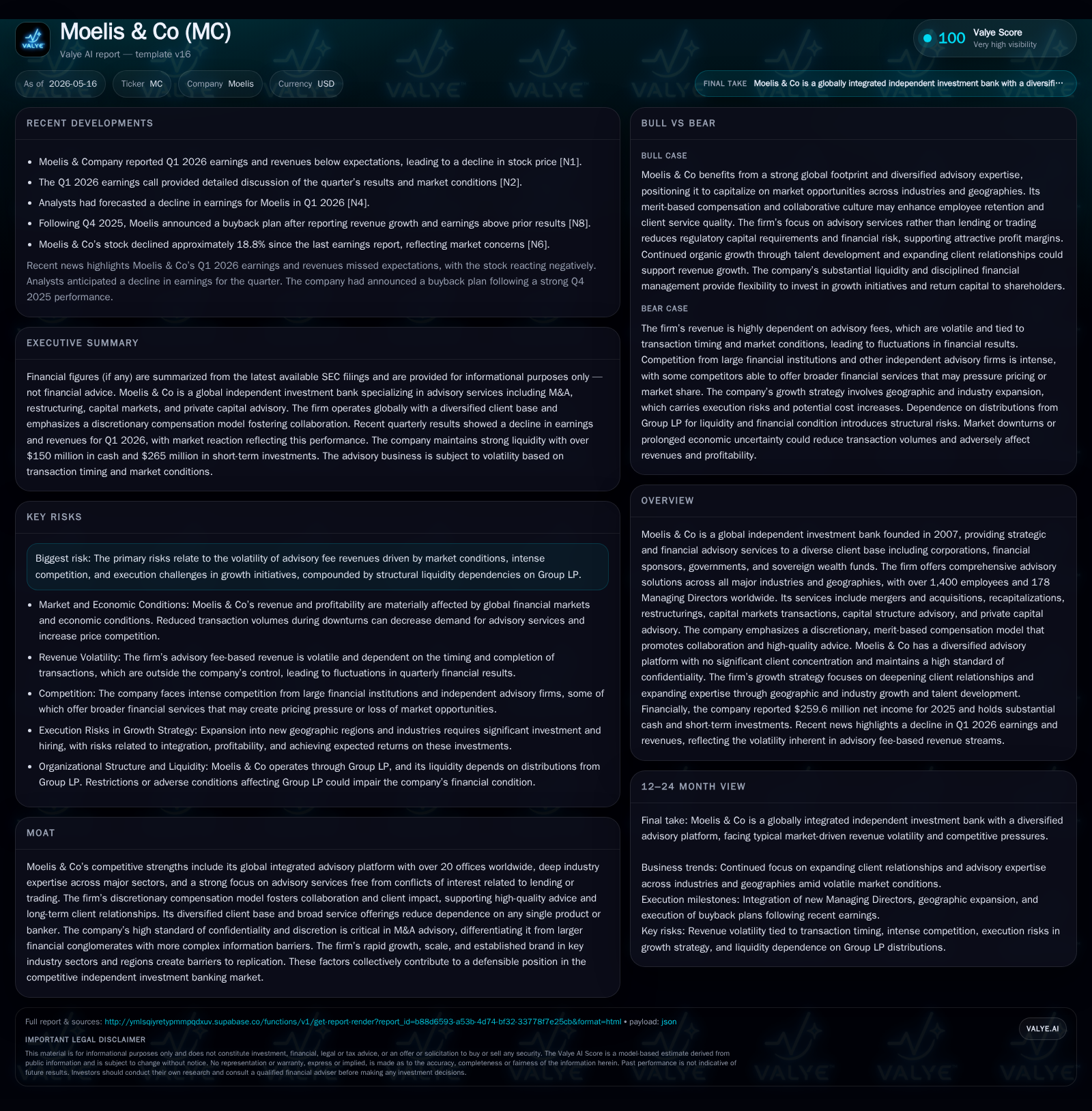
Moelis & Co reported a Q1 2026 earnings and revenue miss that contrasts with its robust growth narrative over recent years. The latest filings indicate softer advisory demand amid competitive and market volatility pressures, complicating near-term growth momentum. While Moelis retains a defensible position as a leading global independent advisory firm with diversified services and a collaborative culture, challenges around talent retention, execution of rapid scaling, and market-driven fee volatility present notable risks. Watch for updates on client mandates, geographic mix shifts, and managing director hiring trends to gauge recovery prospects.
Q1 2026 Operating Update Reveals Near-Term Challenges
Moelis & Co’s first-quarter financial disclosure [S2] highlighted a significant miss on both revenue and earnings estimates compared to consensus forecasts [N1], signaling tangible headwinds for the firm's core advisory business. Despite its resilient franchise, the ongoing volatile market environment dampened client transaction activity volumes, particularly in M&A mandates and capital markets advisory segments [S3]. Management commentary during the Q1 earnings call emphasized cautious client behavior against uncertain macroeconomic factors impacting deal timing and fee realization [N2]. The updated investor presentation reiterated focus on long-term growth drivers but acknowledged the need to navigate near-term pressure points.[N3]
This departure from prior quarters' momentum contrasts with Moelis's prior sustained growth from broadening advisory engagement scopes. It signals that despite structural advantages such as global scale and a diversified client base, the firm remains vulnerable to cyclical fluctuations in deal flow.
Moelis & Co’s Advisory Business Model and Service Excellence
Founded in 2007 by seasoned bankers seeking independence from collateral lending or trading conflicts, Moelis concentrates exclusively on providing strategic financial advice across M&A, recapitalizations, restructurings, capital markets transactions, and private capital advisory [S1]. Its global platform of approximately 1,416 employees — including over 178 Managing Directors — operates out of more than 20 offices worldwide covering key geographies spanning the Americas, Europe, Asia-Pacific, and the Middle East.
The firm's discrete compensation philosophy avoids transactional commission-based incentives; instead it employs a discretionary merit-based approach to promote collaboration across product lines and regions [S1], reinforcing its 'One Firm' culture characteristic. This intellectual capital-intensive model underpins attractive profit margins and client trust by ensuring senior bankers deliver high-touch attention without conflicting interests that could dilute advice quality.
Moelis has carefully cultivated industry expertise across major sectors — Technology; Industrials; Healthcare; Energy; Power & Utilities; Infrastructure; Consumer; Financial Institutions; Media & Telecom; Real Estate — enabling holistic advisory solutions tuned to unique sector dynamics [S1]. The firm's integrated service offering includes both company-side counsel in restructurings as well as creditor-side mandates reflecting broad capital structure advisory capabilities [S15].
Competitive Positioning within the Global Investment Banking Industry
Within a competitive landscape dominated by large bank-affiliated firms with extensive product suites encompassing lending, underwriting, sales/trading, Moelis’s pure-play advisory stance allows it to sidestep perceived cross-selling conflicts — a pitch leveraged heavily to sophisticated clients wary of information leaks or misaligned incentives inherent in conglomerate models [S5][S26].
Key peers include Evercore Partners Inc., Houlihan Lokey Inc., Lazard Ltd., Perella Weinberg Partners, PJT Partners Inc., each with different mixes of specialization or scale [S19].
However, this positioning creates exposure to pronounced cyclicality in advisory fees driven by economic cycles impacting deal-making appetite. Further competitive pressure arises from the ongoing battle for top-tier managing directors whose personal networks often anchor lucrative client relationships; losing such talent risks fragmentation of mandates. The firm acknowledges intense competition not only on fee pricing but also on talent acquisition and retention against better-capitalized rivals [S1]. Regulatory costs related to broker-dealer registration compliance (SEC/FINRA oversight) impose additional operational burdens distinct from banking peers [S12].
Key Drivers Supporting Growth Prospects
Despite recent softness in market activity reflected in Q1 results, Moelis’s growth thesis remains anchored in several structural catalysts:
- Deepening engagements with financial sponsors as private equity continues active portfolio rebalancing requiring complex advisory solutions [S15].
- Expansion into emerging markets through strategic alliances such as with ADS in Mexico enhances cross-border transaction offerings catering to multinational clients seeking international footholds [S1].
- Continued internal talent development aimed at promoting from within sustaining bench strength aligns with their cost-efficient organic growth philosophy alongside targeted external hires [S5]. Nearly half of Managing Directors were promoted internally reflecting strong cultural alignment and reduced dependency on costly lateral acquisitions.
- Broad industry diversification reduces client or sector concentration risk while penetrating high-fee-pool verticals like Technology and Healthcare strengthens margin potential.
- Capital-light operational model facilitates scalability through incremental office openings enabling responsive local presence combined with global coordination [S5].
Risks and Constraints on Revenue and Talent Retention
Several constraints temper the optimism around future growth:
- Advisory fees remain inherently volatile dependent upon transaction volume cycles which are influenced by macroeconomic shocks including inflation concerns or geopolitical instability [S4].
- Sustained firm expansion requires diligent management of operational overheads especially before newly established offices become profitable. Execution risk rises as resources divert toward integration and training expenses highlighted in recent risk disclosures [S1].
- Talent retention represents possibly the most significant challenge given the fiercely competitive landscape for senior bankers who possess substantial client relationships; attrition risks could lead to client defections impacting revenues materially [S1]. Compounding this is evolving legal scrutiny decreasing enforceability of non-compete clauses limiting contractual protections.
- Increasing regulatory oversight imposes direct compliance costs as well as indirect reputational risk if procedures around material non-public information handling fail [S4][S18]. Such events could deter potential clients concerned about confidentiality breaches.
Monitoring Indicators for Future Performance and Strategy Execution
Investor focus should center on several quantifiable operational indicators which can presage recovery or further retrenchment:
- Quarterly management discussions regarding pipeline health provide timely proxies into demand elasticity for advisory mandates amidst shifting economic landscapes [N2][N3].
- Tracking trends in managing director hires versus departures will signal stability or erosion within critical leadership layers affecting business continuity.
- Monitoring regional revenue contributions reveals geographic shifts that might influence margin profiles given variable local market conditions.
- Observing developments in strategic alliances or new office openings offers insight into forthcoming capacity enhancements aimed at seizing larger addressable markets.
- Updates on compensation policy adaptations may indicate efforts to curb turnover or attract sought-after bankers.
Concise Financial Overview: Liquidity, Income, and Capital Efficiency
At March 31, 2026 quarter-end Moelis & Co held cash and cash equivalents totaling approximately $153 million providing substantial liquidity buffer for operations or opportunistic investments [F1]. Though specific recent income statement metrics for Q1 are pending detailed publication beyond press releases [S2],[S3], historical operating income reflected sustained profitability consistent with the firm’s low capital intensity model supporting steady cash generation.
The firm benefits from limited balance sheet risk given absence of lending or proprietary trading activities which insulates it from capital market shocks eroding bank-affiliated peers’ earnings. However volatility inherent in fee income necessitates prudent cost management to maintain margins through lean operating leverage dynamics embedded in their advisor-centric staffing structure.
Disclaimer: This analysis is based solely on publicly available filings up to May 2026 without speculative projections or opinions outside documented evidence.
Disclaimer: This is research-only, informational analysis and not investment advice. It may include AI-generated interpretation and general industry context. Always verify important details using primary sources.

Comments