
Amazon Strengthens Foothold with $10.9 Billion Globalstar Acquisition and Strategic AI Investments
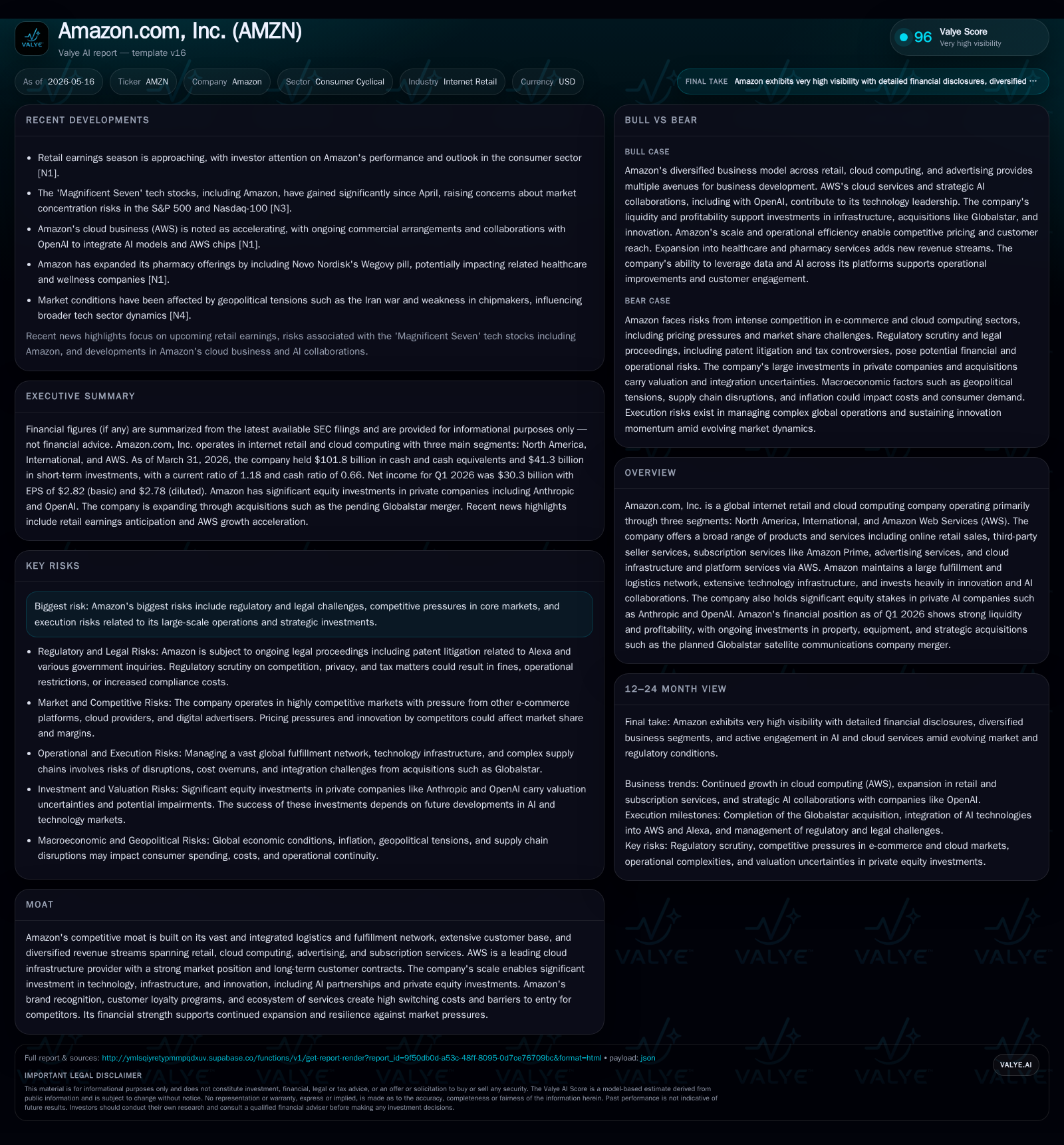
Amazon's Q1 2026 updates underscore an aggressive expansion into satellite communications and AI, balanced by robust cloud and retail growth supported by a strong financial position.
In Q1 2026, Amazon advanced its strategic diversification by announcing a $10.9 billion acquisition of Globalstar, broadening its satellite communications capabilities. The company also enhanced its AI footprint through significant investments in private AI firms such as OpenAI and Anthropic. Operationally, Amazon reported growth in both product and service sales, notably driven by AWS and advertising, amidst increased operating expenses linked to scaling infrastructure and innovation. Its sizeable debt issuances alongside ample credit facilities provide the liquidity backbone for these expansions while regulatory and integration risks remain key watchpoints.
Q1 2026 Operating Update: New Developments Driving Forward Momentum
Amazon's latest quarterly filing dated April 30, 2026 [S2] reveals several pivotal developments shaping its near-term operational landscape. Foremost among these is the definitive agreement reached on April 14, 2026, to acquire Globalstar, Inc., a satellite communications company, for an aggregate value of approximately $10.9 billion including debt [S6]. The structure offers Globalstar shareholders a cash or stock election capped at $90 per share alongside proration mechanisms to balance consideration types.
This deal strategically augments Amazon’s existing network infrastructure by expanding into low-earth orbit satellite communications, complementing its vast logistics ecosystem. Closing is projected in 2027 pending regulatory approvals and operational milestones related to satellite replacements [S6]. Concurrently, Amazon has formalized post-acquisition service agreements with Apple Inc., underscoring the commercial viability of this expansion.
The quarter also featured notable accounting changes regarding fair value measurement of certain assets including derivatives linked to energy contracts; unrealized gains/losses are now reflected within operating expenses impacting earnings volatility [S2]. Importantly, Amazon reported upward fair value adjustments totaling roughly $12.3 billion on nonvoting preferred stock holdings—primarily tied to private AI investments—in "Other income (expense), net," rendering significantly higher non-operating income for the period [S2,S18].
Liquidity remains robust with no draws on substantial unsecured revolving credit lines totaling $20 billion available as of March 31, 2026 [S2]. Long-term debt increased due to recent note issuances aggregating over $50 billion in March 2026 for general corporate activities including acquisitions [S7]. This strong financial footing underpins Amazon’s aggressive growth initiatives.
Amazon’s Multifaceted Business Model: Retail, Cloud, Advertising, and Subscriptions
Amazon operates via three main segments—North America retail, International retail, and Amazon Web Services (AWS)—each contributing unique revenue streams monetized through distinct mechanisms [S1,S15]. Retail revenues derive from both direct product sales and a fast-growing third-party seller services platform that earns commissions plus advertising fees.
Subscription services such as Amazon Prime foster customer loyalty via integrated shipping benefits, exclusive content access, and additional perks that enhance switching costs [S8]. Advertising services leverage deep customer shopping insights across the ecosystem to deliver targeted marketing solutions critical to both retail sellers and external clients.
AWS constitutes a leading cloud infrastructure provider offering scalable computing power, storage solutions, artificial intelligence tools, and platform services under long-term contractual engagements ensuring recurring revenue predictability [S1,S15]. This segment remains a key profit driver due to the high margin nature of cloud operations.
Significantly, Amazon’s private equity stakes in cutting-edge AI companies Anthropic ($8 billion invested) and OpenAI (over $15 billion Series C investment plus potential up to $35 billion commitment) marry deep technological innovation with operational execution [S22]. These partnerships facilitate embedding AI capabilities across AWS offerings as well as enhancing consumer products like Alexa.
Fulfillment efficiency is sustained by Amazon's massive logistics network spanning warehouses, transportation fleets including last-mile delivery assets — all digitally orchestrated — further solidifying competitive advantage by blending scale with speed [S1].
Industry Structure and Amazon’s Competitive Positioning
In internet retailing, Amazon benefits from powerful network effects stemming from its multi-sided marketplace connecting millions of buyers with sellers worldwide while capturing ancillary revenues through advertising services layered atop commerce activity. Its scale enables investment in automation technologies elevating fulfillment capacity unmatched by most peers.
AWS is entrenched as a top cloud infrastructure provider competing against Microsoft Azure and Google Cloud but maintaining leadership through breadth of service portfolio, global data center footprint, enterprise contracts with high switching costs, and continuous innovation that incorporates advances in AI workloads directly aligned with customer needs.
Amazon’s competitive moat is amplified by synergistic cross-segment integration creating an ecosystem where customers derive value from combined offerings—Prime memberships link shopping convenience with streaming content; AWS powers internal IT alongside external clients; advertising capitalizes on transactional data; satellite integration could add next-gen connectivity advantages.
Regulatory scrutiny globally examines potential market power abuses especially concerning third-party seller practices and antitrust concerns in cloud computing but so far has not yielded binding constraints that materially undermine operational scope though ongoing vigilance is warranted given litigation developments including patent disputes related to Alexa functionalities [S5].
Growth Catalysts: Cloud Expansion, AI Ventures, and Satellite Integration
AWS continues scaling underpinned by multi-year contracts with enterprise customers driving increasing consumption of compute/storage resources especially around emerging AI applications which demand specialized hardware accelerators—investment trends indicate growing portion of technology spend allocated towards augmenting AI-specific service layers backed by OpenAI/Anthropic collaborations.
Advertising services sustain growth leveraging ever-improving targeting precision fueled by proprietary consumer data streams unique to Amazon’s platform combined with expanding formats from sponsored products through video ads enhancing monetization opportunities beyond basic search placements [S8].
Retail product sales grow structurally driven by geographic expansion paired with Prime membership penetration bolstered through exclusive content additions sustaining strong retention rates despite macroeconomic headwinds [N1,S8].
The forthcoming acquisition of Globalstar marks an innovative leap into providing satellite-based connectivity potentially reinforcing logistics communication networks or launching entirely new service verticals targeted at underserved markets globally—this can create differentiated value chains resistant to terrestrial broadband limitations while leveraging Amazon’s fulfillment know-how for integrated last-mile offerings.
Leveraging new equity commitments under the OpenAI agreement allows Amazon strategic optionality in accessing next-generation generative AI models that can power diverse applications ranging from intelligent supply chain management tools to personalized consumer interfaces enhancing user experience and operational efficiency at scale.
Risks and Challenges: Regulatory, Competitive Headwinds, and Operational Execution
Legal proceedings remain an unpredictable factor especially involving intellectual property cases such as the longstanding Alexa patent matter which has recently seen favorable rulings but remains subject to appeal delaying final resolution with potential financial implications up to several hundred million dollars [S5].
Regulatory pressures particularly around antitrust investigations into marketplace conduct or cloud dominance pose ongoing compliance costs alongside possible restrictions or penalties affecting business models.
Execution risk rises as Amazon integrates large-scale acquisitions like Globalstar; realizing synergies depends on effective coordination between legacy teams while navigating technical complexities inherent in satellite network deployment timelines tied to operational milestones—a failure here could delay anticipated benefits or inflate costs disproportionately.
Competitor intensity continues across all fronts: in retail from Walmart & Alibaba focusing on omnichannel expansion; in cloud from Microsoft/Azure investing heavily into hybrid-cloud solutions; in advertising from Google/Facebook innovating targeting mechanisms challenging Amazon’s market share; in AI emerging startups posing disruptive technological leaps requiring vigilant innovation pacing.
Macroeconomic variables impacting consumer discretionary spending could influence retail volumes while inflationary pressure may affect fulfillment cost structures necessitating operating expense discipline despite growth imperatives.
Monitoring Points: Key Milestones and Signals to Watch Next
Tracking regulatory approval progress of the Globalstar merger will be critical as any delays or adverse conditions could hinder strategic timetable or redefine transaction economics [S6,N1]. Achievement of satellite replacement milestones will serve as tangible KPIs indicating integration success.
Updates regarding utilization rates or revenue contributions stemming from AI investments—especially deployment of OpenAI-powered services within AWS ecosystems—will be informative about monetization trajectory of these heavy upfront commitments [S22,N10].
Next quarterly earnings will shed light on sustained momentum in advertising revenue growth rates relative to consumer purchasing trends given broader macro uncertainty along with AWS segment margins signaling efficiency gains or reinvestment levels.
Closer observation of operating expense classifications involving unrealized fair value gains/losses linked to energy contracts may reveal volatility signals affecting near-term earnings quality as indicated in recent accounting disclosures [S2,S27].
Finally, maintaining healthy leverage ratios amid elevated long-term debt issuances will require attention especially if capital markets environment shifts impacting refinancing conditions or cost of capital metrics over time.
This analysis synthesizes facts drawn exclusively from recent SEC filings dated through April 30, 2026 ([S1]-[S29]) supplemented by industry insights without providing investment advice.
Disclaimer: This is research-only, informational analysis and not investment advice. It may include AI-generated interpretation and general industry context. Always verify important details using primary sources.

Comments