
Fabrinet's Strategic Execution and Risk Profile in Q3 2026
Fabrinet’s Q3 2026 results reveal operational strength tempered by geopolitical and customer concentration risks within its complex precision optical manufacturing services.
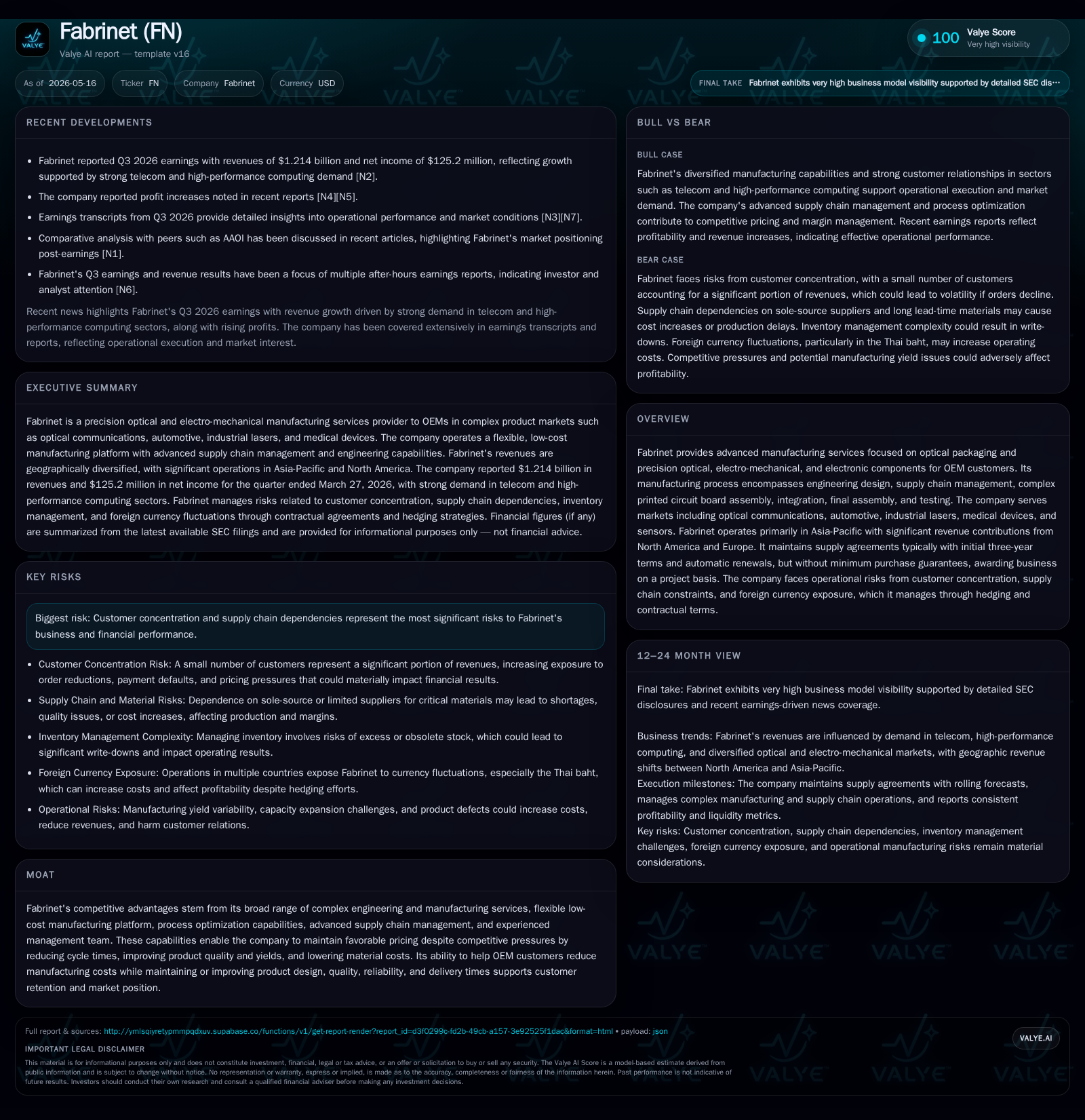
In Q3 2026, Fabrinet posted increased net income driven by strong demand in telecom and high-performance computing sectors, despite headwinds from foreign currency volatility and political unrest in Thailand. The company's broad engineering-driven manufacturing capabilities, anchored in Asia-Pacific with significant North American and European revenue, position it well amidst industry consolidation. However, customer concentration, geopolitical sensitivities, and supply chain dependencies continue to pose notable risks. Growth hinges on expanding capacity in China, optimizing process efficiencies, and navigating evolving market dynamics.
Q3 2026 Operating Highlights: What Changed
Fabrinet’s Q3 fiscal 2026 filing (ended March 27) reports net income of approximately $333.8 million, reflecting a solid operational performance buoyed by continued strength in core telecom and high-performance computing (HPC) end markets [S2][F1][N2]. Revenue for the quarter reached $1.214 billion, up meaningfully year over year due to favorable volume growth.
However, income was partially offset by unrealized foreign exchange losses stemming from currency hedging instruments amid a volatile forex environment—particularly related to Thai baht and Canadian dollar exposures—which aggregated to an unrealized loss of around $16.2 million recognized in other comprehensive income during the quarter [S2][S18]. Such currency fluctuations remain a persistent earnings swing factor despite active hedging strategies.
Geopolitical tensions and social unrest in Thailand surfaced as an explicit risk factor affecting operations. Management emphasized that ongoing demonstrations or changes in political or economic conditions there could materially disrupt business activities [S2]. Concurrently, the company reaffirmed its strategic investment commitment to expanding its manufacturing footprint within the People’s Republic of China (PRC), while recognizing inherent regulatory and operational risks associated with doing business there [S2].
Despite macro uncertainties, Fabrinet generated $201.8 million of net cash from operating activities over the nine months ended March 27, underscoring robust internal cash flows enabling sustained capital investments [S2]. Capital expenditures notably increased as the company continues to scale its capacity—particularly in Asian facilities.
Business Model and Core Manufacturing Capabilities
Fabrinet operates as a contract manufacturer specializing in highly complex optical packaging along with precision optical, electro-mechanical, and electronic device assembly for original equipment manufacturers (OEMs) primarily in telecommunications but also automotive sensors, industrial lasers, medical devices, and related sectors [S1].
Its value proposition rests on delivering end-to-end manufacturing solutions encompassing engineering design input, supply chain management of sophisticated components including circuit boards, advanced packaging techniques integrating optics with electro-mechanical elements, final assembly lines optimized for yield and quality control testing [S14]. This integrated capability suite caters to customers’ needs to reduce product unit costs while maintaining stringent quality standards required by critical end markets.
The company’s manufacturing is predominantly based throughout the Asia-Pacific region—leveraging cost advantages especially in Thailand—but Fabrinet contracts its output mostly to customers headquartered in North America and Europe [S1]. Customer agreements typically span three years with automatic renewal provisions; however, orders are awarded on a project-by-project basis without binding minimum purchase guarantees. This limits revenue visibility but allows flexibility adapting to shifting product life cycles common in technology hardware sectors.
Pricing power derives from Fabrinet’s ability to compress cycle times through optimized manufacturing processes; focus product mix shifts towards more complex assemblies commanding higher margins; improve yield rates reducing waste; and negotiate favorable supplier terms enabled by scale procurement [S1]. These levers help counterbalance competitive pricing pressures prevalent across contract manufacturing industry segments.
Industry Positioning and Competitive Landscape
The precision optical manufacturing industry is characterized by technical complexity barriers that form Fabrinet’s core moat. The company leverages advanced engineering expertise alongside highly automated production platforms to build products that are challenging for competitors lacking equivalent process know-how to replicate reliably at scale [S1].
Consolidation trends among optical component suppliers have reduced the pool of independent OEMs outsourcing production. Large players like Nokia (post-acquisition of Infinera), Lumentum (NeoPhotonics), Coherent Corp., and Cisco (Acacia Communications) have either internalized significant manufacturing capacity or consolidated purchasing power—pressuring third-party contract manufacturers like Fabrinet via lower volumes or tougher contractual terms [S1]. This dynamic requires disciplined customer relationship management as well as continuous innovation in operational efficiency.
Competitors range from regional EMS providers with limited optical expertise to large-scale global manufacturers pursuing economies of scale through diversified electronics offerings. Fabrinet differentiates itself by its depth in optical packaging complexity combined with flexible volume scaling capabilities across heterogeneous product mixes.
Drivers of Growth: Market Demand and Operational Levers
Forecast growth initiatives revolve around several key catalysts:
Capacity Expansion: Ongoing capital expenditures primarily aimed at augmenting PRC production facilities underpin medium-term growth plans given rising demand from cloud data centers leveraging optics for high-speed interconnects [N2][S2]. Asia-Pacific remains central to cost-competitive supply chains as well as proximity to key suppliers.
Market Trends: Optical communications continue evolving with increasing bandwidth demands prompting new generations of modules requiring sophisticated packaging techniques served by Fabrinet’s capabilities. Similarly, HPC segment growth fuels demand for specialty electro-mechanical subassemblies where precision is vital.
Product Mix Optimization: Shifting portfolio emphasis towards higher complexity assemblies offering better margin profiles supports both top-line expansion and profitability enhancements. Process refinement initiatives reducing cycle times improve throughput maximizing fixed asset utilization rates.
Customer Relationships: Expanding share-of-wallet among existing clients remains feasible through deepening engineering collaboration fostering design-for-manufacturability adoption driving longer-term procurement commitments even if formal purchase guarantees remain absent.
Overall demand appears structurally supported by secular trends favoring fiber optic deployments globally alongside growing automation needs across industrial laser applications rather than cyclically driven sprees.
Risk Factors: Customer Concentration, Geopolitical Exposure, Supply Chain
Chief risks highlighted include:
Customer Concentration: Heavy reliance on a handful of customers means any order reduction or payment default could materially hurt revenue streams. Project-based awards without minimum guarantees compound this risk creating potentially significant volatility quarter-to-quarter [S1].
Geopolitical Risks: Demonstrations and political instability especially acute recently in Thailand introduce operational disruption potential at key manufacturing hubs affecting output schedules or cost structures. PRC investments entail regulatory uncertainty given foreign-investment rules plus macroeconomic policy dynamics typical of China market context [S2].
Supply Chain Dependencies: Complex raw material sourcing subject to global chip shortages or logistical bottlenecks can impede production agility impacting delivery timelines crucial for OEM partners.
Foreign Exchange Volatility: Despite active hedging programs covering major currency exposures like Thai baht and Canadian dollar, reported earnings exhibit sensitivity to unrealized mark-to-market fluctuations particularly under turbulent forex markets reducing earnings predictability short term [S2][S18].
Industry Consolidation Effects: Customer consolidation decreases number of potential outsourcers while increasing buyer bargaining power potentially compressing average selling prices over time unless offset by service differentiation.
Key Monitorables: Upcoming Milestones and Demand Signals
Future indicators warrant close watch:
- Quarterly order backlog updates giving forward indication of volume trends especially out of telecom/HPC verticals.
- Progress reports regarding capital deployment effectiveness within PRC facilities including ramp milestones evidencing expanded throughput or cost positions.
- Evolution in pricing environment signaling ability to maintain gross margin leverage amid competitive dynamics.
- Developments around Thailand social-political context influencing site stability or cost inflation considerations.
- New customer wins or contract renewals extending partnership tenure indicating successful account retention amidst industry flux.
- Supply chain normalization status post any prior disruptions affecting lead times or input availability crucial for sustaining steady production cadence.
Management commentary at quarterly earnings calls will likely offer updated qualitative insight into these variables alongside confirmed guidance revisions should material shifts emerge [N5][N8][S3].
Latest Financial Snapshot: Balance Sheet, Liquidity, Performance
Latest financial snapshot
| Metric | Value | Period |
|---|---|---|
| Cash & equivalents | $357mm | |
| 2026-03-27 | ||
| Current assets | $2.9bn | |
| 2026-03-27 | ||
| Current liabilities | $1156mm | |
| 2026-03-27 | ||
| Current ratio | 2.55x | |
| 2026-03-27 |
Source: SEC companyfacts cache [F1].
| Metric | Value |
|---|---|
| Cash & Equivalents | $356.6M |
| Total Debt | $21.7M |
| Current Ratio | 2.55 |
| Net Income (TTM) | $332.5M |
Fabrinet enters Q4 2026 with robust liquidity supported by nearly $357 million cash reserves against modest debt outstanding estimated near $22 million reflecting a conservative capital structure [F1][S2].
Disclaimer: This is research-only, informational analysis and not investment advice. It may include AI-generated interpretation and general industry context. Always verify important details using primary sources.

Comments