
KPET Ultra Paceline’s Strategic IPO and Business Combination Outlook
KPET Ultra Paceline highlights its current status as a newly public SPAC holding substantial IPO proceeds while advancing toward an initial business combination.
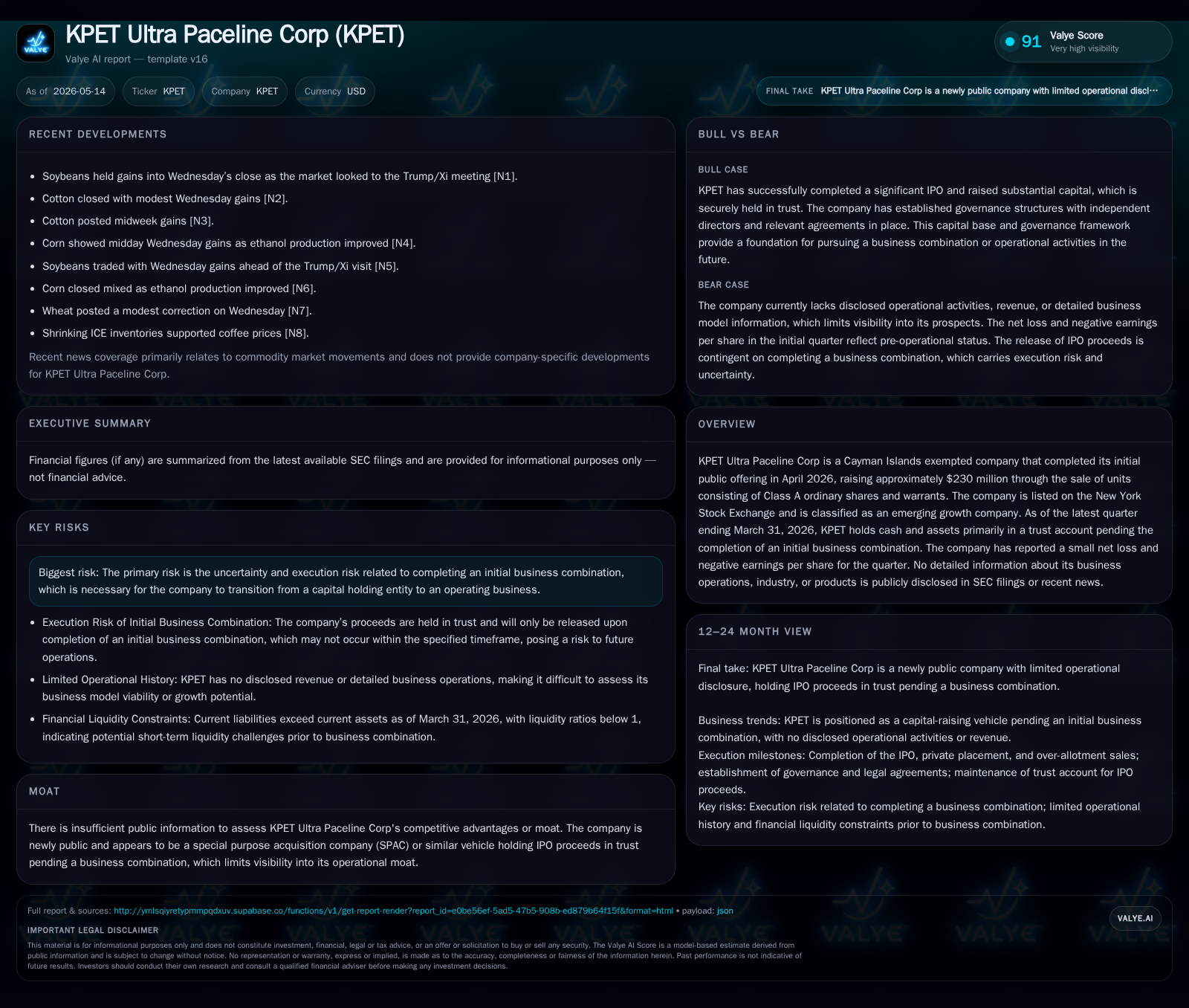
KPET Ultra Paceline Corp completed its IPO in April 2026, raising roughly $230 million through units comprising Class A shares and warrants. The company, classified as an emerging growth entity, currently holds these proceeds in a trust account pending completion of a business combination that will transition it from a capital vehicle to an operating company. Its latest 10-Q filing discloses a modest net loss and limited operational details, underscoring that growth hinges on successful acquisition execution amid the competitive SPAC environment. Ongoing risks stem primarily from the uncertainty of completing a qualifying business combination within mandated timelines.
Latest Quarterly Report Highlights and Near-Term Milestones
KPET Ultra Paceline Corp’s most recent quarterly filing dated May 13, 2026, confirms its status as a recently public Special Purpose Acquisition Company (SPAC) that completed its initial public offering (IPO) in early April 2026 [S2][S3]. The IPO raised approximately $230 million gross through the issuance of units consisting of one Class A ordinary share plus one-sixth of a warrant exercisable at $11.50 per share [S8][S12]. These proceeds are predominantly held in a U.S.-based trust account under Continental Stock Transfer & Trust Company acting as trustee, restricting the use of funds prior to completing an initial business combination or liquidation event [S3][S12].
For the quarter ending March 31, 2026—the company’s first post-IPO period—financial results show a modest net loss of around $40,000 consistent with administrative expenses associated with pre-operating dissolution costs typical to SPACs [F1][S2]. Liquidity reported includes cash and equivalents near $1.76 million. However, this figure represents operational cash outside of the trust account wherein the majority IPO proceeds reside securely until release conditions are met according to regulatory safeguards protecting shareholder interests [F1][S3].
No substantive operating revenues or disclosures about identified acquisition targets appear in this filing, highlighting the company’s current position as a capital-raise holding entity focused entirely on progressing toward an actionable merger transaction.
Business Model of KPET Ultra Paceline: SPAC Framework Explained
KPET Ultra Paceline Corporation exemplifies the archetypal SPAC business model—a shell company formed expressly to raise capital through an IPO with no commercial operations at inception [S3][S8]. The raised capital is placed into an interest-bearing trust account designed explicitly for acquiring or merging with an operating private or public entity within a specified timeframe (usually two years) post-IPO.
Units sold during the IPO trade as bundled securities combining one Class A ordinary share with one-sixth fractional warrant. Each full warrant grants holders the option to purchase additional Class A shares at $11.50—providing upside leverage if post-merger equity appreciates [S8]. This structure creates potential future dilution but also incentivizes long-term investment in the combined company.
Investors retain redemption rights allowing them to redeem their shares out of trust for roughly their pro-rata share of funds if they opt not to proceed with the consummated merger deal. This risk-mitigating feature is standard among SPACs but injects uncertainty into deal economics for sponsors and other equity holders.
Sponsor management—who typically hold ‘founder shares’ or Class B shares with differing economic interests—bear responsibility for deal sourcing, due diligence, negotiation, and closing amid intense market competition from identical entities seeking high-quality targets suited for public markets [S16]. Management indemnification agreements exist typical of such structures ensuring protection against litigation tied to transaction execution risk [S4].
Market Structure and Competitive Dynamics in the SPAC Field
The SPAC landscape on exchanges like NYSE remains congested yet undergoing heightened scrutiny post-IPO due to evolving SEC regulatory enforcement focused on transparency and investor protection behaviors observed since early 2020s surges. KPET contends with hundreds of peer vehicles targeting overlapping candidate sectors for mergers upward of mid-to-large cap private businesses seeking accelerated public listing alternatives.
Sponsors compete not only on deal quality but also speed-to-market given customer patience constraints tied tightly to fixed timelines (approximately two years), after which failure to consummate a transaction triggers liquidation protocols requiring return of principal minus expenses.
Valuation discrepancies between private targets and public market expectations frequently challenge negotiations causing prolonged deal timelines or renegotiations that can generate shareholder skepticism impacting warrants pricing and equity performance post-combination.
Furthermore, investor wariness related to warrant dilutions complicates capital structure outcomes once combinations occur since exercised warrants increase float beyond initial offerings affecting earnings-per-share trajectories.
Overall transparency demands lead KPET and competitors to disclose significant risk factors prominently—as reiterated in KPET’s latest filings which maintain unchanged risk descriptions from initial prospectus despite no material new developments highlighted recently [S18].
Growth Catalysts: What Could Spark KPET’s Evolution Post-Business Combination
Given KPET’s nascent operational state without active revenues or announced targets yet, growth prospects hinge principally on two measurable catalysts:
- Successful Target Identification & Acquisition: KPET’s core value driver rests upon managing teams sourcing an appropriate acquisition candidate whose fundamentals align well with public market investors’ expectations around revenue stability and growth potential;
- Post-Merger Operational Scaling Potential: Post-business combination success depends on how rapidly and efficiently the acquired entity can grow revenues organically or synergistically expand cost efficiencies while satisfying compliance requirements inherent in public-company reporting.
These milestones have concrete impact upon stock price trajectories directly linked to investor sentiment regarding management’s ability to close deals swiftly within deadlines alongside clear communication surrounding strategic rationales driving acquisitions.
Moreover, KPET’s flexibility afforded by several months within an extension window (up to potentially 27 months if exercised) provides additional runway possibly improving deal quality over hurried transactions just before forced expiration phases.
Risk Factors and Execution Challenges in Completing Initial Business Combination
SPACs inherently bear pronounced execution risks by design. For KPET:
- Failure To Close Suitable Merger Within Deadlines: Typically set at two years post-IPO (extendable by three months), inability triggers mandatory liquidation returning investor capital minus costs;
- Shareholder Redemption Risks: High redemption rates may materially reduce available deal financing complicating transaction viability;
- Regulatory Scrutiny & Compliance Burdens: Ever-evolving SEC requirements may impose costly delays or necessitate adjustments impacting timing or structure;
- Dilution From Warrant Exercises: Dilutive pressure from warrants can depress stock performance after combination, weakening long-term value creation potential;
- Unidentified Additional Risks: Filings explicitly affirm undisclosed risks remain possible that could adversely affect future operations or financial condition without warning; these highlight unpredictabilities endemic within transformative corporate events like business combinations [S2][S18].
Risk disclosures have remained consistent with those originally filed without material changes indicating ongoing prudence but no alleviation of inherent uncertainties associated with such ventures.
Upcoming Triggers: Key Events and Metrics to Monitor
Key landmarks investors should track include:
- Announcement or disclosure of Letters of Intent (LOIs) signaling concrete target negotiation progress;
- Scheduling shareholder votes necessary for approving final business combination terms;
- Redemption election windows opening post-announcement affecting available merger proceeds;
- Expiry dates tied to statutory completion deadlines including any exercised timeline extensions;
- Subsequent quarterly filings updating operational progress or unexpected delays.
Transparency surrounding these milestones will significantly influence perceptions around KPET’s ability to deliver accretive combinations transforming it into an operating public company eventually capable of generating organic earnings growth versus remaining merely a capital pool entity.
Summary and Strategic Considerations
KPET Ultra Paceline represents a newly minted SPAC vehicle that has adeptly navigated its initial IPO phase raising substantial public capital secured under prudent trust arrangements pending deployment toward its inaugural merger. The immediate financial footprint remains minimal—a start-up negative earnings profile reflecting early-stage administrative expenses common across similar entities yet balanced by strong cash reserves kept aligned with regulatory safeguards.[F1][S2][S3]
Strategically, KPET’s entire investment proposition revolves around successfully sourcing an appealing acquisition candidate capable of commanding favorable investor reception post-combination. Achieving this involves navigating complex competitive dynamics among numerous contemporary SPAC peers while managing timing pressures imposed by strict regulatory frameworks.
Risk remains materially elevated given no assurance exists around target identification timeliness or transaction closure effectiveness. Warrant exercise dilution coupled with redemption uncertainties compound challenges for shareholder value maximization.
In aggregate, KPET illustrates the quintessential transitional challenge facing newly public acquisition-focused vehicles: converting latent financial capital into tangible operational growth through expertly executed business combinations amidst evolving regulatory landscapes and investor expectations.
This analysis is based solely on publicly available information as disclosed through SEC filings up to May 13, 2026. No forward-looking projections or investment recommendations are offered herein.
Disclaimer: This is research-only, informational analysis and not investment advice. It may include AI-generated interpretation and general industry context. Always verify important details using primary sources.

Comments