
CVS Health’s Integrated Healthcare Model Drives Sustainable Growth Amid Market and Regulatory Challenges
CVS Health’s strong first-quarter performance highlights the benefits of its diversified healthcare platform despite persistent cyclical and regulatory headwinds.
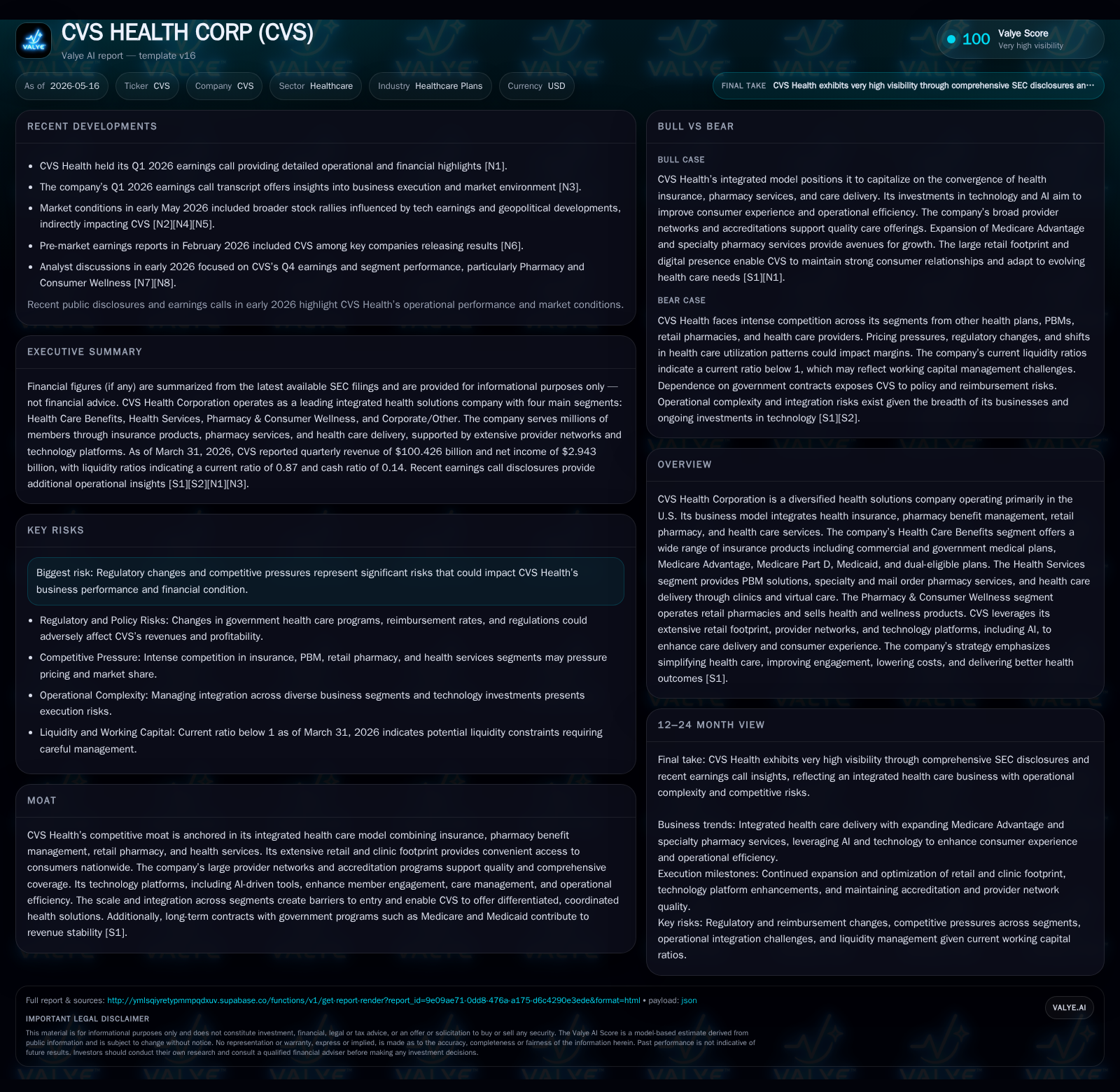
In Q1 2026, CVS Health reported steady operational momentum, leveraging its integrated platform that spans health plans, pharmacy services, retail operations, and healthcare delivery. The company continues to benefit from its broad member base and extensive provider network while focusing on technology-driven care simplification. Growth is supported by expansion in Medicare Advantage, specialty pharmacy services, and digital offerings, although regulatory risks and competitive pressures remain key challenges. CVS’s scale, integration, and innovation underpin its competitive moat as it navigates evolving industry dynamics and patient preferences.
Recent Operating Update
CVS Health's first quarter ended March 31, 2026, demonstrated continued operational stability with no material developments altering the previously disclosed risk profile or business outlook according to the 10-Q filed May 6, 2026 [S2]. The company confirmed strong revenue generation across core segments in its May 6 earnings release incorporated into an 8-K filing on the same day [S3][S5]. These results reinforce CVS's strategic positioning amidst competing industry forces.
The absence of changes in risk factors suggests management confidence in navigating regulatory uncertainties and competitive pressures prevailing as of early 2026 [S9]. Enhanced digital capabilities continue to support service delivery efficiency while expanding patient engagement.
Business Model
CVS Health operates an interconnected healthcare ecosystem consisting primarily of four reportable segments: Health Care Benefits (insurance), Health Services (PBM and clinical care), Pharmacy & Consumer Wellness (retail pharmacy), and Corporate/Other functions [S1][S4].
Revenue Mechanics
- Health Care Benefits: This segment predominantly derives revenues from premiums paid by more than 37 million members covered under commercial plans, Medicare Advantage contracts, Medicaid programs, PDPs (Prescription Drug Plans), and other government-sponsored plans. Volume growth is driven by enrollment increases particularly in Medicare products; price dynamics depend on plan design, negotiated provider rates, and regulatory reimbursement levels. Risk assumption on medical costs defines profitability.
- Health Services: Revenues primarily stem from administrative fees collected for PBM services managing formulary design, pricing negotiations with manufacturers, retail pharmacy network contracts (including CVS Pharmacy itself), specialty pharmacy fulfillment via retail or mail order channels, plus care delivery through clinics (MinuteClinic) and virtual modalities. Volume is linked to prescription fill counts and clinical service utilization.
- Pharmacy & Consumer Wellness: Retail locations generate revenue from prescription sales reimbursed mainly by payors such as PBMs and managed care organizations along with front store merchandise sales paid mostly by consumers via cash or card. Proprietary brands comprise roughly 20% of front store revenue. Fees for supporting Health Services’ pharmacy fulfillment add incremental income.
The company focuses on integrating these offerings to create a seamless patient experience that fosters loyalty and reduces healthcare costs through coordinated care management programs leveraging proprietary data and AI-enhanced platforms [S21][S23].
Industry Structure and Competitive Position
CVS faces competition from multiple fronts:
- In health insurance (Health Care Benefits), competitors include large national insurers offering Medicare products plus regional plans and government-run Original Medicare plans. Differentiation arises through product design quality, provider networks breadth/depth, accreditation status, customer service quality, pricing strategies, and financial strength [S27][S29].
- The PBM landscape within Health Services comprises large standalone PBMs like Prime Therapeutics or MedImpact; PBMs operated by insurers such as Cigna’s Express Scripts or UnitedHealth’s Optum Rx; often competing aggressively on formulary management capabilities and cost control programs [S12].
- Retail pharmacy competes heavily against Walgreens Boots Alliance stores, supermarket chains like Walmart with embedded pharmacies, Amazon’s online pharmacy offerings disrupting traditional models along with independent pharmacies focused locally. Convenience via store footprint (~9k locations) combined with consumer loyalty programs (ExtraCare®) help retain customers [S15][S20].
- Healthcare delivery via MinuteClinics competes with urgent care centers, local primary care practices including affiliated health systems and emerging telehealth providers.
CVS's vertically integrated model creates competitive barriers by controlling multiple points in the value chain— from insurance underwriting through drug distribution to direct patient clinical encounters—allowing for better data utilization and cost management synergy [S1].
Growth Drivers
Several structural trends support CVS’s medium-term growth trajectory:
- Medicare Advantage Expansion: Steady demographic shifts toward a larger aging population increase demand for Medicare Advantage plans where CVS has established significant market share with Aetna-branded offerings reaching millions of enrollees [S24][N2].
- Specialty Pharmacy Growth: Increasing prevalence of complex chronic illnesses requiring specialty pharmaceuticals supports volume expansion in high-margin mail order/specialty fulfillment services within both Health Services and Pharmacy segments.
- Technology Adoption: Investment in AI-enabled tools facilitates improved chronic disease management programs reducing hospitalization rates while enhancing member engagement via apps/smart scheduling features supporting MinuteClinic visits or vaccination appointments [S21][S23].
- Consumer Loyalty Programs: The ExtraCare® card enhances front store sales effectiveness by providing personalized marketing offers tied closely with prescription refill patterns encouraging broader consumer spending beyond prescriptions [S4][N3].
- Integrated Care Delivery: Expansion into value-based primary care through acquisitions such as Oak Street Health reflects CVS’s pivot toward holistic healthcare provision aligned with risk-based reimbursement structures fostering improved outcomes at lower costs [S24].
Risks / Watchpoints / Constraints
Despite strengths there remain notable risks constraining growth or margins:
- Regulatory Uncertainty: Ongoing scrutiny over drug pricing reforms including potential caps/rebates impacting PBM economics; changes to Medicare/Medicaid funding formulas; evolving regulations targeting transparency in pharmacy benefit arrangements could pressure profitability [S13][S14].
- Competitive Pressures: Intense price competition across segments may compress margins; disruption from tech-enabled entrants especially in retail pharmacy delivery models or virtual care platforms.
- Operational Complexity: Integrating diverse businesses spanning insurance underwriting to retail operations requires constant investment; failure to realize synergies or execute on innovation initiatives could impair returns.
- Seasonality & Utilization Volatility: Pharmacy volume swings due to flu seasons or weather-related consumer behavior changes introduce variability especially in front store revenues 15.
- Supply Chain Dependence: Relationships with pharmaceutical manufacturers critical; any disruptions or pricing negotiations affecting drug availability pose risks.
What To Watch Next
Investors should follow these operating markers closely:
- Enrollment trends specifically in Medicare Advantage products measured each quarter post annual enrollment windows.
- Specialty pharmacy prescription fill volumes signaling demand for high-cost therapies.
- Progress in technology platform adoption metrics related to member engagement tools and clinic visit volumes.
- Updates regarding regulatory developments impacting drug pricing policies or PBM contractual frameworks.
- Retail segment traffic trends aligned with execution of merchandising initiatives tied to ExtraCare® upgrades.
- Quarterly margin progression reflecting cost control measures amid competitive price pressure.
Financial Snapshot (as of Q1 2026)
Latest financial snapshot
| Metric | Value | Period |
|---|---|---|
| Cash & equivalents | $9.5bn | |
| 2026-03-31 | ||
| Total debt | $63.7bn | |
| 2025-12-31 | ||
| Net debt | $54.2bn | |
| 2025-12-31 | ||
| Current assets | $74.8bn | |
| 2026-03-31 | ||
| Current liabilities | $86.4bn | |
| 2026-03-31 | ||
| Current ratio | 0.87x | |
| 2026-03-31 |
Source: SEC companyfacts cache [F1].
| Metric | Value | Period Ending |
|---|---|---|
| Cash & Equivalents | $9.54 billion | |
| 2026-03-31 | ||
| Total Debt | $63.7 billion* | |
| 2025-12-31 | ||
| Current Assets | $74.8 billion | |
| 2026-03-31 | ||
| Current Liabilities | $86.4 billion | |
| 2026-03-31 | ||
| Current Ratio | 0.87 | |
| 2026-03-31 | ||
| Revenue (annualized) | $402 billion* | |
| FY ended 2025 |
*Debt figures reference end-of-year latest available data. The company's current liabilities exceed current assets resulting in a sub-unity current ratio indicating working capital constraints typical for companies managing significant payables cycles within healthcare payor/provider models [F1].[N2]
This liquidity position necessitates disciplined cash flow management but is supported by strong operational cash generation consistent with CVS’s scale.
This analysis synthesizes public SEC disclosures combined with industry context to provide a comprehensive picture of CVS Health Corporation’s strategic posture entering mid-2026. While financial metrics underpin the narrative minimally here per policy directives, the operating details form the backbone illustrating durable sources of growth offset by entrenched sector risks inherent in regulated healthcare markets.
This report avoids investment recommendations or price forecasts consistent with Valye News policy.
Disclaimer: This is research-only, informational analysis and not investment advice. It may include AI-generated interpretation and general industry context. Always verify important details using primary sources.

Comments