
Ultragenyx’s Q1 2026 Results Highlight Challenges and Gene Therapy Pipeline Progress
Ultragenyx's latest quarter reveals ongoing commercial pressures alongside meaningful advances in gene therapy candidates.
In Q1 2026, Ultragenyx reported revenue below expectations with a widened net loss, attributed partly to seasonal sales effects and operational restructuring. Despite near-term financial headwinds, the company made critical pipeline progress including FDA acceptance of a key gene therapy biologics license application (BLA). Ultragenyx continues to rely on its rare disease focus and gene therapy R&D to drive future growth amidst manufacturing and regulatory challenges.
Q1 2026 Operating Update: Revenue Miss and Pipeline Milestones
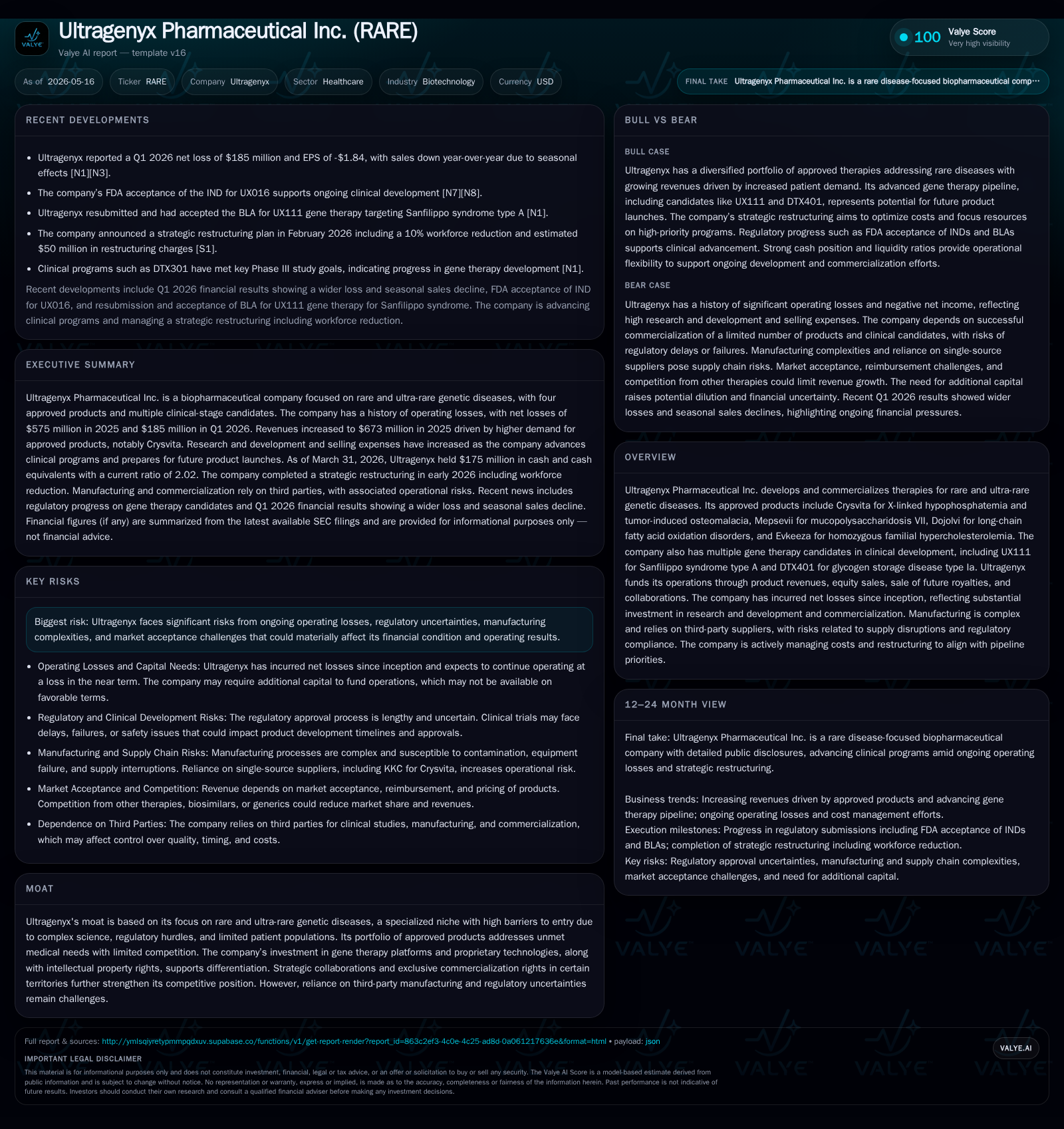
Ultragenyx Pharmaceutical Inc. filed its Q1 2026 10-Q on May 6, revealing a quarterly revenue shortfall relative to market expectations coupled with a widened net loss [S2][N2][N6]. The company attributed part of the revenue softness to seasonal factors affecting IV-administered products. Operationally, Ultragenyx is progressing through a strategic restructuring that began in early 2026 involving approximately 10% workforce reduction and termination of some contract manufacturing agreements related to UX143 [S2][S3][S10]. This restructure aims to concentrate resources on higher-value pipeline assets and improve efficiency.
On the clinical front, a renewed positive development bolsters the growth outlook: the FDA accepted the resubmitted Biologics License Application (BLA) for UX111 (formerly ABO-102), an AAV9-based gene therapy candidate for Sanfilippo syndrome type A [N7][N8][S16]. This regulatory milestone is critical as it represents one of the company's leading pipeline projects targeting a devastating ultra-rare genetic disease without effective treatment options. The impending FDA review timeline sets an important upcoming catalyst beyond the near-term commercial challenges.
Ultragenyx’s Business Model and Product Portfolio Dynamics
Ultragenyx operates as a biopharmaceutical entity specializing in treatments for rare and ultra-rare genetic disorders [S1][S23]. Its revenue generation stems from commercial sales of four approved products—Crysvita (XLH and tumor-induced osteomalacia), Mepsevii (mucopolysaccharidosis VII), Dojolvi (long-chain fatty acid oxidation disorders), and Evkeeza (homozygous familial hypercholesterolemia)— supplemented by collaboration revenues, royalties from strategic partnerships such as KKC for Crysvita in select geographies, equity financing activities, and the monetization of future royalties [S1][S23].
Given the extremely limited patient populations typical of orphan diseases, Ultragenyx's business model inherently focuses on highly specialized, complex therapies demanding significant investment in precision manufacturing often outsourced to third-party providers [S1][S15]. This dependence introduces operational risks around supply continuity but enables capital-efficient scale given capex intensity. The company's approach emphasizes leveraging proprietary technology platforms including advanced gene therapy vectors alongside enzyme replacement therapies.
Competitive Positioning in Rare and Ultra-Rare Disease Therapeutics
The rare disease therapeutics sector features high entry barriers—extensive scientific complexity in genetic medicine development; stringent regulatory paths often augmented by orphan drug exclusivities; narrow patient populations limiting large-scale competition; and significant intellectual property protections [S1][S21]. Ultragenyx's portfolio benefits from these structural safeguards combined with exclusive commercialization rights (e.g., Evkeeza outside the U.S.) that buffer against direct competitive threats.
Moreover, the firm's investment in gene therapy R&D contributes a differentiated competitive edge relative to peers focused solely on small molecules or traditional biologics. However, this space remains vulnerable to supply chain disruptions due to reliance on single-source active pharmaceutical ingredient (API) manufacturers or CMOs specializing in viral vector production [S15][S2]. Regulatory uncertainty post-launch also poses risks given novel modalities' evolving oversight standards.
Growth Drivers: Gene Therapy Pipeline and Commercial Expansion
The principal growth engine lies in clinical progression of late-stage gene therapies—UX111 targeting Sanfilippo A and DTX401 for glycogen storage disease type Ia—both addressing diseases with no current curative options [S1][S2]. Successful regulatory approvals would significantly expand Ultragenyx's market footprint. Measurable KPIs include FDA approval timing for UX111 BLA under review post acceptance [N7], pivotal trial data releases anticipated within the next year for DTX401 [S17], plus enrollment milestones.
Concurrent with pipeline advancement is scaling revenues from established products via label expansions or geographic launches. Global uptake of Crysvita beyond primary markets into Latin America has shown momentum [S22]. Evkeeza's approval across EMEA and Japan complements US sales with potential growth as reimbursement landscapes mature. The firm's strategy involves maintaining robust post-marketing clinical activities and medical affairs support to sustain demand in these niche segments.
Key Risks: Regulatory, Manufacturing, and Market Acceptance Challenges
Ultragenyx faces multifaceted risks endemic to orphan biopharma companies. Regulatory pathways remain inherently unpredictable especially for complex gene therapies where additional data requests or inspection outcomes can delay commercialization despite prior Fast Track or RMAT designations [S15][S20]. Manufacturing risks loom large due to dependency on external CMOs with limited oncology-grade vector production capacity; any disruption could hinder clinical trial supply or market availability [S15][S2].
Market acceptance risks persist as payer reimbursement policies tighten particularly given high-cost profiles of gene therapies. Though orphan status often alleviates pricing pressures somewhat, coverage variability across regions may weigh on adoption speed [S21]. Additionally, ongoing operating losses underline execution risk; profitability depends heavily on scaling new product revenues while controlling expenses amid research intensiveness.
Upcoming Catalysts: Clinical Readouts and Commercial Execution
Key near-term events to monitor include:
- FDA action date expected within months for UX111 BLA following recent acceptance [N7][N8][S16]
- Data readouts from DTX401 trials slated for first half of 2027 providing evidence of efficacy/safety crucial for approval filings [S17]
- Implementation progress of restructuring plan including cost savings realization during H1 2026 [S10]
- Expansion efforts for commercial products internationally impacting sales trajectories over remainder of 2026 [S3]
- Updates on other pipeline assets such as GTX-102 antisense oligonucleotide for Angelman syndrome potentially entering clinical trials [S23] These milestones will offer concrete signals regarding technical feasibility of gene therapy programs alongside commercial scaling which underpin Ultragenyx’s medium-term valuation.
Latest Financial Snapshot
Latest financial snapshot
| Metric | Value | Period |
|---|---|---|
| Cash & equivalents | $175mm | |
| 2026-03-31 | ||
| Current assets | $657mm | |
| 2026-03-31 | ||
| Current liabilities | $325mm | |
| 2026-03-31 | ||
| Current ratio | 2.02x | |
| 2026-03-31 |
Source: SEC companyfacts cache [F1].
| Metric | Value |
|---|---|
| Cash & Equivalents | $175 million |
| Current Assets | $657 million |
| Current Liabilities | $325 million |
| Current Ratio | 2.02 |
As of March 31, 2026, Ultragenyx held $175 million in cash equivalents supporting liquidity amidst continued operating losses noted historically [F1]. Despite persistent net losses generated primarily by heavy research & development outlays and commercialization costs ([S1],[F1]), cash reserves combined with future royalty monetizations provide an adequate runway expected to cover at least the next twelve months [S2]. Careful management of expenses through restructuring initiatives further aims to temper burn rates going forward.
Disclaimer: This analysis is based exclusively on publicly available information as of May 16, 2026. It does not constitute investment advice or an offer to buy or sell securities. Readers should perform their own due diligence before making decisions concerning Ultragenyx Pharmaceutical Inc.
Disclaimer: This is research-only, informational analysis and not investment advice. It may include AI-generated interpretation and general industry context. Always verify important details using primary sources.

Comments