
Imunon Advances Ovarian Cancer Immunotherapy Amid Phase III Momentum
Imunon reports continued Phase III progress on IMNN-001 and maintains sufficient liquidity to support ongoing clinical development.
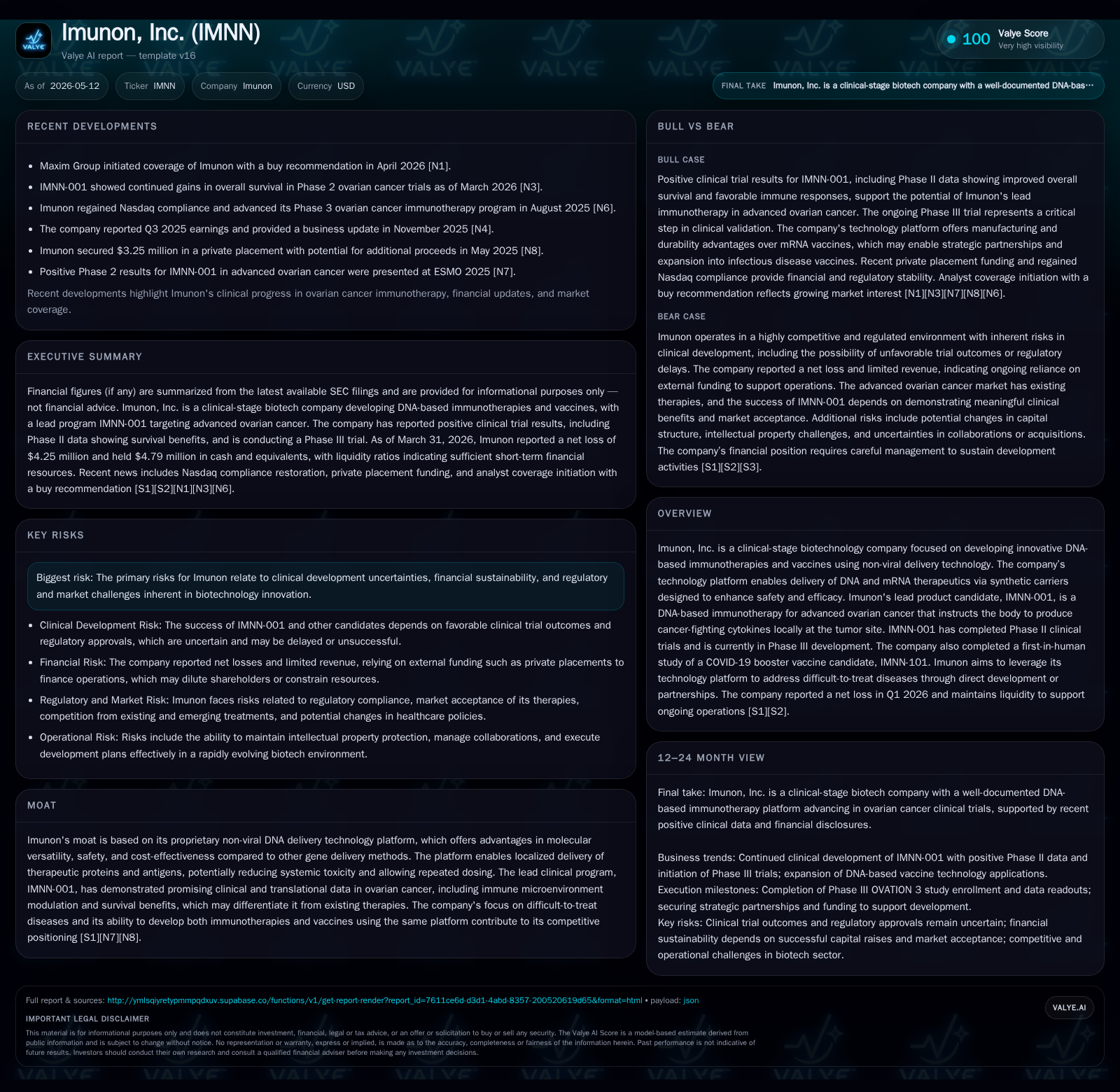
In its Q1 2026 10-Q filing, Imunon emphasized advancing its lead DNA-based immunotherapy candidate, IMNN-001, into late-stage clinical development for advanced ovarian cancer while maintaining a cash position supporting near-term operational needs. The company's proprietary non-viral synthetic DNA delivery platform differentiates it within the gene therapy space by enabling localized cytokine production with reduced systemic toxicity and redosing capability. Near-term growth hinges on successful Phase III trial outcomes and pipeline expansion through vaccine candidates and strategic partnerships. Risks remain elevated due to clinical and regulatory uncertainties inherent to biotechnology innovation alongside ongoing funding requirements.
Quarterly Update and Recent Clinical Developments
Imunon's May 12, 2026 Form 10-Q filing establishes that the company is actively progressing its clinical programs with a clear operational focus centered on IMNN-001, its lead DNA-based immunotherapy targeting advanced ovarian cancer [S2]. The company continues to invest in the pivotal Phase III trial of IMNN-001 following successful completion of Phase II studies demonstrating favorable safety and preliminary efficacy signals. In parallel, the COVID-19 booster vaccine candidate, IMNN-101, has completed first-in-human testing, underscoring Imunon's technology versatility across oncology and infectious diseases [S3].
Liquidity remains a focal point; despite a net loss position typical of clinical-stage biotechs, Imunon reported $4.79 million in cash and equivalents as of March 31, 2026, alongside current assets of approximately $6.62 million versus $4.17 million in current liabilities yielding a comfortably above one current ratio of 1.59 [F1]. This financial posture underpins ongoing R&D activities with an emphasis on optimizing trial execution and preparing for regulatory engagement.
Management's recent conference call reaffirmed commitment to advancing the development pipeline alongside prudent capital management during this high-investment phase [S3].
Imunon's Business Model and Proprietary Technology Platform
Imunon's value creation revolves around its proprietary synthetic non-viral DNA delivery platform engineered for targeted intracellular delivery of DNA and mRNA payloads [S1]. Unlike viral vector approaches that carry risks of immunogenicity and limited repeat dosing due to neutralizing antibodies, Imunon's synthetic carriers facilitate repeated administrations with enhanced safety profiles—a critical advantage in chronic or multi-dose treatment regimens common in oncology immunotherapies.
The platform enables localized expression of therapeutic proteins such as cytokines directly at tumor sites, potentially modulating the tumor microenvironment to elicit durable anti-cancer immune responses while minimizing systemic adverse effects. IMNN-001 embodies this approach by instructing cells within ovarian tumors to produce cancer-fighting cytokines aiming to overcome immunosuppressive barriers.
Commercially, Imunon remains in the clinical development stage without established sales revenue [S1]. The company plans either direct marketing pending approvals or leveraging strategic alliances for commercialization—reflecting standard practices given the high capital demands of biopharmaceutical launches. Platform versatility extends beyond oncology into vaccinology, demonstrated by their exploratory COVID-19 booster program which could form a foundation for future infectious disease candidates.
Industry Competitive Dynamics and Positioning
Imunon's moat arises predominantly from its synthetic non-viral gene delivery technology which contrasts with incumbent viral vector platforms such as adeno-associated virus (AAV) that dominate gene therapy applications but face constraints including high production cost, limited payload capacity, and preexisting immunity issues [S1]. This positions Imunon favorably amidst growing demand for safer, scalable nucleic acid therapeutics.
Within the immuno-oncology landscape targeting solid tumors like ovarian cancer—a notoriously hard-to-treat indication—IMNN-001's localized cytokine mechanism offers differentiation versus systemic checkpoint inhibitors or antibody-drug conjugates whose efficacy can be limited by off-target toxicities or resistance mechanisms.
However, competition is intensifying as global biotech firms invest substantially in cell therapies, immune modulators, and personalized vaccines. Regulatory complexity around gene therapies including stringent manufacturing controls represents an entry barrier but also heightens operating risk given the requirement for consistent quality supply chains. Pricing pressures loom large in light of government cost containment initiatives likely to impact reimbursement environments not only in the U.S. but internationally [S1].
Pathways to Growth: Clinical Milestones and Strategic Partnerships
Imunon's growth trajectory is tightly linked to successful readouts from IMNN-001's ongoing Phase III trials which will be pivotal in determining regulatory approvals and commercialization potential [N1][S1]. Positive interim data highlighting survival benefits or immune modulation biomarkers would enhance investor confidence and partner appeal.
The COVID-19 booster vaccine candidate adds portfolio diversification opportunities albeit at an exploratory stage. Given the company's platform strategy, new pipeline entrants leveraging analogous delivery methods can be accelerated through phases more efficiently than de novo technologies.
Strategic partnerships represent another critical growth lever as Imunon has indicated interest in collaborative alliances to share development risk and expand commercial reach [S1]. Such deals might include licensing arrangements or co-development collaborations particularly targeting geographies where local partners can navigate complex market dynamics more effectively.
Risks and Potential Constraints on Development and Commercialization
The primary risk factors remain endemic to clinical-stage biopharma firms: trial outcomes are inherently uncertain both in safety/tolerability profiles and efficacy endpoints which determine go/no-go decisions impacting valuation dramatically [S8]. Delays due to recruitment challenges or unforeseen adverse events could extend timelines considerably.
Financial sustainability is another core concern; current liquidity levels support operations near term but additional financing will likely be required to complete pivotal trials and build commercial infrastructure if approvals materialize [F1][S2]. Dilution risk from future equity raises is typical but underscores dependency on capital markets.
Regulatory environments are dynamic; evolving standards around gene therapy manufacturing controls plus intensified payer scrutiny driven by healthcare cost containment programs could constrain pricing power limiting eventual revenue capture [S1]. Market adoption risks also hinge on competitive innovations outpacing Imunon's candidates or changes in treatment paradigms diminishing target populations.
What to Watch: Upcoming Catalysts and Execution Markers
Near-term attention should focus on interim data announcements from IMNN-001 Phase III trials expected throughout the coming quarters [S3][N1]. Positive signals here are fundamental milestones setting valuation inflection points.
Regulatory interactions such as Fast Track designations or breakthrough therapy status applications will signal agency receptiveness enhancing development visibility. Progress updates on the COVID-19 booster program will also serve as incremental news flow reflecting platform adaptability.
Partnership announcements would validate external confidence in the technology platform while providing additional resources or market pathways.
Investor scrutiny on operating cash burn rates against cash runway projections post-Q1 results will inform capital strategy ahead.
Latest Financial Snapshot and Liquidity Analysis
Latest financial snapshot
| Metric | Value | Period |
|---|---|---|
| Cash & equivalents | $5mm | |
| 2026-03-31 | ||
| Current assets | $7mm | |
| 2026-03-31 | ||
| Current liabilities | $4mm | |
| 2026-03-31 | ||
| Current ratio | 1.59x | |
| 2026-03-31 |
Source: SEC companyfacts cache [F1].
As of March 31, 2026, Imunon held approximately $4.79 million in cash and equivalents supplemented by current assets approximating $6.62 million against current liabilities near $4.17 million yielding a current ratio of approximately 1.59—an adequate liquidity cushion for near-term operational needs [F1].
The company's net losses remain substantial consistent with investment-intensive R&D expenditure cycles with operating losses exceeding $14 million as reported for FY 2025 [F1]. Total debt from earlier periods stood near $6 million last reported but net debt position after adjusting for cash reduces financial leverage concerns somewhat [F1].
This financial profile aligns with expectations for companies at this stage focusing resources heavily on clinical advancement rather than commercial revenue generation. Sustaining operations over subsequent quarters will require mindful expense management alongside diligent pursuit of alternative financing means to mitigate dilution and maintain trial momentum.
Disclaimer: This analysis is based solely on publicly available filings as cited including recent SEC disclosures up to May 12, 2026, third-party news coverage, and validated companyfacts figures without access to internal non-public information. It does not constitute investment advice but aims to provide detailed industry context guided by observed evidence.
Disclaimer: This is research-only, informational analysis and not investment advice. It may include AI-generated interpretation and general industry context. Always verify important details using primary sources.

Comments