
United-Guardian Navigates Competitive Pricing and Supply Challenges While Expanding Distribution
Q1 2026 highlights include tackling contract manufacturing disruptions, intensifying global competition, and strategic distribution expansion.
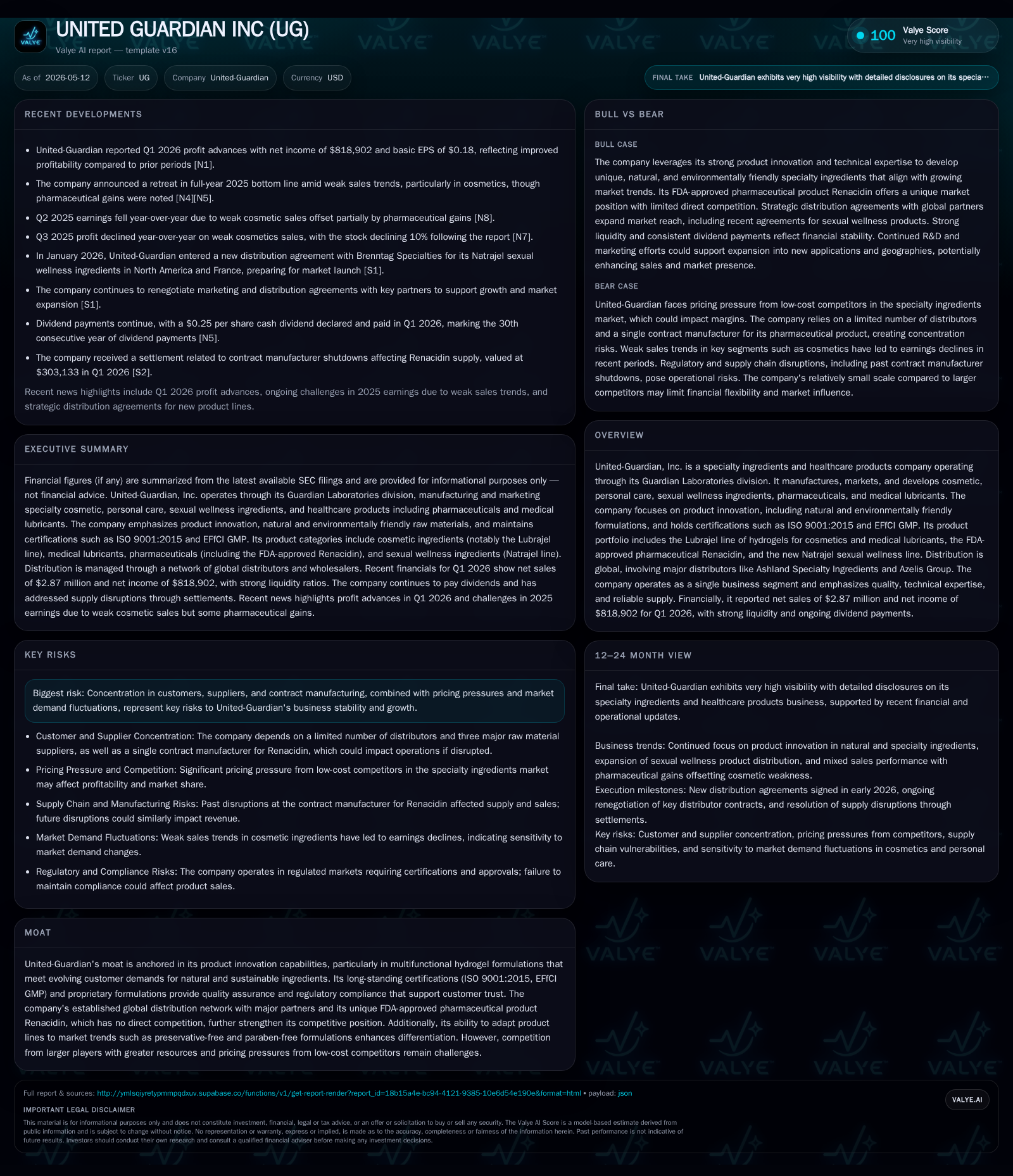
United-Guardian’s Q1 2026 report reveals pressures from lower-priced international competitors and a supply disruption in its pharmaceutical segment due to a contract manufacturer’s facility shutdown. The company leverages longstanding product innovation strengths and certification-driven quality assurances across specialty cosmetic, personal care, medical lubricants, and pharmaceutical ingredients to maintain market relevance. Expansion efforts hinge on recent distribution agreements targeting North America and France, while risks include customer concentration and pricing pressures. Robust liquidity supports ongoing dividends and strategic investments, with milestones to monitor including ramp-up of sexual wellness product sales and resolution of supply chain issues.
Recent Operating Update
In its first quarter of 2026 filing dated May 12 [S2], United-Guardian disclosed continued competitive headwinds from lower-priced Asian and European specialty ingredient manufacturers offering alternatives that do not always match the performance or quality level of United-Guardian’s products. To mitigate pricing pressures, the company works closely with distributor partners to structure competitive pricing strategies including volume discounts when appropriate.
A notable operational challenge during Q1 was an unexpected shutdown of the contract manufacturer’s facility responsible for producing Renacidin, the company’s FDA-approved pharmaceutical product. This disruption affected the ability to fulfill complete orders in late 2023 through early 2024. United-Guardian initiated a claim for damages related to this breach and has recognized monetary consideration from the contract manufacturer within net income pertaining to a settlement agreement [S2]. Resolving this supply issue remains critical to restoring full sales capacity in this segment.
Additionally, January 2026 marked a business development milestone as United-Guardian signed a distribution agreement with Brenntag Specialties. This partnership expands distribution of the nascent Natrajel sexual wellness ingredient line across the U.S., Canada, and Mexico while also deepening Lubrajel/Natrajel presence in France—a market renowned for personal care innovation [S1]. Although sexual wellness product sales were absent during 2025 as commercial ramp-up was pending, manufacturing readiness positions United-Guardian to capture growth in that segment promptly.
Business Model Overview
United-Guardian operates largely through its Guardian Laboratories division. It manufactures, markets, and develops specialty cosmetic ingredients (notably hydrogels), personal care components, sexual wellness ingredients under the brand Natrajel, pharmaceuticals such as Renacidin, and medical lubricants [S1]. Revenue derives primarily from sales of these specialized ingredient formulations sold mostly via distributor networks like Ashland Specialty Ingredients and Azelis Group 9.
Price realization depends on leveraged distributor contracts that navigate global pricing competition while emphasizing product quality to justify premium positioning. Volume growth is driven by expanding end-market applications in cosmetics and healthcare sectors receptive to natural, preservative-free formulations aligned with consumer trends.
A key strength lies in product innovation capabilities with proprietary hydrogel technologies (Lubrajel) that serve multifunctional roles including moisturizing bases or medical lubricant applications. These formulations are optimized continuously through R&D efforts focused on unmet needs and eco-friendly raw materials sourcing. The company maintains important certifications—ISO 9001:2015 quality management system compliance and EFfCI GMP standards—to ensure consistent manufacturing quality required by regulatory bodies [S1].
Pharmaceutical operations depend on external contract manufacturing agreements given the regulatory complexities involved with Renacidin production. This reliance introduces operational risks if partner facility disruptions occur.
Industry Structure & Competitive Position
The specialty ingredient industry is characterized by intense global competition from well-capitalized European firms and Asian manufacturers who frequently compete aggressively on price [S2]. Many competing products do not offer comparable performance or quality assurance but are impactful enough to exert pricing pressure on United-Guardian’s offerings.
United-Guardian differentiates through its innovation pedigree in hydrogel chemistry paired with regulatory-approved pharmaceutical offerings unique within its niche (Renacidin) that face no direct substitutes. Its rigorous certifications reinforce trust among customers requiring compliant ingredients for regulated domains such as medical devices or pharmaceuticals.
Distribution partnerships spanning key geographies enhance reach but simultaneously create dependencies that concentrate revenue among few major customers—a notable risk factor [S1]. The relatively small scale compared to multinational chemical firms limits bargaining power but fosters nimble innovation responses tailored to specialized customer demands.
Growth Drivers
Innovation & Product Development
United-Guardian’s growth fundamentally rests on its capacity to innovate novel specialty ingredients that address growing demand for natural, sustainable cosmetic formulations free from parabens or preservatives. Its R&D pipeline aims at both extending existing hydrogel applications and cultivating new functional properties that can unlock markets.
Geographic Expansion & Distribution Agreements
The recent agreement with Brenntag Specialties exemplifies targeted geographical diversification aimed at leveraging established distributor footprints in North America and Europe. Successful commercialization of the Natrajel sexual wellness line could open a high-growth adjacent market segment.
Regulatory Approvals & Product Certification
Maintaining FDA registrations and international GMP standards enables access to regulated healthcare sectors which command higher margins but require strict compliance—protecting United-Guardian against lower-tier competitors lacking credentials.
Risks / Watchpoints / Growth Constraints
Supplier & Customer Concentration Risk
Concentration among a handful of distributors exposes the company to volatility should any single partner reduce orders or fail operationally [S1]. Dependency on one contract manufacturer for Renacidin creates supply chain vulnerability highlighted by recent disruptions.
Pricing Pressure & Competition
Price undercutting by Asian/European competitors challenges margin protection despite United-Guardian’s focus on superior formulation quality [S2]. The company must balance competitive pricing strategies without eroding product value perception.
Trade Policy & Supply Chain Disruptions
Tariffs enacted by the U.S. government alongside retaliatory responses have created complex trade dynamics affecting raw material costs, availability, and end-market access [S1][S16]. Ongoing geopolitical uncertainties may continue to disrupt procurement channels or inflate expenses.
Market Adoption Pace for New Products
Commercial traction for newly launched Natrajel products remains nascent; failure to generate meaningful sales volumes could hinder revenue diversification plans.
What To Watch Next
- Progression of Renacidin supply normalization post contract manufacturer settlement: restoring full production capacity is necessary for pharmaceutical revenue stability.
- Initial revenue contributions from the Natrajel sexual wellness line leveraging Brenntag distribution network expansion in North American and French markets.
- Pricing strategy adaptation amid persistent international competitive pressures.
- Any material impacts arising from evolving U.S. trade policies impacting cost structure or distribution logistics.
- Quarterly updates on distributor order volumes signaling shifts in customer demand or portfolio mix changes.
Financial Snapshot (March 31, 2026) [F1][S2]
Latest financial snapshot
| Metric | Value | Period |
|---|---|---|
| Cash & equivalents | $735854 | |
| 2026-03-31 | ||
| Current assets | $12mm | |
| 2026-03-31 | ||
| Current liabilities | $1466665 | |
| 2026-03-31 | ||
| Current ratio | 8.05x | |
| 2026-03-31 |
Source: SEC companyfacts cache [F1].
The balance sheet reflects strong liquidity with an elevated current ratio indicating robust short-term asset coverage relative to liabilities. Cash generation from operations improved year-over-year reflecting increased net income contributions despite macroeconomic headwinds [S2][N2]. Dividend payments remain a priority alongside measured investment in marketable securities enabling financial flexibility for future growth opportunities.
Disclaimer
This analysis is provided solely for informational purposes based on publicly filed documents as of May 12, 2026. It does not constitute investment advice or recommendations regarding United-Guardian Inc. Investors should perform their own due diligence before making any investment decisions.
Disclaimer: This is research-only, informational analysis and not investment advice. It may include AI-generated interpretation and general industry context. Always verify important details using primary sources.

Comments