
Forte Biosciences Advances FB102 in Autoimmune Trials Supported by Strong Financial Position
The clinical-stage biopharma progresses its lead anti-CD122 antibody with positive celiac disease data and a recent capital raise boosting liquidity.
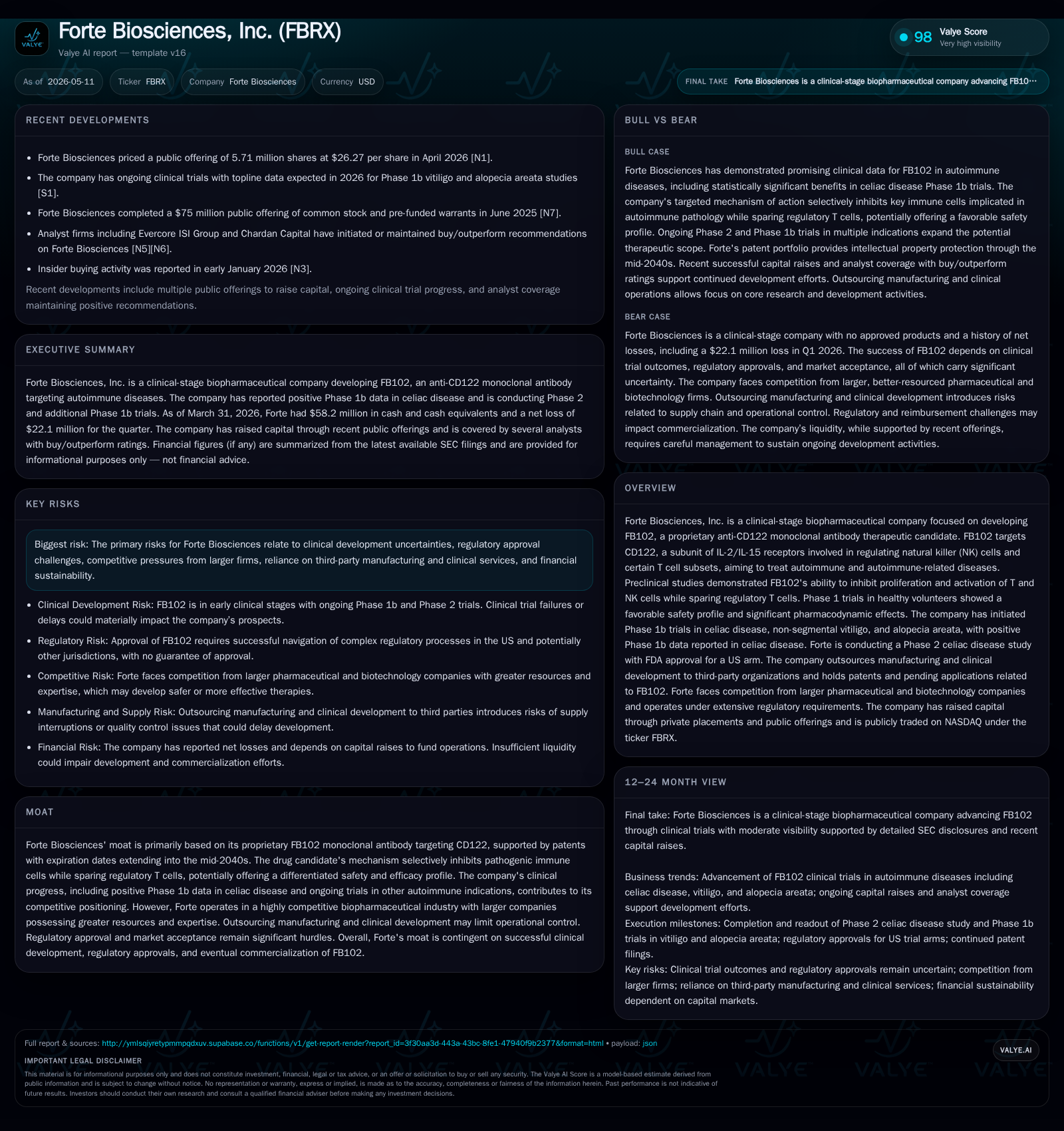
Forte Biosciences' 2026 Q1 report highlights ongoing development of FB102, its proprietary monoclonal antibody targeting CD122 for autoimmune diseases, including positive Phase 1b data in celiac disease. The company maintains a strong liquidity position following a recent equity offering, supporting continued clinical advancement and regulatory interactions. Forte’s reliance on third-party manufacturing and the competitive biopharma landscape temper operational control and risk exposure. Growth catalysts hinge on successful clinical trial progression and eventual regulatory approvals.
Recent Operating Update
Forte Biosciences’ latest quarterly filing dated May 11, 2026 ([S2]) focuses primarily on the ongoing clinical development of FB102, its lead therapeutic candidate targeting the CD122 subunit involved in autoimmune pathology. The company is advancing a Phase 2 study in celiac disease under FDA-sanctioned protocols that include a U.S. patient arm—marking an important step toward validating safety and efficacy in a controlled patient population ([S2], [S1]). Earlier Phase 1b results in celiac disease were encouraging, showing statistically significant benefits in histological endpoints such as intraepithelial lymphocyte density and villous height-to-crypt depth ratios alongside symptom improvements compared to placebo ([S1]).
In April 2026, Forte completed a significant equity capital raise—issuing approximately 5.71 million shares priced at $26.27 each—to bolster its cash position for continued pipeline investment ([S3], [N1]). This infusion increases their operational runway amid the costly late-stage trials typical in biopharmaceutical development.
Business Model
Forte’s commercial value proposition centers on FB102, a proprietary monoclonal antibody that antagonizes CD122—the IL-2/IL-15 receptor subunit regulating natural killer (NK) cells and select T-cell subsets implicated in autoimmune disease mechanisms ([S1]). By selectively inhibiting pathogenic effector cells without impairing regulatory T cells (Tregs), FB102 aims to offer an improved safety profile relative to competing immunomodulators.
The company has pursued multiple indication pathways: active Phase 2 efforts in celiac disease—with FDA agreement—and earlier phase studies in non-segmental vitiligo and alopecia areata have been launched ([S1]). FB102’s mechanism exhibited robust preclinical inhibitory data against T and NK cell proliferation and activation while maintaining Treg function ([S1]). From a revenue mechanics perspective, Forte stands pre-commercialization; hence revenues are non-existent currently. Future revenue depends fundamentally on regulatory approvals followed by market uptake governed by payor coverage decisions and pricing dynamics.
Notably, Forte operates as a lean biotech outsourcing its manufacture of clinical-grade material to contract manufacturing organizations (CMOs) and delegates clinical trial management to contract research organizations (CROs) ([S14]). While outsourcing limits fixed infrastructure costs, it also introduces supply chain vulnerabilities and reduces direct control over quality assurance processes essential for biologics production.
Industry Structure and Competitive Position
Forte operates within the highly competitive immunology-biopharmaceutical sector characterized by rapid technological innovation, stringent regulatory environments, and dominance by large pharma players with deep R&D budgets ([S14]). Competitors include established companies developing antibodies and novel modalities targeting related autoimmune pathways such as IL-2/IL-15 axis components or broader immunosuppressants.
Intellectual property protection for FB102 derives from patents extending through the mid-2040s covering compositions and methods of use targeting CD122 ([S1], [S13]). This exclusivity coupled with differentiated pharmacodynamics underpins their moat; however, emerging biosimilars or next-generation immune therapies could erode market share upon product launch.
The clinical trial successes reported thus far enhance Forte’s standing but remain early-stage hurdles among many—regulatory approval processes demand extensive confirmatory data sets across multiple autoimmune conditions (). Additionally, demonstrating differentiated efficacy/safety vs standard-of-care will be crucial given the entrenched prescriber adoption patterns.
Growth Drivers
Progression through key clinical milestones remains the primary growth engine for Forte. The ongoing Phase 2 celiac disease study is pivotal—success here unlocks potential accelerated pathways towards FDA approval given unmet needs for therapy beyond strict gluten avoidance ([S2], [S1]). Positive results can catalyze expansion into vitiligo and alopecia areata indications presently in Phase 1b stages.
Supporting this is robust patent coverage assuring sustained commercial exclusivity until the mid-2040s—a critical factor for justifying investment into lengthy development timelines ([S13]).
Capital raised from recent offerings enhances financial flexibility to fund these costly trials without immediate concerns over liquidity or refinancing risks ([N1], [F1]). The strong cash position coupled with a solid current ratio (~2.75) shields near-term operations from external funding dependencies ([F1]).
Regulatory engagement quality also influences growth; Forte's FDA-approved US arm in the Phase 2 trial signals constructive collaboration potentially enabling smoother future submissions and label expansions ([S2], [S1]).
Risks / Watchpoints / Growth Constraints
Clinical Trial Uncertainty: As with all biopharmaceutical development programs, FB102 faces inherent risks that late-phase trials may fail to replicate early positive safety or efficacy signals impacting approval prospects.
Regulatory Hurdles: Stringent FDA requirements around immunomodulatory biologics impose risks of delays or requests for additional studies impacting timelines (). Evolving legislative pressures around drug pricing add uncertainty about future reimbursement landscapes ([S15], [S16], [S24], [S27]).
Competition: Larger well-capitalized competitors with broader pipelines possess advantages in market development presence that may challenge Forte's commercial uptake post-launch ([S14], [S13]).
Manufacturing Dependence: Outsourced CMO reliance concentrates supply chain risk—raw material shortages or production disruptions could delay trial execution or commercialization ([S14]).
Financial Sustainability: Forte maintains a strong cash position of approximately $58.2 million and a healthy current ratio of about 2.75 as of March 31, 2026, supporting near-term liquidity ([F1]). However, as a pre-commercial company without product revenues, ongoing capital raises may be necessary to fund development until commercialization generates sustained revenue streams ([N1]). Dilution risk exists with future offerings if milestones underperform.
Coverage & Reimbursement: Post-approval pricing pressure from government programs and payors could compress margins or restrict patient access to FB102 therapies given cost containment trends especially in autoimmune drug categories ([S15], [S16], [S24]).
What to Watch Next
Key upcoming milestones include readouts from the ongoing Phase 2 celiac disease study scheduled per management commentary; success here will be critical to shaping regulatory filing strategies and potential partnering discussions ([S2], [S1]).
Advancement timelines for Phase 1b vitiligo and alopecia areata studies also bear monitoring to assess FB102’s broader applicability across autoimmune indications.
Regulatory communications regarding Investigational New Drug (IND) amendments or BLA submissions will signal management’s confidence level in their data package going forward.
Further capital market activities following April’s sizeable equity raise should be observed for signs of fundraising cadence necessary to support multi-year development cycles ([N1], [S3]).
Finally, any updates addressing manufacturing scale-up capacities or supply chain robustness would provide insights into operational preparedness for commercialization phases.
Financial Profile (Brief)
Latest financial snapshot
| Metric | Value | Period |
|---|---|---|
| Cash & equivalents | $58mm | |
| 2026-03-31 | ||
| Current assets | $65mm | |
| 2026-03-31 | ||
| Current liabilities | $24mm | |
| 2026-03-31 | ||
| Current ratio | 2.75x | |
| 2026-03-31 |
Source: SEC companyfacts cache [F1].
As of March 31, 2026, Forte had cash & equivalents of approximately $58.2 million against current liabilities near $23.6 million resulting in a healthy current ratio of about 2.75 that indicates good near-term liquidity coverage ([F1]). Total debt figures currently appear modest with best available data reporting ~$27 million as of mid-2019; no more recent indebtedness has been reported ([F1]), pointing towards relatively low leverage.
Operating losses remain substantial reflecting typical R&D investment burdens in clinical-stage biopharma with full-year operating income loss documented at approx -$70.7 million ending December 31, 2025 ([F1]). Net loss totaled around -$69.4 million same period consistent with pre-revenue status due to lack of approved products generating sales today.
The April equity offering positively impacts leverage ratios by adding fresh capital without increasing debt burden significantly providing an enhanced funding buffer amid intensive pipeline spend periods ahead ([N1], [F1]).
This analysis reflects information through May 11, 2026 based on SEC filings and market reports cited herein. It seeks to provide an informed view of Forte Biosciences’ operational status and strategic positioning without offering investment recommendations.
Disclaimer: This is research-only, informational analysis and not investment advice. It may include AI-generated interpretation and general industry context. Always verify important details using primary sources.

Comments