
Plug Power’s First Quarter 2026: Expanding Green Hydrogen Infrastructure Amid Financial Losses
Plug Power advances its electrolyzer production and infrastructure initiatives while managing substantial losses and maintaining liquidity in Q1 2026.
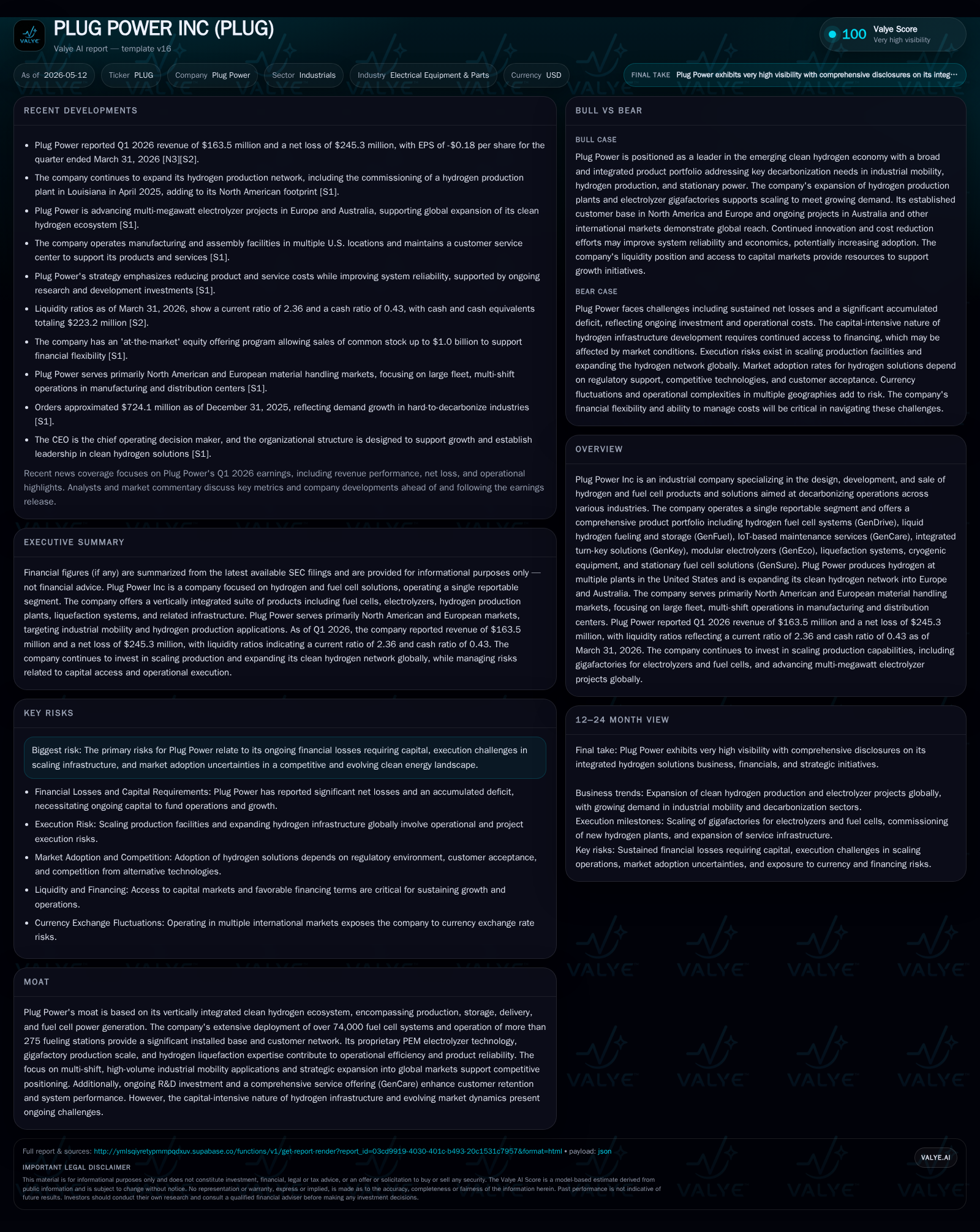
In Q1 2026, Plug Power emphasized scaling its electrolyzer technology and optimizing hydrogen infrastructure as part of a broader strategy to consolidate its vertically integrated clean hydrogen ecosystem. Despite posting a net loss of $246 million, the company maintains a strong liquidity position with over $400 million in combined cash and restricted cash. Plug Power’s product portfolio spans fuel cells, electrolyzers, hydrogen fueling, and service solutions, targeting industrial mobility and decarbonization markets in North America and Europe. Key growth drivers include expanding electrolyzer deployment for on-site green hydrogen generation and global market penetration amid ongoing execution risks related to capital intensity and market adoption.
Latest Quarterly Operating Update Highlights
Plug Power reported first quarter fiscal results ending March 31, 2026, highlighting continued strategic emphasis on expanding its green hydrogen infrastructure portfolio. The company generated a net loss of about $246 million for the quarter, a marked increase compared with roughly $197 million loss in Q1 2025 [S2]. This loss reflects intensified capital deployment to support growth areas particularly in electrolyzer production and custom turnkey solutions.
Combined with other current assets totaling over $1.27 billion against current liabilities around $540.7 million, Plug sustains a strong working capital position of $734 million and a current ratio of approximately 2.36 that underpins near-term financial flexibility [S2][F1].
A notable update disclosed is the active "infrastructure optimization initiative" intended to restructure or monetize select assets to improve liquidity positions. Management emphasized that outcomes depend on market conditions and execution but the initiative may ease short-term funding requirements [S2].
The company also expanded its electrolyzer offerings during the period to support onsite hydrogen generation for industrial applications such as refineries, chemical plants, steel producers, fertilizer manufacturing, and commercial fueling stations—a key pivot towards enabling customers’ self-sufficiency in green hydrogen production [S2][N2].
Diversified Hydrogen Product Portfolio and Business Model
Plug Power operates a vertically integrated clean hydrogen ecosystem with a unified segment encompassing multiple interconnected product lines driving revenue through equipment sales, fuel deliveries, maintenance service contracts, and turnkey system deployments [S1].
At the core sits GenDrive: proton exchange membrane (PEM) fuel cell systems primarily for forklifts used by large-scale distribution centers and factories requiring multi-shift uptime—a niche where fuel cells distinctly outperform traditional lead-acid or lithium-ion battery alternatives by enabling continuous operations without long charging downtime.
Complementing fuel cells is GenFuel, offering liquid hydrogen fueling stations developed internally or via joint ventures providing high throughput fueling capabilities critical for fleet operators transitioning to hydrogen fuel cell electric vehicles (FCEVs). The extensive network—275+ stations—supports growing customer adoption by mitigating “fuel range anxiety” often associated with electrification transitions.
The addition of GenCare services extends customer retention through IoT-enabled predictive maintenance programs that enhance equipment reliability and uptime while creating recurring revenue streams.
GenEco represents a strategic thrust deeper into hydrogen production via modular PEM electrolyzers enabling customers to generate renewable hydrogen onsite using electricity from clean sources. This reduces dependence on third-party hydrogen supply chains prone to logistical cost escalations.
Integrated solutions under GenKey bundle these product lines into turn-key deployments tailored for specific customer environments—accelerating adoption by lowering barriers related to capital outlays or complexity. The product mix thus spans tangible hardware sales (fuel cells, electrolyzers), consumable fuels (hydrogen), plus value-added service contracts fostering stickiness within existing large fleet accounts primarily across North America and Europe [S1].
Competitive Edge in a Growing Hydrogen Industry
Plug Power’s moat derives from deep vertical integration combined with proprietary technological advantages in PEM electrolyzers—the architecture central to scalable green hydrogen production—and fuel cell stacks optimized for industrial applications. The company’s gigafactory-scale manufacturing capability provides economies of scale few competitors match today.
Its installed base exceeding 74,000 fuel cell systems underpins significant brand recognition within material handling fleets that require reliability under demanding multi-shift operations. This translates into embedded switching costs as customers are reluctant to shift away due to operational disruption risk.
Hydrogen production facilities across Tennessee, Georgia, Louisiana coupled with third-party supply arrangements ensure diversified sourcing that mitigates single-point failures. Meanwhile, ongoing R&D investments target improvements in stack durability, efficiency gains in liquefaction technology for fuel storage/delivery under GenFuel solutions—all contributing incremental competitive differentiation over alternative distributed generation or battery-based electrification options.
However analysis highlights the double-edged capital intensity inherent in infrastructure expansion that creates sizeable entry barriers but also constrains rapid scaling amidst macroeconomic uncertainty; this elevated capex demand necessitates careful balance sheet management bolstered by regulatory tailwinds including clean energy tax credits aiming to stimulate adoption but subject to evolving political environments [S1].
Growth Drivers: Electrolyzer Expansion and Global Market Penetration
Key near-term catalysts lie in scaling electrolyzer output aligned with burgeoning demand from sectors actively pursuing decarbonization via onsite green hydrogen generation: refining complexes reducing carbon footprints; chemical manufacturers seeking feedstock substitution; steelmakers integrating clean energy inputs; distributed commercial refueling stations aiming for independence from fossil sources [S2][S1].
Geographically Plug is accelerating presence beyond North America with expansion plans targeting Europe—leveraging joint ventures like AccionaPlug S.L.—and Australia where emerging policy frameworks heavily incentivize green energy infrastructures [S10]. Such diversification addresses market concentration risks while tapping regions poised for rapid decarbonization transitions.
Industrial mobility remains an anchor end-market especially large-scale logistics hubs relying on multi-shift forklift fleets where Plug’s products shorten refueling time versus batteries dramatically impacting productivity margins.
The company references order backlog nearing $724 million at year-end 2025 inclusive of combined sales from fuel cells, electrolysers, support services plus integrated installations suggesting sustained top-line growth potential assuming successful conversion execution [S10].
Turnkey GenKey solutions particularly address practical obstacles faced by customers reluctant to adopt complex new energy architectures solo—plugging product gaps while reducing customer acquisition friction fosters faster ramp rates.
Risks and Execution Challenges in Scaling Operations
Despite visible traction Plug Power confronts multiple headwinds:
- Persistent operating losses reflect negative margin pressures slowing profitability trajectory necessitating frequent capital raises risking dilution or onerous financing costs [S1];
- Infrastructure buildout timelines remain susceptible to delays or overruns owing to supply chain bottlenecks impacting availability of specialized PEM stack components or liquefaction equipment critical for system reliability;
- Market adoption speed varies across end applications complicated by regulatory incentive uncertainty—progress depends heavily on political frameworks sustaining tax credits or subsidies incentivizing green hydrogen uptake;
- Technological scaling risks inherent in thermostable membrane durability or electrolyzer efficiency could impact unit economics if not resolved promptly;
- Access to attractive financing terms remains pivotal; any tightening credit environment raises immediate concerns about funding runway especially given sizeable CapEx commitments tied to gigafactory expansions or new plant commissions;
- Customer concentration risk persists with several large customers comprising disproportionate revenue shares amplifying exposure should any negotiate contract reductions or delay renewals [S15].
Such factors emphasize importance of rigorous execution discipline alongside prudent financial stewardship.
Key Upcoming Milestones and Market Indicators
Critical near-term milestones investors should monitor include:
- Progress updates on the infrastructure optimization initiative detailed post-2025 year-end rebalancing efforts—completion timing will clarify expected near-term liquidity benefits impact on balance sheet strength [S2];
- Quarterly disclosures around deployment cadence of electrolyzers ramped against internal capacity targets indicating ability to bridge supply-demand gaps;
- Order book evolution reflecting customer demand stability across core regions including Europe expansion validity;
- Regulatory developments concerning extension/amendment of clean hydrogen investment credits influencing adoption economics;
- Execution pace of turnkey GenKey solution contracts offering potential acceleration vectors beyond standard equipment sales.
These markers collectively inform visibility into operational scalability constraints versus organic demand dynamics shaping revenue growth outlooks [N4][S3].
Current Financial Profile and Liquidity Snapshot
Latest financial snapshot
| Metric | Value | Period |
|---|---|---|
| Cash & equivalents | $223mm | |
| 2026-03-31 | ||
| Current assets | $1275mm | |
| 2026-03-31 | ||
| Current liabilities | $541mm | |
| 2026-03-31 | ||
| Current ratio | 2.36x | |
| 2026-03-31 |
Source: SEC companyfacts cache [F1].
A snapshot based on Q1 2026 filings underscores Plug Power’s liquidity foundation amid ongoing investment phase:
| Metric | Value (USD millions) |
|---|---|
| Cash & Cash Equivalents | 223.2 |
| Restricted Cash | 183.7 |
| Working Capital | 734.1 |
| Current Ratio | 2.36 |
Total debt levels remain minimal relative to cash reserves, yielding net cash status that supports continued capital deployment capacity absent severe market disruption [F1]. However accumulated deficit exceeds $8 billion reflecting sustained historical losses imposed by prolonged heavy R&D investment cycles typical for nascent clean energy platform providers [S2].
Maintaining balance sheet flexibility will be crucial especially as capital markets fluctuate; accordingly management’s emphasis on asset monetization initiatives both reflects cautious stewardship while seeking paths toward eventual profitability stability [S2][N3].
This analysis assembles evidence strictly from recent quarterly filings paired with contextual annual disclosures without projecting unverified forecasts or investment advice. Plug Power occupies a leading yet still maturing position in industrial-scale green hydrogen markets marked by significant growth opportunities tempered by substantial execution challenges requiring ongoing capital commitment.
Disclaimer: This is research-only, informational analysis and not investment advice. It may include AI-generated interpretation and general industry context. Always verify important details using primary sources.

Comments