
Circle Energy Stakes Ground in Permian Basin Amid Exploration Stage Challenges
Circle Energy maintains strategic acreage control and advances joint venture plans while managing funding and regulatory hurdles in early-stage Permian exploration.
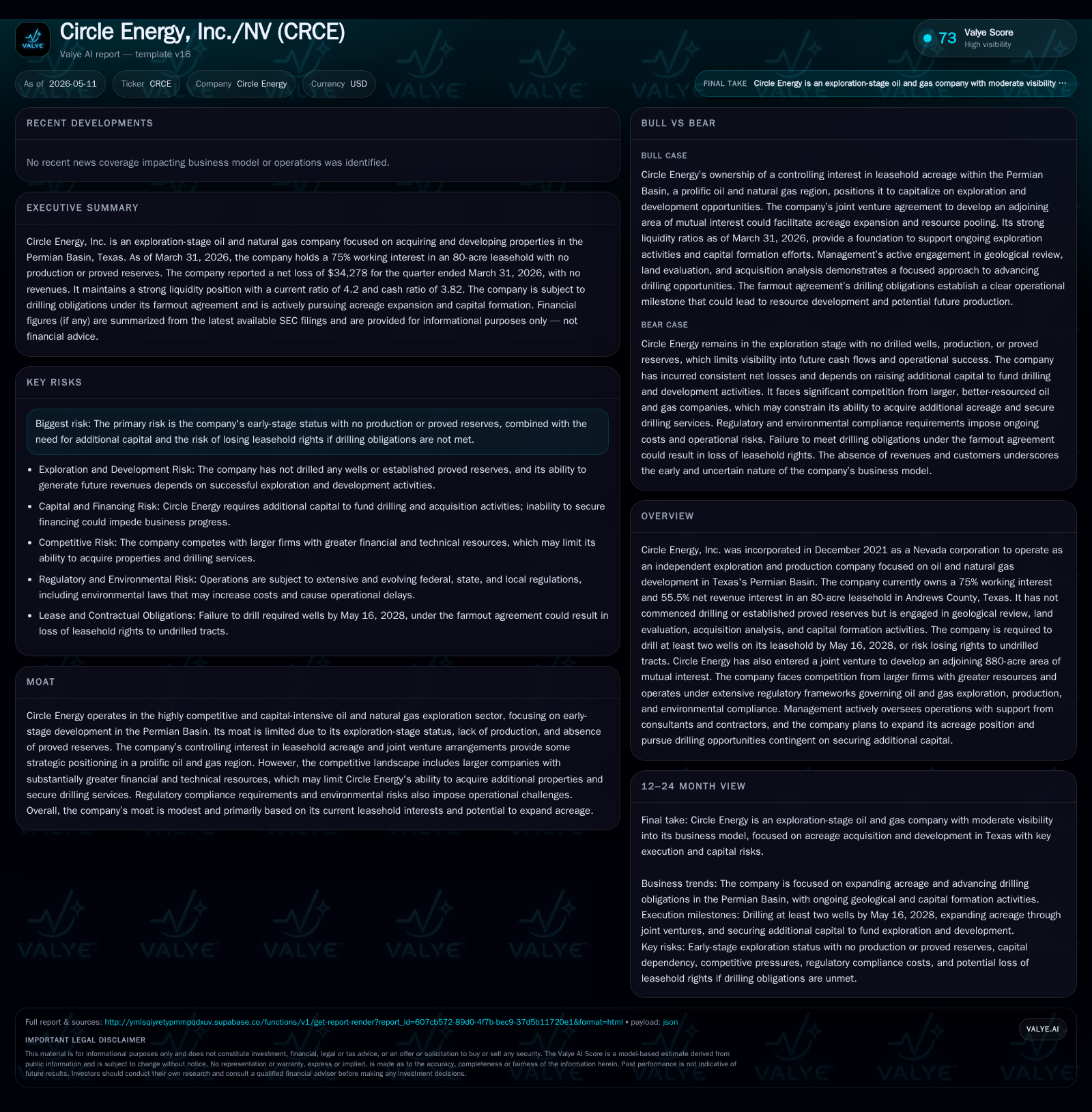
Circle Energy remains an exploration-stage company focused on consolidating leasehold interests in the Permian Basin, specifically in Andrews County, Texas. The latest quarterly filings reaffirm the company’s stable risk profile and ongoing efforts toward geological evaluation and capital formation, with no wells drilled yet but drilling obligations looming by mid-2028. Its competitive moat is modest, tethered mainly to its working interests and joint venture acreage expansion. Key near-term risks revolve around securing sufficient drilling capital and meeting contractual drilling deadlines to preserve lease rights.
Latest Quarterly Operating Update and Strategic Developments
Circle Energy’s latest Form 10-Q filed on May 11, 2026 [S2] reconfirms that the company remains firmly in its exploration stage with no material operational changes since the prior annual report. There have been no developments such as commencement of drilling activities or establishment of proved reserves. Management continues focused activities on geological assessments, leasehold evaluation, and capital formation efforts essential for initiating drilling programs. The risk factors disclosed remain consistent with those outlined in the annual report dated March 24, 2026 [S1], underscoring ongoing exposure primarily linked to early-stage status and funding needs.
A shareholder letter issued shortly after the latest annual report filing on March 25, 2026 [S3] highlights the company's ongoing review of potential strategic transactions. While no definitive agreements have been executed, these evaluations indicate management’s proactive approach toward partnerships or asset acquisitions that may enhance development capabilities or expand acreage positions.
Business Model: Exploration Focus and Leasehold Interests
Circle Energy operates under a classical early-stage upstream E&P model where value creation hinges on acquiring working interests in strategically located oil and gas leases followed by successful exploration programs. Currently, Circle owns a controlling 75% working interest — corresponding to a net revenue interest of approximately 55.5% — in an 80-acre leasehold located in Andrews County within the prolific Permian Basin [S1]. The company has not drilled any wells nor generated any revenue to date.
Revenue mechanics will ultimately depend on commencing production from viable wells once exploratory success is confirmed. Until then, operating costs primarily consist of legal, accounting, land acquisition expenses, and compliance costs related to public company status [S1]. A contractual farmout agreement obliges Circle to drill at least two wells (one on each designated 40-acre tract) by May 16, 2028, failing which undrilled lease tracts automatically revert to Aspen (the lessor). This creates a hard timeline-driven operational imperative for capital deployment.
Additionally, Circle has formed a joint venture with a third party to develop an adjoining approximately 880-acre area of mutual interest surrounding their current leasehold [S1]. This JV structure offers potential scale advantages if successful acquisitions are made within this larger contiguous acreage block.
Competitive Environment and Regulatory Landscape
Operating within the Permian Basin — a highly competitive oil-producing region — Circle Energy faces significant headwinds relative to well-capitalized peers who benefit from deeper technical expertise, better access to capital markets, extensive drilling infrastructure, and economies of scale [S1]. As a small public cap explorer lacking producing assets or proved reserves, Circle is vulnerable to competitive displacement during property acquisitions and may face challenges securing preferred service contracts for drilling operations.
The regulatory environment further complicates operations. Hydraulic fracturing practices essential for resource extraction in these formations are tightly regulated at state (Texas Railroad Commission) as well as federal levels [S1]. Regulatory shifts toward stricter greenhouse gas emissions controls and environmental compliance can impose additional operational costs and delays.
Growth Catalysts: Acreage Expansion and Joint Ventures
Expansion of Circle’s acreage footprint constitutes a primary growth lever. The company intends to build upon its existing direct ownership by acquiring additional mineral rights both within Andrews County and potentially in neighboring counties or regions within the Permian [S1]. The joint venture encompassing some 880 acres adjoining the original lease enhances this strategy by pooling resources with partners for more cost-effective land aggregation and eventual development.
The firm’s obligation under its farmout agreement to drill at least two wells by mid-2028 is itself a growth catalyst forcing near-term activity essential for moving from exploration into appraisal phases. Success here will unlock access to production revenues and increase valuation multiple consistency with peer-stage benchmarks.
Risks and Operational Constraints: Capital Needs and Lease Obligations
Foremost among risks is Circle’s reliance on obtaining substantial additional capital before undertaking costly drilling operations [S1]. The company currently operates with limited cash reserves ($108,675 as of Q1 end) [F1] insufficient to self-fund drilling programs possibly running into several hundred thousand dollars per well when considering well completion including hydraulic fracturing [S1]. Accessing external funding via equity issuance or industry farm-in partners introduces dilution risks or dependency on volatile capital markets.
Another critical risk is failure to meet the May 16, 2028 drilling deadline stipulated in its farmout agreement [S1]. Noncompliance would result in automatic forfeiture of undrilled tracts reverting back to Aspen Holdings, undermining asset base continuity.
Commodity price volatility presents another layer of risk impacting future project economics and willingness of outside investors or joint venture partners to fund operations at acceptable terms.
Regulatory risks stemming from environmental laws targeting emissions reductions or increased scrutiny on hydraulic fracturing could impose cost burdens that further tighten operational margins once production begins [S1].
Upcoming Milestones to Track
Key upcoming milestones imbue visibility into execution progress:
- Announcements surrounding additional capital raises or binding farm-in agreements that secure funding for initial well drills.
- Successful formal acquisition expansions within the joint venture’s ~880-acre area advancing acreage scale.
- Drilling initiation (spudding) of first exploratory well(s) ahead of the May 16, 2028 lease obligation deadline.
- Material outcomes from ongoing strategic transaction evaluations referenced in the recent shareholder letter [S3], such as asset purchases or partnering deals enabling broader operational capabilities. These will mark critical transitions from exploration-stage positioning toward active development phases vital for long-term viability.
2026 Q1 Financial Snapshot
Latest financial snapshot
| Metric | Value | Period |
|---|---|---|
| Cash & equivalents | $108675 | |
| 2026-03-31 | ||
| Current assets | $119434 | |
| 2026-03-31 | ||
| Current liabilities | $28449 | |
| 2026-03-31 | ||
| Current ratio | 4.2x | |
| 2026-03-31 |
Source: SEC companyfacts cache [F1].
The balance sheet evidences modest liquidity with approximately $109K cash supporting working capital comfortably covering short-term liabilities (current ratio ~4.2). However, absence of operating cash inflows or production revenue aligns with exploration phase status noted across recent filings [F1][S2][S3]. Operating expenses mainly comprise administrative overheads such as legal fees associated with acquisition evaluations and regulatory compliance reflective of a public entity context [S1][S2].
In conclusion, Circle Energy’s fundamental story remains rooted in early-stage exploration positioning within a prolific basin balanced against considerable challenges typical for micro-cap upstream companies. Success hinges on timely capital raises enabling required drilling commitments before contractual deadlines while navigating intense competition and evolving regulatory environments. Close attention should be paid to execution progress milestones evidencing movement beyond tenure preservation toward production commencement.
This analysis is intended solely for informational purposes based on SEC filings and publicly available data as of May 11, 2026. It does not constitute investment advice or recommendations regarding securities mentioned herein.
Disclaimer: This is research-only, informational analysis and not investment advice. It may include AI-generated interpretation and general industry context. Always verify important details using primary sources.

Comments