
Accendra Health's Strategic Shift and Financial Resilience Spotlight Home Healthcare Evolution
Recent capital structure actions and business segment realignments underscore Accendra Health’s evolving home healthcare focus amid liquidity constraints.
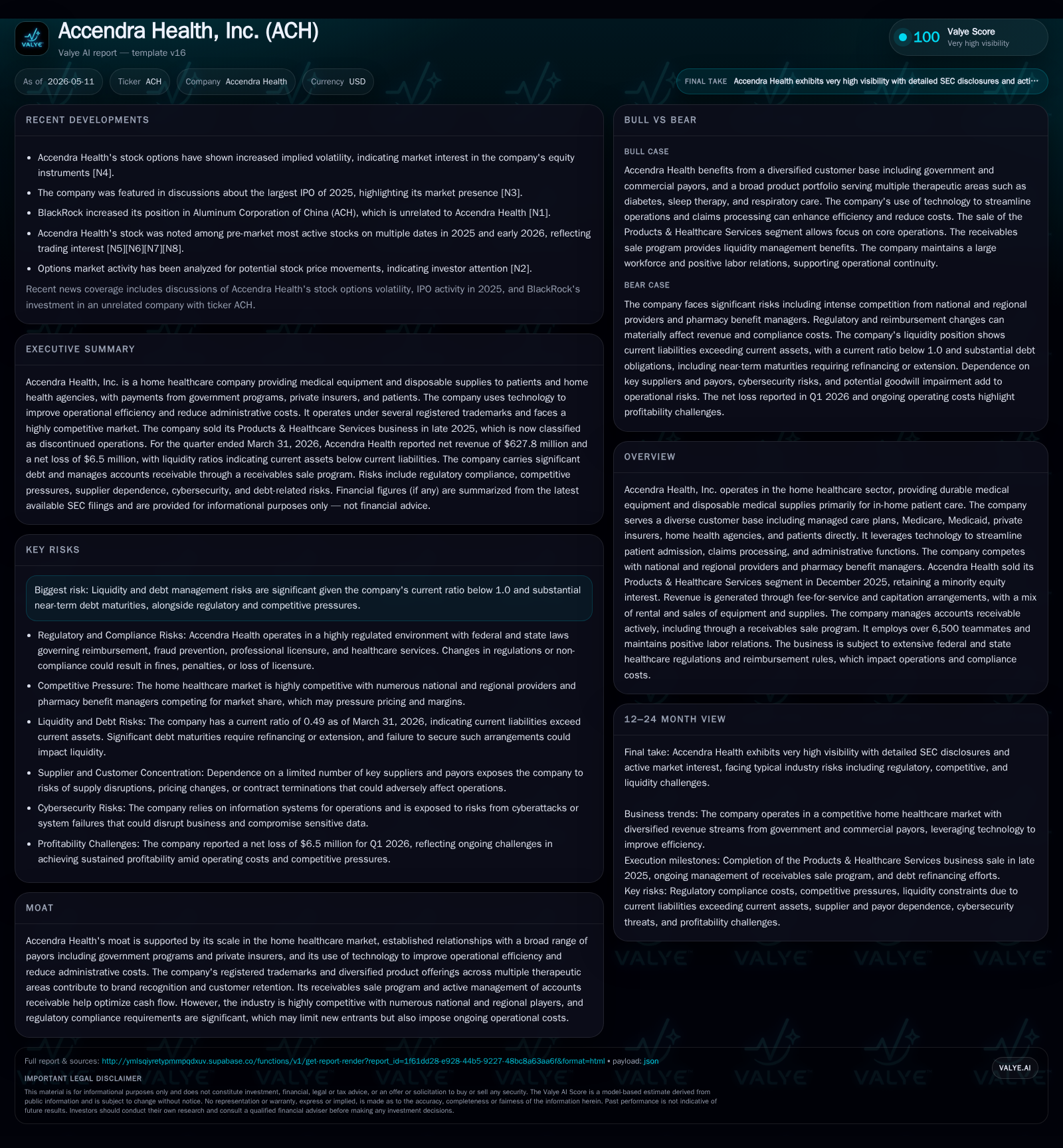
In Q1 2026, Accendra Health finalized its exit from the Products & Healthcare Services segment completed in late 2025, concentrating its operations on core home healthcare equipment and supply delivery. The company secured a waiver on mandatory prepayments of term loans, reflecting active debt management efforts against a backdrop of substantial leverage and a sub-1.0 current ratio. Accendra’s business model depends on durable medical equipment rentals and supplies supplied through both fee-for-service and capitation arrangements, leveraging technology to streamline administrative functions. Competitive positioning relies on scale, payer relationships, and efficient receivables management in a regulatory-intense environment. Key growth opportunities are linked to demographic trends and operational efficiencies, but leverage and liquidity risks remain significant near-term considerations.
Q1 2026 Operating Highlights: What Changed
Accendra Health’s first quarter of 2026 crystallizes its strategic shift post-divestiture of the Products & Healthcare Services (P&HS) business finalized as of December 31, 2025 [S2][S3]. The divestment for approximately $375 million cash allowed the company to streamline focus but retained a 5% minority equity interest in P&HS, reflecting ongoing albeit limited exposure [S2]. Concurrently, Accendra entered into a Commitment and Consent Letter with holders of its senior notes due in 2029 and 2030 that provides waivers for mandatory prepayments under its March 29, 2022 term loan credit agreement—a critical relief given the near-term debt profile [S3]. This move signals active engagement with creditors to maintain liquidity flexibility amid heavy refinancing demands.
Operationally, activities in Q1 emphasized cash flow management against a challenging liquidity backdrop. With cash barely covering a fraction of liabilities ($337 million cash vs $1.2 billion current liabilities), the company manages working capital tightly [F1]. The waiver prevents forced deleveraging that could imperil continuity during refinancing or volatile reimbursement cycles.
Business Model and Product Suite: Durable Medical Equipment Meets Tech Integration
At its core, Accendra Health operates an integrated home healthcare platform supplying durable medical equipment (DME) such as home respiratory therapy devices—including oxygen concentrators and non-invasive ventilators—and disposable medical products like wound care dressings and urology supplies primarily for at-home use [S1]. Revenue streams bifurcate between fee-for-service models where payors reimburse based on utilization plus pricing schedules, and capitation agreements offering fixed per-member-per-month payments that provide revenue predictability but demand cost control [S1].
The company serves an extensive patient base facilitated by contracts with managed care plans, Medicare/Medicaid programs accounting for roughly one-fifth of revenue, various private insurers, home health agencies acting as intermediaries, plus direct patient sales [S1]. To optimize scale benefits over its approximately 6,500 teammates [S1], Accendra leverages technology platforms to automate patient onboarding—with physician-prescribed care plans—simplify claims submissions essential in reimbursement-heavy workflows and reduce overhead via digital administration. This sets a low-cost operating foundation attractive in a margin-pressured industry.
Competitive Positioning in Home Healthcare Services
The home healthcare sector remains extremely competitive with numerous national providers competing alongside regional suppliers and pharmacy benefit managers (PBMs), each vying for payor contracts and fragmented patient volumes. Accendra’s competitive edge lies in its operational scale providing negotiating leverage with large government programs and commercial insurers; further supported by registered trademarks enhancing brand authority across therapeutic areas including sleep therapy devices (CPAP/BiPAP), diabetes management supplies, ostomy products, etc..
Regulatory complexity acts as both gatekeeper for new entrants—due to licensure requirements—and cost burden for incumbents required to comply with federal fraud-and-abuse frameworks such as the Anti-Kickback statute prohibiting remuneration for referrals or orders directly impacting Medicare/Medicaid billings [S5]. Additional oversight under the Stark Law restricts physician self-referrals when financial interests exist in designated health services providers adding compliance layers [S15][S17]. These factors elevate operational rigor but also entrench larger players able to absorb sophisticated compliance costs.
Cash flow optimization through active accounts receivable management including receivables sale programs provides balance sheet agility uncommon among smaller peers operating often at razor-thin margins. This financial engineering partially mitigates working capital stresses endemic in billing cycles dominated by government reimbursements governed by complex coding standards.
Growth Catalysts: Demand Drivers and Efficiency Initiatives
Structurally rising demand underpins growth prospects as demographics skew older with chronic disease prevalence increasing concomitant need for home-based therapies versus institutional care settings—an efficient value proposition aligned with payor cost containment incentives. Expansion opportunities exist in broadening product categories beyond respiratory therapy into diabetes management innovations or advanced wound care technologies supporting healing at home.
Operationally, improving net revenue realization through technology upgrades enhancing claims accuracy, reducing denials or accelerating collections forms an immediate catalyst. Capitation agreements present upside if coupled with disciplined cost control enabling margin expansion over time [N1]. Successfully scaling these contracts can stabilize revenues amid fluctuating fee-for-service reimbursements. Key performance indicators such as accounts receivable turnover rates or uptake metrics on new IT platform deployments will be leading signals of progress.
Key Risks: Debt Burden, Liquidity Constraints, Regulatory Compliance
From an operational risk perspective compliance with intensive federal regulations governing billing practices represents an ongoing concentration risk. Past sector-wide enforcement actions emphasize costly settlements possible under the False Claims Act administered by DOJ/OIG alike warranting conservatism regarding internal controls [S15][S16][S17]. Competitive pressures also persist from large-scale consolidated payors exerting pricing discipline constraining revenue growth potential.
Upcoming Milestones and Market Watchpoints
Market participants should watch upcoming quarterly earnings releases for indications that margin stabilization strategies are effective including improved reimbursement realization or administrative cost containment trends disclosed explicitly. Progress reports on rolling out expanded receivable sale initiatives will be pivotal in assessing near-term liquidity improvements [S2].
Continued adoption rates of information technology initiatives—from claims adjudication automation to customer portal enhancements—serve as intermediate KPIs foreshadowing longer-term efficiency gains.[N1]
Latest Financial Snapshot and Capital Structure Overview
Latest financial snapshot
| Metric | Value | Period |
|---|---|---|
| Cash & equivalents | $337mm | |
| 2026-03-31 | ||
| Total debt | $1522mm | |
| 2026-03-31 | ||
| Net debt | $1185mm | |
| 2026-03-31 | ||
| Current assets | $589mm | |
| 2026-03-31 | ||
| Current liabilities | $1203mm | |
| 2026-03-31 | ||
| Current ratio | 0.49x | |
| 2026-03-31 |
Source: SEC companyfacts cache [F1].
| Metric | $ Mil. (or ratio) |
|---|---|
| Cash & Equivalents | $337M |
| Total Debt | $1,522M |
| Net Debt | $1,185M |
| Current Assets | $589M |
| Current Liabilities | $1,203M |
| Current Ratio | 0.49 |
As reported at March 31, 2026 Q1 quarter-end figures show Accendra confronting substantial leverage challenges juxtaposed against modest liquid reserves indicative of tight working capital conditions yet typical in capital-intensive home health segments reliant on staggered payor reimbursements [F1][S2][S3]. The outstanding senior unsecured notes from both March 2021 ($479 million principal outstanding at 4.5% coupon) and March 2022 ($600 million at 6.625%) compose material components of interest-bearing obligations underpinning debt service costs reported [S2][S3]. Continued strategic engagement with noteholders evidenced by waiver agreements reveals prioritization of maintaining operational runway while exploring longer term deleveraging pathways.
This analysis synthesizes publicly filed SEC quarterly (10-Q) and event (8-K) disclosures along with annual filing context augmented by proprietary sector insight to outline Accendra Health’s evolving strategic posture amidst operational streamlining after divestitures coupled with aggressive debt load management within U.S. home healthcare markets marked by intense competition and regulatory oversight. Market participants should weigh structural long-term demand advantages against pressing liquidity constraints moderated by incremental operational efficiency advancements.
Disclaimer: This document is for informational purposes only and does not constitute investment advice or solicitation.
Disclaimer: This is research-only, informational analysis and not investment advice. It may include AI-generated interpretation and general industry context. Always verify important details using primary sources.

Comments