
Hills Bancorporation’s Localized Real Estate Lending and Wealth Management Drive Steady Growth
Q1 2026 results reinforce Hills Bancorporation's regional banking strength, driven by real estate loans and diversified fee income.
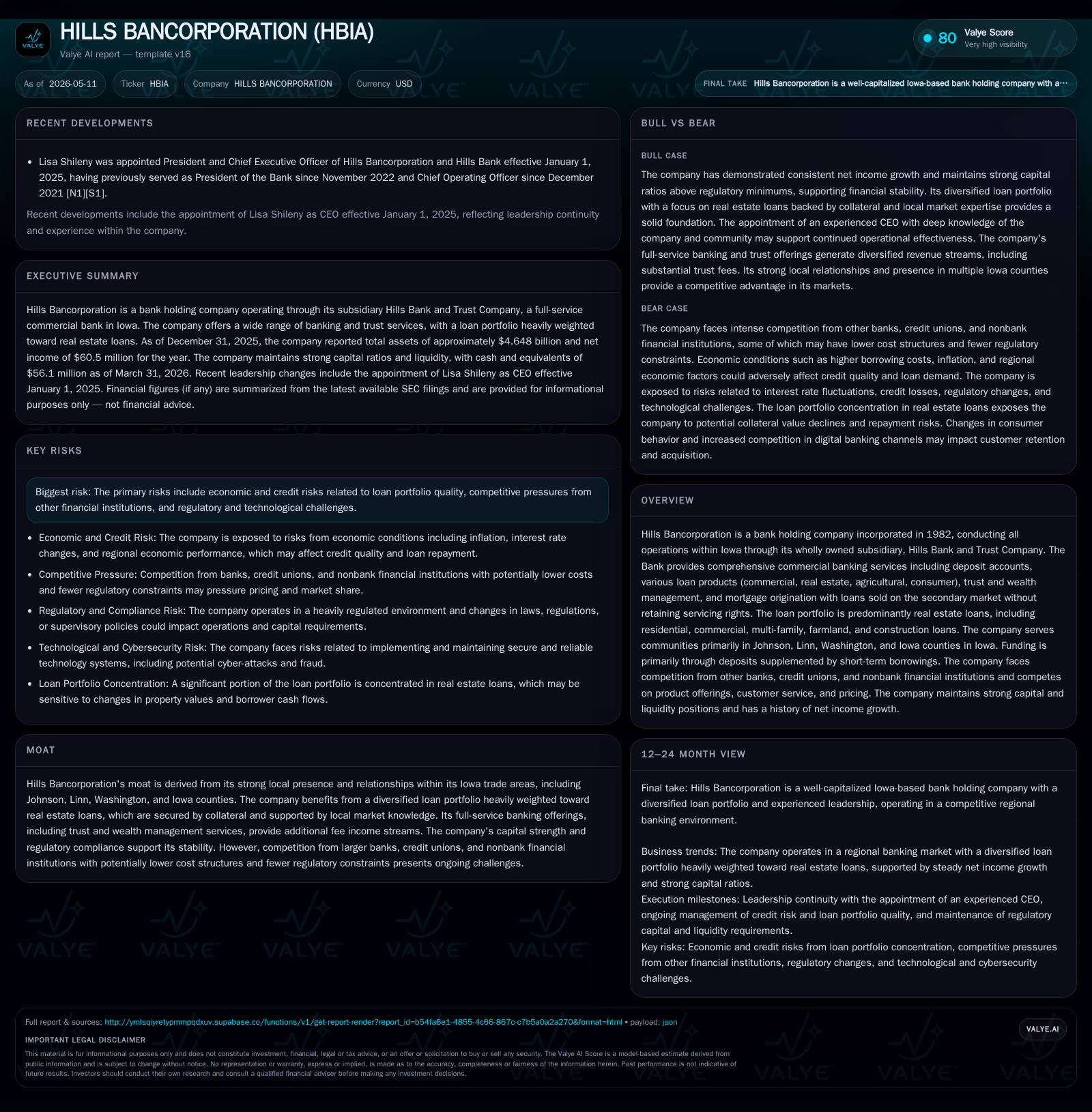
Hills Bancorporation reported solid first-quarter 2026 earnings underpinned by continued loan growth, especially in real estate segments, and expanding trust assets under management. The company benefits from a deep local presence in Iowa which supports a diversified commercial and residential loan portfolio alongside wealth management services. While competitive pressures and credit risks linked to elevated interest rates remain watchpoints, Hills Bank’s full-service offering and capital strength provide resilience within its market niche. Management recently announced a two-for-one stock split signaling confidence in sustained shareholder value creation.
Recent Operating Update
The latest quarterly filing for Q1 2026 positions Hills Bancorporation solidly within its regional banking niche [S2]. The company reported unaudited net income of $21.9 million for the quarter ended March 31, 2026 [S20], maintaining its trajectory from full-year 2025 when it posted $60.5 million in net income [F1]. This performance underscores Hills Bancorporation’s steady profitability amid a challenging banking environment marked by inflationary pressures and shifting Federal Reserve policies.
A noteworthy recent announcement is the Board’s approval of a two-for-one stock split set for June 8, 2026 [S3]. This move aims to enhance stock liquidity and signifies management’s confidence in the company's sustained strength and growth prospects.
Business Model Overview
Hills Bancorporation operates exclusively through its wholly owned subsidiary, Hills Bank and Trust Company, serving communities primarily in Johnson, Linn, Washington, and Iowa counties in Iowa [S1]. As a full-service commercial bank, its revenue streams derive predominantly from:
- Loan Interest Income: A concentrated loan portfolio (over 86% real estate) that includes residential, commercial, multi-family, farmland, construction loans as well as commercial and agricultural lending.
- Deposit Services: Attracting retail and business deposits which constitute the major funding source.
- Fee Income: Generated through trust fees and wealth management services with assets under management reaching $3.3 billion at end-2025 — a key contributor to noninterest income growth [S1]. The bank also originates mortgages sold on the secondary market without retaining servicing rights.
Revenue dynamics are driven mainly by loan volume growth, interest rate trends influencing net interest margin (which improved from 2.78% in 2024 to 3.45% in 2025), and asset management fees tied to AUM increases [S25]. The company balances deposit inflows with short-term borrowings prominently from Federal Home Loan Bank advances to optimize funding costs [S5].
Industry Structure and Competitive Position
Operating exclusively within Iowa grants Hills Bancorporation a focused geographic footprint that allows for strong local relationships — its moat is centered on deep community ties that foster customer loyalty among individuals and businesses [S1]. This concentration enables the bank to leverage superior local market knowledge for underwriting real estate loans secured by tangible collateral.
However, this narrow footprint exposes the company to localized economic fluctuations tied to real estate markets and agricultural sectors dominant in Iowa [S16]. The competitive landscape includes larger regional banks with broader product suites and scale advantages as well as nonbank financial firms competing on pricing or alternative delivery channels. Credit unions also exert pressure given their often lower-cost deposit structures.
Despite these headwinds, Hills’ diversified loan-book mix combined with trust services (which produce relatively stable fee income less sensitive to interest rate cycles) creates structural resilience. Its regulatory capital above well-capitalized thresholds supports operational flexibility.
Growth Drivers
Loan Portfolio Expansion with Real Estate Focus
Residential mortgage lending remains a key engine of growth with $1.4 billion outstanding at end-2025 representing nearly 40% of loans held for investment [S1]. Increases in permanent financing on completed construction projects boosted commercial mortgage balances [S12]. Agricultural lending continues to form a niche segment albeit smaller relative to real estate exposure.
The bank’s disciplined underwriting practices aided an increase of $119 million in net loans during 2025; notably an expanded issuance of first-mortgage residential loans alongside selective commercial credits offsets contraction in construction lending as projects transition to permanent financing [S12][S19].
Wealth Management Fee Growth
Trust fee income rose more than 12% year-over-year driven by an increase of nearly $400 million in assets under management during 2025 to $3.3 billion [S1][S25]. This fee line supplements core interest revenues providing recurring annuity-style cash flow less susceptible to credit cycles.
Capital Return Enhancements
The recent stock split signals intent to improve share affordability and broaden shareholder engagement which can support future capital flexibility for organic growth or acquisitions [S3]. Dividend payouts have consistently grown aligned with earnings expansion evidencing prudent capital deployment [S6].
Risks and Watchpoints
Credit Quality Sensitivities
The heavy concentration toward real estate loans introduces risks aligned with property valuation fluctuations localized within Iowa counties served [S18]. Elevated inflationary pressures despite moderation threaten borrower repayment capacity given cyclical costs impacting household budgets noted during 2025 analysis [S16]. Construction loans carry heightened risk due to estimation uncertainties on project completion costs versus collateral values [S18].
While nonperforming loans declined modestly recently indicating effective credit oversight [S26], the company acknowledges potential volatility related to economic shifts or adverse borrower conditions that may impact future provision requirements.
Funding Stability Concerns
Approximately 22% of deposits being uninsured exposes vulnerability during episodes of financial stress as these depositors tend to be more sensitive to bank performance perceptions leading to potential rapid withdrawals [S11]. Competition from less regulated institutions further pressures deposit retention strategies.
Competitive Intensity & Technology Adaptation
Larger banks able to leverage scale economies could undercut pricing or innovate faster on digital platforms challenging client acquisition/retention [S16]. Hills Bancorporation recognizes technology investments as integral for operational security against cyber threats and fraud while striving to maintain user-friendly digital banking options consistent with evolving client expectations.
What To Watch Next
- Q2 Earnings Release: Monitoring whether loan growth momentum persists amid evolving interest rate policy.
- Deposit Composition Trends: Changes in uninsured versus insured deposit balances offering insight into funding risk appetite.
- Asset Quality Metrics: Updates on allowance for credit losses reflecting economic outlook adjustments.
- Trust & Wealth Assets: AUM trends indicating sustainability of fee income growth.
- Potential M&A Activity: While no recent acquisitions have occurred since early 2000s, any strategic moves would signal growth ambitions beyond organic expansion.
- Regulatory Developments: Impact of any state or federal changes affecting capital requirements or banking operations within the community bank context.
- Implementation progress on technology enhancements identified as key operational priorities.
Financial Profile Summary
Latest financial snapshot
| Metric | Value | Period |
|---|---|---|
| Cash & equivalents | $56mm | |
| 2026-03-31 | ||
| Total debt | $380mm | |
| 2026-03-31 | ||
| Net debt | $324mm | |
| 2026-03-31 |
Source: SEC companyfacts cache [F1].
Using latest available metrics [F1] consolidated balance sheet data as of March 31, 2026 shows:
| Metric | Value (USD) | Period Ended |
|---|---|---|
| Net Income | $60.50 million* | Dec 31, 2025† |
| Cash & Equivalents | $56.08 million | Mar 31, 2026 |
| Total Debt | $380.19 million | Mar 31, 2026 |
| Approximate Net Debt‡ | $324.11 million | Mar 31, 2026 |
| *Annual figure; †From annual filing; ‡Total debt minus cash & equivalents [F1] |
This analysis is intended solely for informational purposes grounded on verified SEC filings through Q1 2026 without offering investment advice or recommendations.
Disclaimer: This is research-only, informational analysis and not investment advice. It may include AI-generated interpretation and general industry context. Always verify important details using primary sources.

Comments