
Liquidmetal Technologies Advances Manufacturing but Commercial Scale Challenges Persist
Latest quarterly filing reveals progress in joint venture manufacturing and sustained operational losses as commercialization hurdles continue.
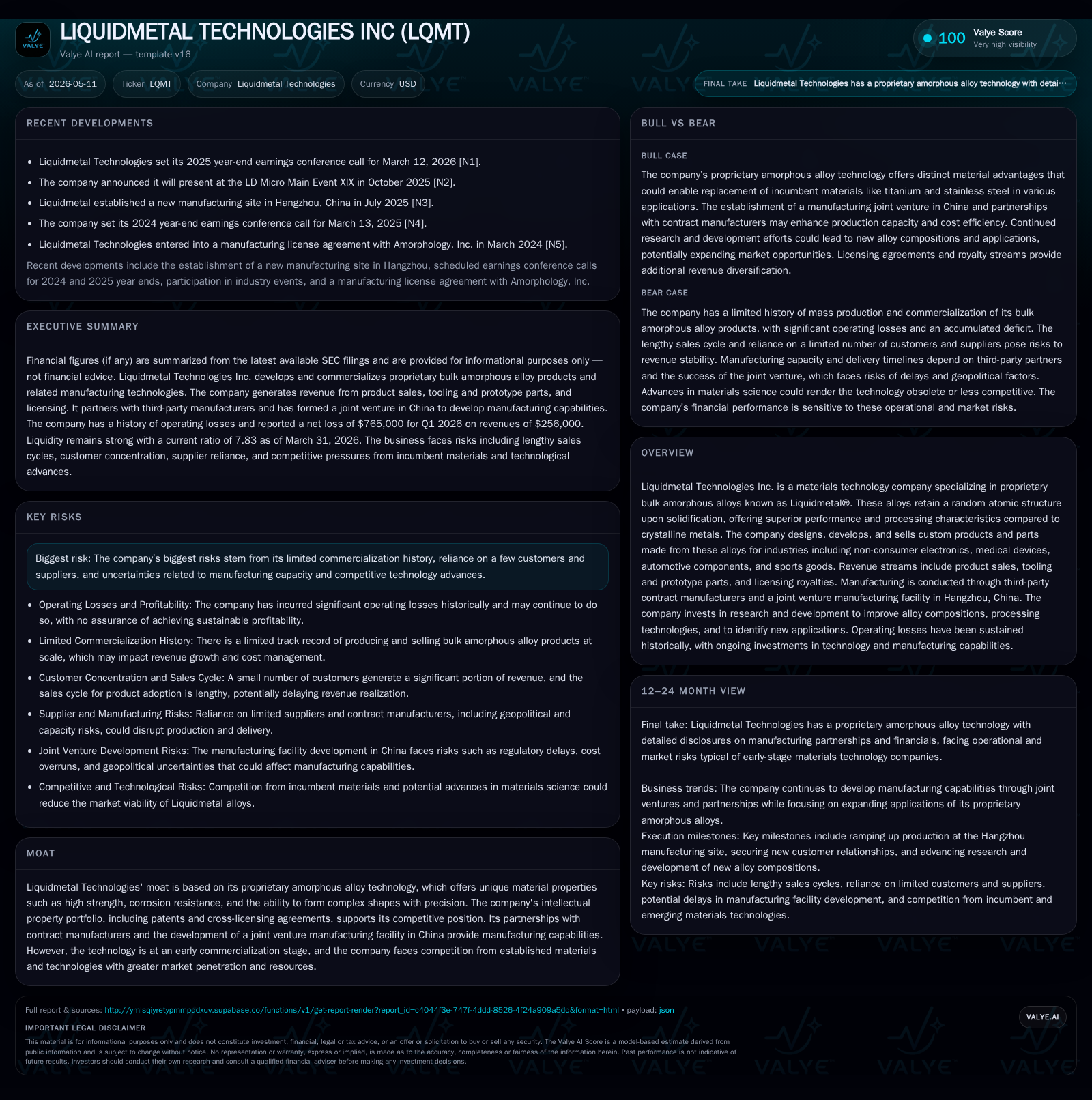
In its 10-Q filing for Q1 2026, Liquidmetal Technologies reported steady progress on its Hangzhou joint venture manufacturing facility, approaching full operational capability within the year. Despite these advancements, commercial production volumes remain limited, contributing to ongoing operating losses driven by elevated R&D and administrative expenses. The company's proprietary bulk amorphous alloys offer unique material properties attractive across several industries, but commercialization remains nascent with long sales lead times and supply chain concentration risks. Going forward, growth hinges on scaled manufacturing ramp-up, licensing deal expansions, and overcoming geopolitical and regulatory uncertainties tied to Chinese operations.
Latest Quarterly Operating Developments
Liquidmetal Technologies’ Q1 2026 10-Q (filed May 8) details continued progress with its joint venture (JV) manufacturing facility in Hangzhou, China. The company expects full manufacturing capabilities at this site within the calendar year but noted that commercial-scale product shipments from the JV remain limited at this stage [S2]. Q1 revenue declined marginally to approximately $256,000 compared to prior periods due mainly to fluctuations in recurring customer orders and medical device demand [S16]. Gross margins held steady around 30%, reflective of low volume commercial output through third-party contract manufacturers. However, operating expenses rose sharply by $237,000 versus the prior-year quarter to $1.21 million as the company incurred increased payroll costs and invested further capital into the factory build-out [S16]. Research and development (R&D) spending remained modest but stable at around $3,000 for the quarter.
The company reported a net loss attributable to shareholders approaching $765,000 for Q1 2026 compared to $568,000 a year prior [S16]. Management emphasized that long sales lead times for new customer adoption continue to suppress revenues while operational cash burn is sustained by ongoing investments in technology infrastructure and production capacity expansion [S2]. Notably, inventory was zeroed by quarter-end as all parts were shipped out before March 31 [S16]. Cash used in operating activities remained below $250,000 for the quarter.
Business Model and Product Offering Analysis
Liquidmetal Technologies specializes in proprietary bulk amorphous alloys—Metallic glasses—that retain a random atomic structure upon solidification rather than forming a crystalline lattice. This atomic disorder grants Liquidmetal alloys exceptional strength, hardness, corrosion resistance, high elastic limits, non-magnetic properties, and an ability to be molded into complex shapes with precision comparable to injection-molded plastics [S2][S1]. These attributes enable broader design freedom relative to titanium or stainless steel alloys by combining mechanical performance with cost-effective molding processes.
The company’s revenue model includes three main streams: (i) sales of custom parts made from these amorphous alloys targeting industries such as non-consumer electronics (e.g., rugged components), medical devices requiring biocompatibility and precision molding, automotive parts valuing strength-to-weight ratios, and sports goods; (ii) tooling and prototype part sales supporting customers in product development phases; and (iii) royalties derived from licensing its patented alloy compositions and manufacturing technologies [S1][S2].
Manufacturing is outsourced predominantly to third-party contract manufacturers with the building of a co-owned JV factory in Hangzhou as a strategic effort to internalize some fabrication capacity. However, given the early commercialization phase and precise custom specifications involved per order, production volumes remain limited with considerable variability around lead times [S1].
Competitive Position and Industry Structure
Liquidmetal operates within a niche of advanced materials technology focused on bulk amorphous metal alloys. While traditional competitors exist indirectly—such as titanium or stainless steel producers—the unique material properties it offers carve out a defensible position albeit in an embryonic market segment [S1][S7]. Its intellectual property portfolio comprising patents on alloy formulas and processing techniques forms a substantial barrier to entry alongside cross-licensing arrangements.
The industry's supplier landscape exerts concentrated risk: all key alloying, mold making, and component manufacturing currently flows through one primary Chinese supplier or JV partner. This reliance exposes Liquidmetal's supply chain to geopolitical tensions exacerbated by tightened U.S.-China trade restrictions that have recently intensified tariff uncertainties impacting raw materials sourcing and finished part costs [S7]. Regulatory scrutiny related to foreign investment in China also poses potential delays or disruption risks for the JV plant’s permit acquisitions [S1][S7].
Customer switching costs are present but moderate due to the specialized nature of Liquidmetal’s materials; however, long lead times for qualification dampen rapid adoption velocity.
Key Growth Drivers and Market Opportunities
The path toward scaling revenues depends primarily on bringing the Hangzhou JV manufacturing facility fully online to ramp production volumes beyond prototype status—addressing current capacity constraints imposed by reliance on external contract manufacturers [S2]. Achieving routine commercial product shipments would enable steadier revenue recognition with improving gross margins expected as volume normalizes.
Licensing deals represent another growth vector through royalty income without concomitant capital expenditures. Ongoing R&D efforts targeting novel alloy formulations or enhancements may unlock applications previously inaccessible with traditional crystalline metals—potentially expanding addressable markets across medical implants requiring precision combined with biocompatibility or automotive lightweight structural components.
Elevated end-use diversification—from ruggedized industrial electronics parts to sports equipment—provides optionality should specific vertical demand cycles fluctuate.
Risks and Operational Constraints
Significant risk resides in Liquidmetal’s limited track record commercializing these alloys at scale despite decades of patented technology existence [S1][S7]. Customer adoption cycles are lengthy given technical validation requirements leading to slow revenue ramp-ups. This extends negative operating cash flows which pressure liquidity over time.
Supplier concentration presents operational fragility: dependence on one China-based manufacturer exposes vulnerability amidst international trade tensions including tariffs or sanctions affecting supply continuity or cost structures [S7]. Regulatory hurdles delaying the JV plant’s permit approvals create execution uncertainty on capacity timelines.
Capital resources must be carefully managed as ongoing operating losses require recurrent funding rounds absent near-term profitability prospects. Moreover, competition from incumbent metals providers leveraging entrenched supply chains or newly developed amorphous alloys could erode nascent market share unless Liquidmetal accelerates commercialization pace [S1][S7].
Upcoming Milestones and What to Monitor
Key developments will revolve around tangible evidence that the Hangzhou joint venture attains full manufacturing operational capability as forecasted within calendar year 2026 [S2]. Metrics such as increasing shipment volumes of standard commercial parts beyond tooling or prototypes will signal advancing market acceptance.
Announcements related to expanded licensing partnerships or royalty contracts would mark diversification away from direct product sales towards recurring revenue streams. Additionally, any updated management guidance regarding production capacity utilization rates or revised timelines linked to regulatory permits should be watched closely.
Capital sufficiency amidst growing operational expenditures will remain under scrutiny; hence disclosures about upcoming financing activities or cash burn trends bear relevance.
Current Financial Profile and Liquidity
Latest financial snapshot
| Metric | Value | Period |
|---|---|---|
| Cash & equivalents | $7mm | |
| 2026-03-31 | ||
| Current assets | $14mm | |
| 2026-03-31 | ||
| Current liabilities | $1821000 | |
| 2026-03-31 | ||
| Current ratio | 7.83x | |
| 2026-03-31 |
Source: SEC companyfacts cache [F1].
As of March 31, 2026 Liquidmetal Technologies reported $7.4 million in cash and equivalents alongside roughly $11.8 million invested in debt securities totaling available liquidity around $19.2 million [F1][S4]. Current assets stood near $14.3 million against current liabilities of approximately $1.82 million yielding a robust current ratio of about 7.83 [F1], affirming short-term solvency without distress.
Despite cash reserves appearing adequate for the foreseeable future under prevailing operating loss assumptions (~$0.77 million net loss quarterly), sustaining operations heavily depends on successful commercialization traction reducing net burn over time [S2][F1]. The total debt figure reported stems from older filings with no recent increment disclosed; net debt is effectively negative when considering cash balances [F1].
Disclaimer: This analysis is based solely on publicly available filings as of May 2026 and does not constitute investment advice or recommendations regarding securities of Liquidmetal Technologies Inc.
Disclaimer: This is research-only, informational analysis and not investment advice. It may include AI-generated interpretation and general industry context. Always verify important details using primary sources.

Comments