
MAIA Biotechnology Advances Telomere-Targeted Immunotherapy with Phase 3 Initiation and U.S. Trial Expansion
MAIA Biotechnology reports key clinical progress in NSCLC trials and strengthens collaboration frameworks amid operational and financial challenges.
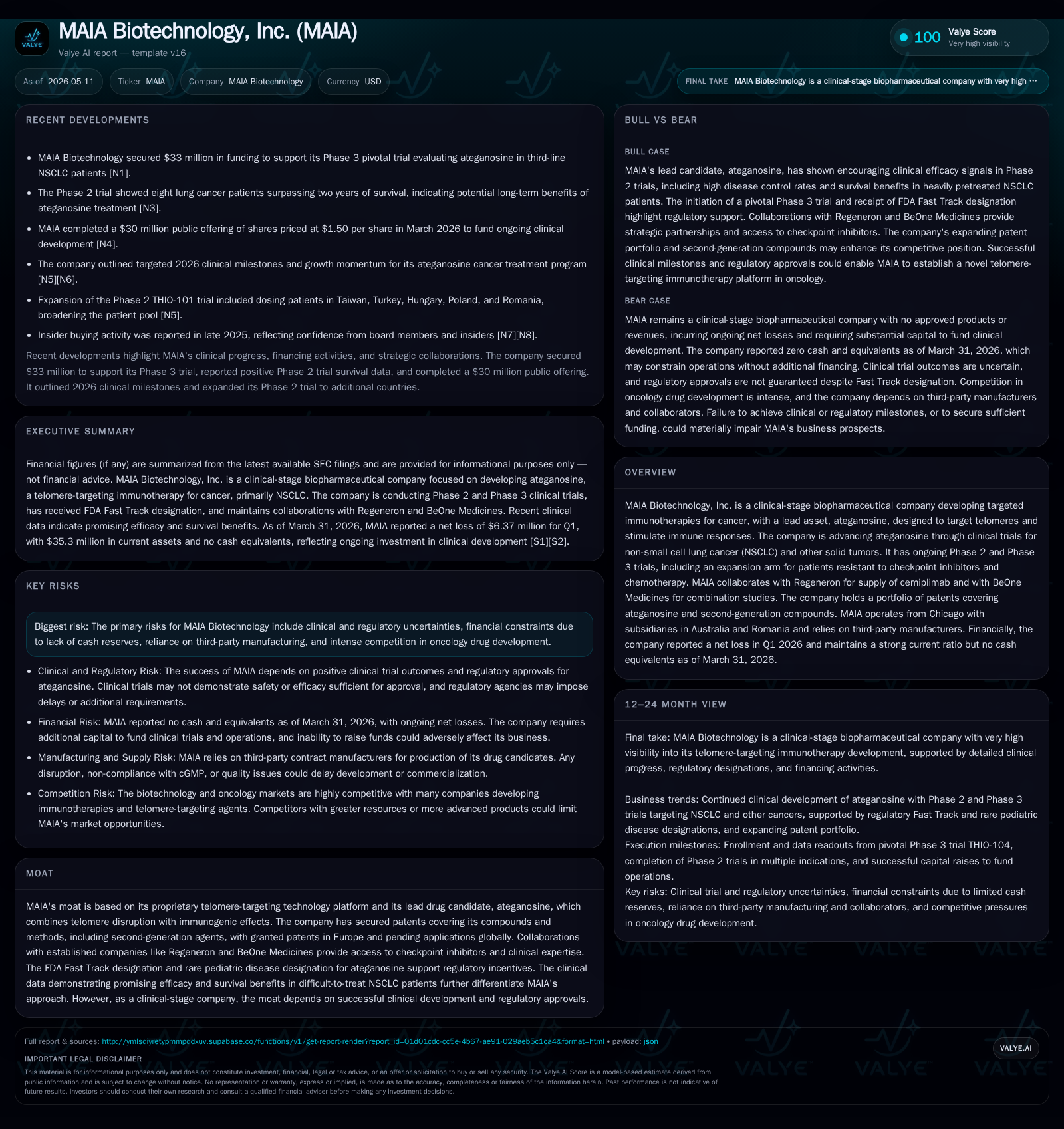
In its latest 10-Q filing, MAIA Biotechnology disclosed significant milestones including the activation of its first U.S. clinical site for the Phase 2 expansion trial assessing ateganosine in advanced non-small cell lung cancer (NSCLC). The company secured $33 million in financing to support its ongoing pivotal Phase 3 trial (THIO-104) targeting chemo- and checkpoint inhibitor-resistant NSCLC patients. MAIA’s business model centers on ateganosine — a novel telomere-targeted immunotherapy — augmented by collaborations with Regeneron and BeOne Medicines. While the clinical pipeline shows promise, operational execution, funding sustainability, and competition from established oncology therapies remain critical risk vectors to monitor.
Latest Quarterly Update: Clinical and Operational Progress in Q1 2026
MAIA Biotechnology’s May 11, 2026, 10-Q filing reveals continued clinical momentum anchored by the activation of its first U.S. clinical trial site for the Phase 2 expansion study of ateganosine in advanced non-small cell lung cancer (NSCLC) [S2][S3]. This milestone broadens patient enrollment capabilities beyond prior European locations, enhancing patient diversity and access to the more substantial U.S. oncology trial infrastructure. The expansion arm targets third-line NSCLC patients resistant to checkpoint inhibitors and chemotherapy—an area of high unmet medical need.
Funding catalysts underpinning this progression include a $33 million capital raise announced in early April dedicated to supporting the ongoing pivotal Phase 3 THIO-104 trial initiated in 2025, which compares ateganosine plus a checkpoint inhibitor versus chemotherapy in a randomized setting of up to 300 patients [N1][S2]. These developments set the stage for anticipated filings seeking accelerated FDA approval in this refractory NSCLC population later in 2026 contingent on positive trial outcomes.
Additionally, MAIA pursues expanded oncology indications through upcoming Phase 2 trials focused on hepatocellular carcinoma (HCC), colorectal cancer (CRC), and small cell lung cancer (SCLC) using combination regimens with BeOne Medicines’ immune checkpoint inhibitor tislelizumab. This multipartite approach evidences strategic portfolio diversification intending to broaden clinical applicability beyond lung cancer [S1][S3].
MAIA’s Business Model: Telomere-Targeting Immunotherapy Asset Focus
MAIA operates as a clinical-stage biopharmaceutical company specializing in targeted immunotherapies for solid tumors centering on its lead compound ateganosine (also referenced as THIO or 6-thio-dG) [S1]. Ateganosine’s novel mechanism involves incorporation into telomeres—structures essential for chromosomal integrity—inducing telomere dysfunction that triggers selective tumor cell death while simultaneously enhancing anti-tumor immune responses. This dual mechanism represents a distinctive therapeutic angle relative to conventional chemotherapy and immunotherapy agents.
Crucially, ateganosine is administered sequentially with Regeneron’s PD-1 immune checkpoint inhibitor cemiplimab (Libtayo®), which MAIA receives under a no-cost supply agreement established since February 2021. In exchange, Regeneron holds exclusive development rights for combinations involving PD-1 inhibitors within NSCLC during the study periods, significantly reducing MAIA's procurement costs for this costly drug while enabling streamlined combinatorial therapy protocols [S1][S17].
Manufacturing responsibilities are outsourced entirely to third parties compliant with FDA cGMP requirements—a common strategy for biotechnology firms lacking internal production facilities—but this reliance introduces external quality control dependencies that may impact timelines or scale-up post-approval [S12]. Intellectual property protections include granted patents across European jurisdictions as well as pending applications globally covering first-generation ateganosine compounds along with newer second-generation agents enhancing their technological moat [S1].
Industry Context and Competitive Positioning in Targeted Oncologic Therapies
Within oncology drug development, especially targeting heavily pretreated NSCLC populations refractory to checkpoint inhibitors and chemotherapy, competition is intense from both established pharma incumbents and emerging biotech innovators exploring various mechanisms including targeted molecular therapies, bispecific antibodies, CAR-T cells, and novel immune modulators.
MAIA's focus on telomere-targeting represents one of few approaches attempting to disrupt fundamental tumor biology while harnessing immune stimulation synergistically—a potential point of differentiation over single modality drugs. FDA Fast Track designation coupled with rare pediatric disease status granted for ateganosine underscores regulatory acknowledgement of both novelty and urgent unmet needs inherent in these indications [S1]. However, reliance on external manufacturers constrains rapid scalability relative to vertically integrated competitors.
The company's mainstay NSCLC franchise also faces competitive pressure from multiple approved CPIs beyond cemiplimab alone—including pembrolizumab and nivolumab—and evolving treatment standards incorporating chemoimmunotherapy combinations or targeted agents depending on molecular profiling. Success hinges not only on robust efficacy signals but clear safety differentiation given many treatment-experienced patients' fragile health status.
Growth Prospects: Clinical Trial Expansion, Regulatory Milestones, and Collaborations
MAIA’s near-term growth trajectory is linked predominantly to successful execution of pivotal clinical trials alongside strategic collaborations amplifying therapeutic breadth. The activation of its first U.S.-based trial site widens recruitment reach vital for achieving enrollment thresholds in timely fashion within THIO-101's expansion cohort evaluating chemo-/CPI-resistant NSCLC subgroups [S3][S14].
Multiple Phase 2 programs planned with BeOne Medicines target additional solid tumor types—HCC, CRC, SCLC—each designed as single-arm trials combining ateganosine with tislelizumab supplied by BeOne Medicines under collaborative arrangements that preserve MAIA’s global rights outside these partnerships [S1][S17]. Success across these lines could materially expand market opportunity beyond NSCLC.
Key upcoming regulatory catalysts focus on submitting an accelerated approval application leveraging compelling survival data from early Phase 2 analyses showing median overall survival exceeding two years among some lung cancer patients treated with the combination sequence—a result substantially surpassing historical benchmarks (~5.8 months OS) for late-line NSCLC cohorts [N3][S15][S18]. Positive interim or final data releases from THIO-104 Phase 3 will also constitute major inflection points impacting future valuation narratives.
Risks and Constraints: Clinical, Financial, and Market Challenges
Despite promising scientific rationale and initial clinical data, MAIA confronts multifaceted risk factors intrinsic to late-stage biotechnology ventures [S12]. Clinical risks include inherent uncertainties around patient recruitment rates particularly within selected resistant populations where heterogeneity may influence outcomes; possible delays or failures in achieving clinically meaningful endpoints; and unpredictable regulatory review timelines even when Fast Track pathways are employed.
Financially, the company reported zero cash & equivalents at March 31, 2026 but maintains a high current ratio of approximately 5.59 due to relatively modest current liabilities—reflecting primarily working capital adequacy rather than liquidity from cash balances necessitating near-term capital raises to sustain operations through late-stage studies given ongoing net losses consistent with research-focused biopharma without revenue-generating products yet [F1][S2]. Such funding dependencies pose dilutionary risks or compel unfavorable financing terms if clinical results falter.
Market constraints include intense competition from well-funded immuno-oncology franchises; potential reimbursement challenges post-commercialization given pricing pressures; dependency on third-party manufacturing introducing supply chain vulnerabilities; and evolving regulatory environments impacting approval scopes or post-marketing requirements.
Upcoming Catalysts: Key Milestones to Monitor in 2026
Stakeholders should track several measurable indicators throughout the year: enrollment progress updates including metrics from U.S. sites now active; interim efficacy/safety data for Phase 2 expansion arms; initiation dates for HCC/CRC/SCLC Phase 2 studies; timing of accelerated approval submissions based on mature OS datasets; announcements concerning manufacturing scale advancements or supply agreements; regulatory feedback interactions including advisory committee scheduling; and any fresh partnership deals or additional patent grants reinforcing competitive moats [S2][S3][N1][N3].
Such milestones will collectively inform assessment regarding proof-of-concept sustainability beyond the third-line NSCLC niche toward broader oncologic indications.
Financial Overview: Current Liquidity and Capital Deployment
Latest financial snapshot
| Metric | Value | Period |
|---|---|---|
| Cash & equivalents | 0 USD | |
| 2026-03-31 | ||
| Current assets | $35mm | |
| 2026-03-31 | ||
| Current liabilities | $6mm | |
| 2026-03-31 | ||
| Current ratio | 5.59x | |
| 2026-03-31 |
Source: SEC companyfacts cache [F1].
As of March 31, 2026, MAIA Biotechnology reported cash and equivalents at zero USD but held current assets totaling approximately $35.3 million against $6.3 million current liabilities resulting in a healthy current ratio near 5.59 indicating strong short-term solvency supported largely by receivables or other liquid assets apart from cash balances [F1]. The company has incurred consistent net losses commensurate with early clinical development phases without product revenues recorded yet.
The recent $33 million equity financing secured specifically targets funding sufficiency through completion of the critical Phase 3 THIO-104 trial reflecting proactive capital management aligned with upcoming operational expenditures related primarily to trial conduct costs including patient recruitment support across geographies, monitoring services, data analysis activities and regulatory compliance expenditures [N1][S2].
Looking ahead, balanced stewardship of these financial resources alongside strategic deployment into prioritized indications remains imperative given cash burn profiles typical within biotech R&D intensive companies confronting protracted clinic-to-market horizons.
This analysis is based solely on information publicly available as of May 11, 2026 including company SEC filings and news sources referenced herein. It does not constitute investment advice or endorsement. Readers should conduct further due diligence considering their own investment objectives and risk tolerance parameters.
Disclaimer: This is research-only, informational analysis and not investment advice. It may include AI-generated interpretation and general industry context. Always verify important details using primary sources.

Comments