
Commvault Systems Advances Cyber Resilience with SaaS Transition and Strategic Restructuring
Latest quarterly filings reveal operational shifts and strategic restructuring supporting Commvault's cloud-native cyber resilience platform amid intensifying competition.
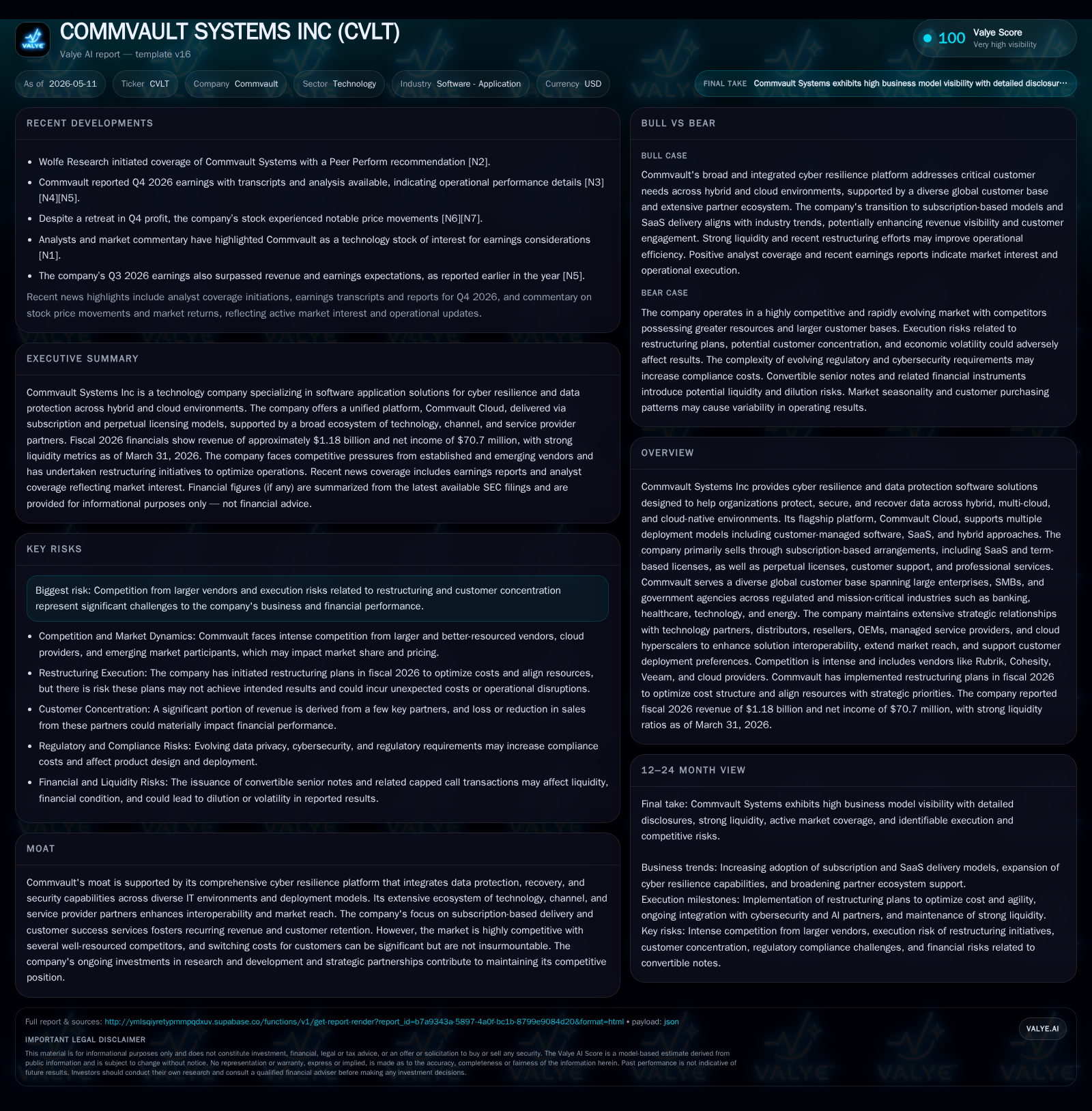
Commvault Systems Inc showcased solid operational execution in its latest quarter, emphasizing its transition to subscription-based and SaaS models within its Commvault Cloud platform. The company is navigating industry headwinds through strategic restructuring aimed at cost optimization and agility, while maintaining a broad ecosystem of technology partnerships. Its competitive moat is anchored in comprehensive cyber resilience solutions adapted for hybrid and multi-cloud environments, although competitive pressures and customer switching costs remain key challenges. Financially, Commvault demonstrates healthy liquidity and steady profitability metrics as it balances investment in innovation with disciplined capital management.
Recent Operating Update
The most recent quarterly report through January 28, 2026 [S2] highlights ongoing efforts by Commvault Systems Inc to advance its strategic transition toward subscription- and SaaS-based delivery models within its flagship Commvault Cloud platform. The company implemented restructuring plans in fiscal 2026 aimed at streamlining cost structures and enhancing operational agility. While these initiatives reflect management’s intent to align resources more efficiently with evolving market demands, the filing recognizes inherent execution risks such as loss of key personnel or unforeseen costs that could impact productivity or growth trajectories. Notably, during Q3 fiscal 2026, Commvault continued executing share repurchases under its existing program [S14].
Additionally, the April 28, 2026 8-K filing [S3] provided an earnings update consolidating the quarter’s operating results. These disclosures confirm steady momentum in subscription revenue segments complemented by stabilizing perpetual license sales — reflecting demand durability amid industry transitions. Commvault’s broad customer base across enterprise, SMBs, and government sectors remained engaged as the company emphasized improved solution deployment efficiency through cloud-native architectures.
Business Model
Commvault operates primarily as a software provider specializing in cyber resilience solutions encompassing data protection, recovery, security, and governance. The core offering is the Commvault Cloud platform engineered to operate seamlessly across on-premises infrastructure, hybrid clouds, multi-cloud setups (e.g., AWS, Azure, Google Cloud), and native SaaS environments [S1].
Revenue generation stems chiefly from:
- Subscription-based arrangements including SaaS offerings which provide steady recurring revenues.
- Term-based licensing contracts largely focused on software use rights.
- Perpetual licenses retained by some customers preferring traditional ownership models.
- Ancillary streams from customer support services and professional consulting engagements.
Subscription services emphasize flexibility with deployment options that cater to diverse IT strategies — spanning fully managed SaaS to hybrid installations where customers maintain some infrastructure control but leverage cloud benefits. This diversified delivery model enhances appeal across verticals ranging from regulated financial institutions requiring rigorous compliance capabilities to technology firms prioritizing scalability.
Margins are influenced by factors such as product mix shifts favoring higher-margin cloud delivery, infrastructure hosting costs associated with SaaS scale-up, and investment levels in R&D crucial for sustaining technological edge [S1]. The company underscores customer success management as vital to adoption retention in increasingly competitive landscapes.
Industry Structure and Competitive Position
The cyber resilience sector is marked by rapid innovation cycles spurred by escalating cybersecurity threats including ransomware and data breaches. Customer priorities increasingly focus on unified platforms capable of integrating data protection with identity security and compliance governance across complex hybrid environments.
Commvault competes against large incumbents like IBM (Spectrum Protect), Veritas Technologies (NetBackup), Dell Technologies (PowerProtect), native cloud specialists such as Druva or Rubrik, and emerging startups leveraging AI-enabled automation. Competitive advantages hinge on:
- Comprehensive solution breadth covering backup/recovery plus cyber recovery workflows.
- Deployment flexibility accommodating heterogeneous IT environments without vendor lock-in.
- Extensive partner ecosystem incorporating technology alliances (e.g., hyperscalers), channel partners, OEMs, managed service providers enhancing distribution coverage [S12].
Nonetheless, switching costs for customers can be substantial given integration complexities but are not insurmountable; thus incumbency is a mixed blessing dependent on continual innovation pace. Pricing pressure from competitors particularly those born cloud-native poses challenges to margin expansion.
Growth Drivers
Structural growth drivers include:
- Rising frequency/severity of cyberattacks motivating accelerated adoption of robust cyber resilience frameworks.
- Increasing regulatory emphasis on data privacy/security placing premium on governed backup/recovery platforms.
- Digital transformation trends pushing enterprises toward hybrid/multi-cloud architectures demanding interoperable data protection solutions.
- Adoption acceleration of SaaS/cloud models facilitating predictable subscription revenues coupled with scalable usage patterns.
- Expansion into government sectors offering access to sizable contracts albeit with longer sales cycles [S22].
Key KPIs relevant to these drivers are increased subscription bookings/retention rates, renewal volumes for term licenses/support contracts, expansion of channel partner certifications/integrations, new compliant feature rollouts (e.g., FedRAMP authorization), and backlog growth in professional services engagements [N2].
Risks / Watchpoints / Growth Constraints
Risks include:
- Execution uncertainty related to restructuring efforts that might disrupt ongoing growth or impair employee morale [S2][S22].
- Competitive intensity potentially suppressing pricing leverage or eroding market share especially against entrenched legacy vendors or aggressive cloud-native entrants [S18].
- Revenue concentration risks linked to large enterprise/government customers which may delay orders or seek pricing concessions amid budgetary pressures [S23].
- Capital allocation challenges stemming from $900 million zero-coupon convertible senior notes issued in September 2025 which may affect liquidity if conversion triggers occur; also dilution implications for shareholders are noted [S19].
- Regulatory compliance burdens evolving globally including data residency laws, AI governance requirements impacting product development timelines or deployment restrictions [S17].
What to Watch Next
Stakeholders should monitor:
- Upcoming quarterly results post-January 2026 period for subscription growth rates vs bookings expectations highlighting sales execution effectiveness.
- Progress updates on restructuring outcomes including cost savings captured versus reinvestments made into R&D or go-to-market expansions.
- Expansion of strategic partnerships or new integrations particularly with leading hyperscalers enhancing competitive positioning.
- Government sector booking trends indicative of success in navigating procurement cycles under fluctuating budget conditions.
- Developments regarding convertible notes redemption/conversion scenarios affecting capital structure dynamics.
Financial Profile (Latest FY ended March 31, 2026) [F1]
Latest financial snapshot
| Metric | Value | Period |
|---|---|---|
| Cash & equivalents | $900mm | |
| 2026-03-31 | ||
| Current assets | $1287mm | |
| 2026-03-31 | ||
| Current liabilities | $658mm | |
| 2026-03-31 | ||
| Current ratio | 1.95x | |
| 2026-03-31 |
Source: SEC companyfacts cache [F1].
| Metric | Value (USD) | Period Ended |
|---|---|---|
| Revenue | 1.18 billion | |
| 2026-03-31 | ||
| Operating Income | 74 million | |
| 2026-03-31 | ||
| Net Income | 71 million | |
| 2026-03-31 | ||
| Cash & Equivalents | 900 million | |
| 2026-03-31 | ||
| Current Assets | 1.29 billion | |
| 2026-03-31 | ||
| Current Liabilities | 658 million | |
| 2026-03-31 | ||
| Current Ratio | ~1.95 | |
| 2026-03-31 |
These figures demonstrate a stable profitability profile accompanied by strong liquidity cushions. The near twofold current ratio indicates solid short-term financial health mitigating immediate concerns despite outstanding convertible liabilities [F1][S19]. The sizeable cash reserve supports ongoing investments required for sustaining SaaS infrastructure expansions vital in the cyber resilience domain.
This analysis synthesizes the latest SEC filings alongside recent publicly available discourse without offering investment recommendations. It aims solely to present an informed industry perspective based on disclosed operational facts combined with contextual sector insights.
Disclaimer: This is research-only, informational analysis and not investment advice. It may include AI-generated interpretation and general industry context. Always verify important details using primary sources.

Comments