
Circle Internet Group Defies Blockchain Competition Through Stablecoin Dominance and Platform Integration
Circle's latest quarterly filing highlights sustained stablecoin network strength amid development challenges with its Arc blockchain.
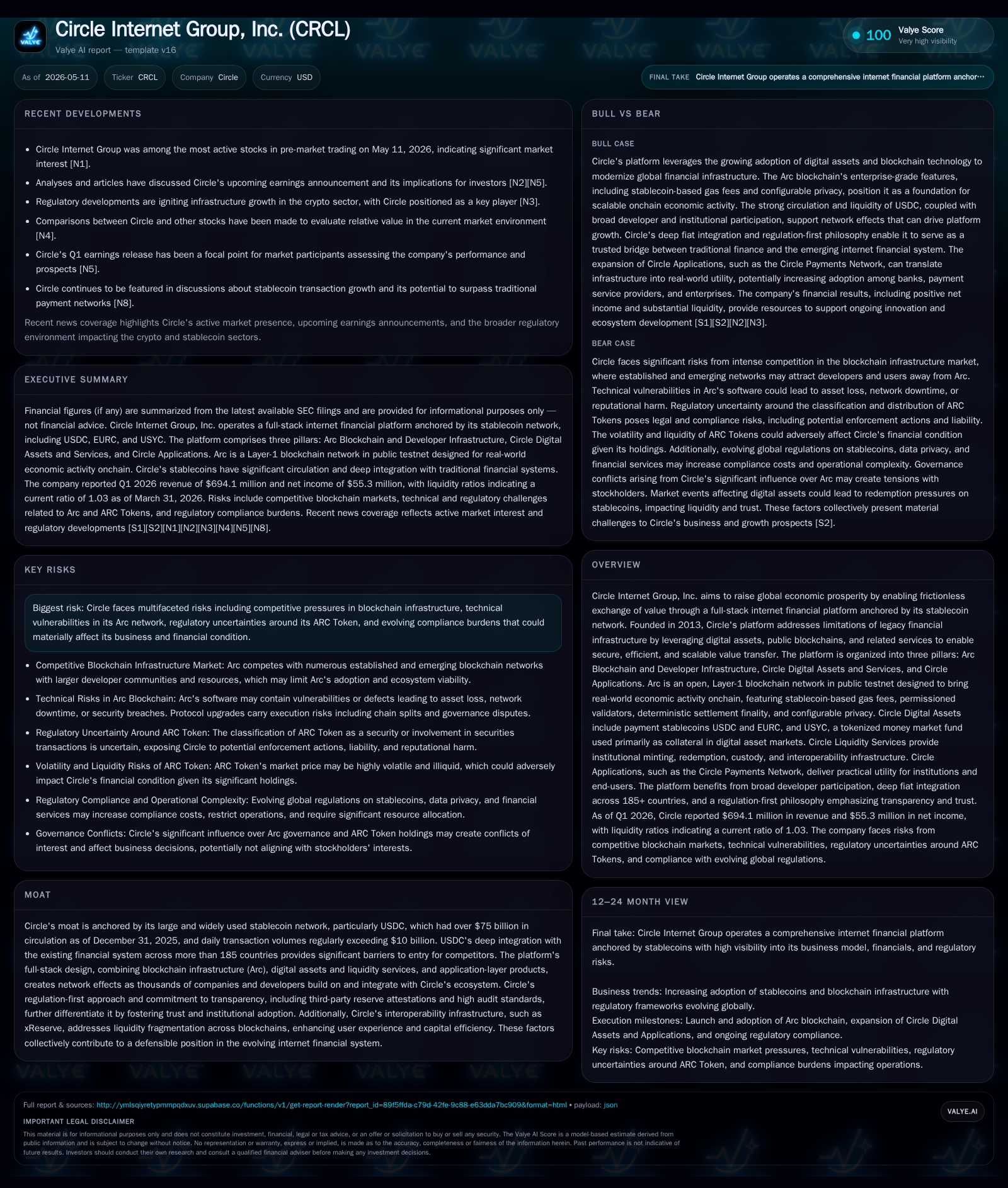
In its Q1 2026 filing, Circle Internet Group demonstrated resilience driven by its flagship stablecoin USDC, maintaining over $75 billion in circulation with strong transaction volumes. Despite early-stage technical hurdles and competitive pressures in launching its Arc Layer-1 blockchain, Circle's full-stack platform approach integrates digital assets, developer tools, and enterprise applications to reinforce network effects. Growth catalysts include expanding institutional adoption and regulatory clarity from the GENIUS Act, while risks center on blockchain execution and evolving compliance landscapes. Key milestones ahead will clarify Arc’s market traction and regulatory engagement as Circle sustains capital investment to support its multi-pillar internet finance strategy.
Latest Quarterly Operating Developments: Resilience in Stablecoin Growth
Circle's Q1 2026 filings reveal a stablecoin network exhibiting remarkable resilience amid broader sector volatility. The flagship USDC stablecoin remains the core economic driver with circulation levels holding steadfast above $75 billion at March quarter-end [S2]. Management acknowledges elevated R&D expenses tied to ongoing Arc blockchain development — indicating investment prioritization towards this novel Layer-1 protocol despite short-term cost headwinds [S2][S3]. This financing strategy reflects a tradeoff between current profitability pressures and longer-term value creation potential through integrated platform expansion.
Platform Overview: The Three Pillars of Circle’s Value Creation
Circle’s platform architecture rests on three synergistic pillars designed to capture value across the digital asset stack [S1]:
Arc Blockchain and Developer Infrastructure: An open-source Layer-1 blockchain designed specifically for scaling internet-scale real-world economic activity onchain. It introduces innovations such as stablecoin-based gas fees, permissioned validators for enterprise-grade control, deterministic finality of settlements, and configurable privacy controls to balance transparency with compliance needs.
Circle Digital Assets and Services: Anchored by payment stablecoins USDC (USD-backed), EURC (EUR-backed), and USYC — a tokenized Treasury Money Market Fund providing yield-accruing collateral alternatives. These instruments enable instant settlement at low cost while being redeemable one-for-one against fiat reserves held within Circle’s custodial structure.
Circle Applications: Including the Circle Payments Network (CPN) facilitating B2B payment flows leveraging digital assets for near real-time settlement alongside StableFX which enables seamless foreign exchange among multiple stablecoins reducing dependency on traditional credit lines.
This full-stack integration fosters considerable network effects as developers adopt Circle Wallets and Contracts tools that simplify smart contract deployment without requiring specialized cryptographic expertise — lowering barriers to innovation deployment while maintaining security rigor. Coupled with Circle's "regulation-first" posture entailing transparent third-party audits and robust compliance infrastructure, these elements contribute to institutional trust critical in today’s regulatory environment.
Competitive Positioning and Industry Dynamics in Digital Asset Infrastructure
The digital asset landscape features intense competition both at the token level—where various stablecoins vie for adoption—and at the blockchain infrastructure level where numerous Layer-1 protocols compete for developer mindshare [S2][S1]. While Arc aims to carve out niche advantages through configurability and integration focused on payments use cases, incumbent blockchains possess larger ecosystems benefiting from first-mover effects.
USDC's deep integration into more than 185 countries’ financial systems establishes formidable switching costs around liquidity access, regulation compliance familiarity, and broad custody partnerships hindering challengers [S1][S6]. Regulatory frameworks can act as both moat enhancers due to licensed status retention barriers but simultaneously introduce operational complexities fueled by evolving enforcement actions across jurisdictions.
Technological innovation speed further escalates competitive intensity as emerging protocols might deploy newer consensus mechanisms or privacy architectures faster than Arc can stabilize feature-set delivery. Circle acknowledges these dynamics candidly in risk disclosures citing possible adoption shortfalls impacting ARC Token valuation prospects should the network fail to achieve critical mass swiftly.
Growth Catalysts: Expanding Ecosystem, Enhanced Utility, and Regulatory Tailwinds
Circle's primary growth trajectory lies in several measurable vectors [S1][N7][N10]:
- Continued institutional adoption fueling greater stablecoin transactional volume potentially surging past legacy payment giants Visa/Mastercard in total processed value as stablecoins increasingly underpin treasury operations.
- Developer ecosystem growth contingent upon successful Arc mainnet launch followed by decentralized application deployments enabled via user-friendly smart contract platforms like Circle Contracts reducings entry complexities.
- Regulatory clarity ushered in by the GENIUS Act (effective January 2027 or earlier upon rulemaking) defining permitted payment stablecoin issuers (PPSIs), thus enhancing market confidence in compliant assets like USDC.
- Expansion of multi-currency settlements via EURC alongside USDC facilitates cross-border finance simplification responding directly to corporate treasury demands.
These catalysts map tightly onto KPIs such as volume growth metrics for both primary mint/redemption activity via Circle Mint services and secondary market transaction flows measurable through blockchain data analytics.
Risks to Monitor: Arc Token Launch Uncertainties and Regulatory Shifts
Despite solid fundamentals in its core stablecoin business lines, Circle faces material risks primarily linked to the nascency of its Arc blockchain initiative [S2][S23]:
- Technical vulnerabilities inherent to new Layer-1 blockchain implementations pose risks of software exploits potentially resulting in asset loss or service disruptions jeopardizing credibility.
- The highly competitive Layer-1 landscape means developer community buildout may lag rival ecosystems equipped with entrenched tooling developer incentives undermining demand for block space or application innovation on Arc.
- The precise timeline for ARC Token launch remains fluid given dependencies on technical readiness, transition plans from initial consensus models toward Proof-of-Stake variants, prevailing market conditions impacting token economics sentiment plus comprehensive legal/regulatory vetting increasing execution uncertainty.[S2]
- Failure or delay could generate reputational damage among strategic partners including institutional presale purchasers like a16z crypto who participated in recent private placements totaling approximately 740 million tokens at $0.30 each valuing the network at around $3 billion but subject to lock-up restrictions post-launch.[S29]
- Regulatory scrutiny evolves rapidly; increased enforcement actions or new unfavorable interpretations of digital asset laws could require operational adjustments or capital reallocations impairing growth.[S6]
These factors warrant vigilant monitoring to understand implications not only on liquidity but also investor confidence given ongoing litigation risks including disputes with former advisors seeking fees relating to capital raises.[S23]
Upcoming Milestones and Market Signals to Watch
Key upcoming events offering visibility into circle’s execution progress include:
- Rollout phases of Arc Network mainnet moves from testnet toward fully decentralized validator governance regimes signaling readiness for broader user onboarding.[S2]
- ARC Token issuance schedules aligning with protocol milestones such as successful Proof-of-Stake transitions expected no later than mid-decade timeline guarantees embedded in purchase agreements.[S29]
- Implementation of GENIUS Act regulations anticipated from early 2027 providing clearer federal compliance guardrails enabling competitive positioning versus non-compliant peers.[S1]
- Monitoring quarterly updates regarding reserve management strategies balancing liquidity sufficiency against capital efficiency especially under tightening global payment system regulations.[S2] These checkpoints will refine assessment of structural opportunity versus cyclical friction influencing Circle’s valuation framework.
Financial Snapshot: Liquidity, Capital Structure, and Profitability Highlights
As of Q1 end, Circle maintains roughly $1.5 billion in cash equivalents supporting operations alongside substantial current assets mainly driven by reserve holdings backing USDC liabilities [F1]. The current ratio close to unity at 1.03x indicates tight working capital management reflective of regulatory constraints mandating high-quality liquid asset buffers.[F1] Operating losses recorded at -$96 million during prior fiscal year evidence continued investment into platform development over near-term profitability concerns[S2]. This expense profile aligns with strategic initiatives focusing on Arc technology maturation while sustaining scale benefits from existing digital asset service lines.
This analysis leverages publicly available SEC filings through May 11, 2026 ([S1],[S2],[S3]), company financial statements ([F1]), complemented by sector news context (). It aims exclusively at operational insight without investment recommendations or price forecasts.
Disclaimer: This is research-only, informational analysis and not investment advice. It may include AI-generated interpretation and general industry context. Always verify important details using primary sources.

Comments