
Global Payments Offloads Issuer Solutions and Accelerates Share Repurchase Amid Transformation
Q1 2026 filings reveal Global Payments’ strategic shift focusing on Merchant Solutions while deploying significant capital for share repurchases.
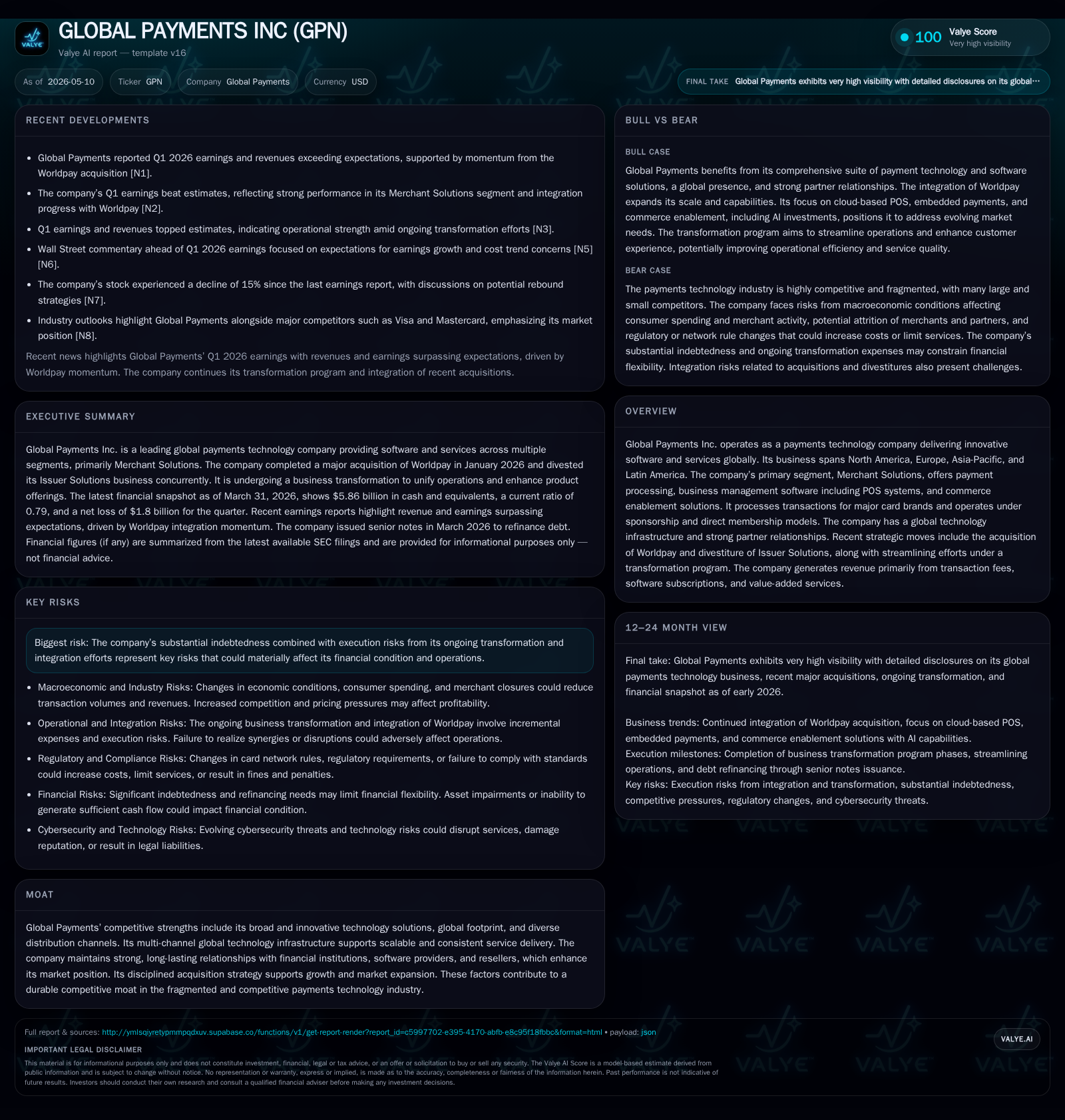
In Q1 2026, Global Payments completed its transformative acquisition of Worldpay and divested its Issuer Solutions segment, marking a clear strategic pivot towards merchant-centric payment technologies. The company is also advancing an accelerated $500 million share repurchase program, underscoring a commitment to capital return amid integration and transformation expenses expected through mid-2027. Leveraging a global technology platform and strong partner relationships, the firm positions itself competitively in a fragmented market while managing risks from elevated leverage and evolving regulation.
Q1 2026 Operating Update: Transformation Milestones and Capital Deployment
Global Payments’ latest 10-Q filing dated May 8, 2026 [S2] offers the clearest lens on its near-term operational progression following the landmark January acquisition of Worldpay Holdco, LLC. This deal, executed concurrently with the divestiture of its Issuer Solutions business to Fidelity National Information Services (FIS), signals a deliberate realignment towards merchant-focused payment ecosystems. Consideration for Worldpay was approximately $6.2 billion in cash plus shares issued to former owners representing about 15.45% of Global Payments’ outstanding equity post-close [S1][S3].
The company further announced an accelerated share repurchase (ASR) program totaling $500 million commenced May 6, with nearly 5.74 million shares repurchased by May 8 [S3]. This move reflects confidence in cash flow generation potential despite ongoing incremental transformation costs projected through the first half of 2027 [S1][S2]. Management’s discussion highlights streamlining efforts including consolidated technology leadership and unified go-to-market activities under the Global Payments brand umbrella.
The integration of Worldpay is underway alongside transition services supporting the Issuer Solutions spin-off. These dual transactions refocus Global Payments as a simplified global platform primarily oriented around Merchant Solutions — encompassing payment processing, business management software (POS systems), and commerce enablement solutions.
Business Model Overview: Merchant Solutions at the Core
Global Payments generates most revenue via transactional service fees pegged either to transaction value or per-transaction charges depending on region and payment type [S7]. This includes payment authorization, settlement, chargeback management, terminal services, billing consolidation, and various value-added offerings such as data analytics for customer engagement.
Software subscription/licensing fees from customized POS platforms and other business management systems provide recurring revenue streams independent of transaction volume fluctuations [S1]. Commerce enablement is broadening this base with tools spanning human capital management to accounts receivable automation and inventory analytics — directly enhancing merchants' operational efficiency.
Revenue mechanics depend heavily on customer segments ranging from small businesses to large enterprises across diverse geographies. Direct membership models with major card brands foster tighter control and margin capture versus sponsorship-based arrangements where third-party banks play intermediary roles [S7][S29]. The global multi-channel infrastructure supports scalability while integrated ecosystems create switching costs enhancing retention.
Competitive Positioning in Global Payment Technologies
The payments technology sector is highly fragmented yet fiercely competitive with incumbent financial institutions, fintech disruptors like Stripe and Block, alongside traditional processors such as Fiserv jostling for market share [S25]. Global Payments’ competitive moat rests on several pillars:
- Broad technology platform spanning multiple channels delivering consistent service experience globally;
- Deep-rooted financial institution partnerships enabling access to card networks under direct membership models;
- Disciplined recent acquisitions fostering scale and product diversification;
- Unified branding and streamlined operations reducing complexity relative to peers.
Yet these strengths require adept management given regulatory complexity that acts as both barrier to entry but also a cost center [S8]. Integration success of Worldpay remains pivotal to realizing anticipated economies of scale without customer attrition amid service disruptions [S26].
Growth Drivers in Merchant Solutions and Commerce Enablement
Growth levers align with structural tailwinds favoring digital payments adoption worldwide. Transaction volumes benefit from geographic expansion across North America, Europe, Asia-Pacific, and Latin America through both organic growth and bolt-on acquisitions enabled by strong capital markets access [N2][S1].
Broader software penetration beyond payments into operational domains offers sticky revenue streams complementing transaction fees. Initiatives under the transformation program include developing AI-enabled analytics and customer engagement tools designed to increase merchant demand generation effectiveness [S1][N1].
Cross-selling opportunities arise as brand unification improves visibility and enables seamless commerce enablement across client bases previously segmented by legacy systems. Measurable KPIs include transaction volume growth rates per region, software subscription upticks, average revenue per merchant location, and margin expansion through operational improvements.
Risks from Leverage, Integration, and Regulatory Pressure
Balance sheet leverage stands out as a core risk vector with total debt nearing $21.0 billion offset by $5.9 billion cash balances leaving net debt around $15.1 billion as of March-end 2026 [F1][S2]. Incremental transformation expenses continue through H1 2027 encompassing system harmonization costs plus potential asset writedowns affecting earnings visibility [S2]. Risks extend to potential delays or failure to realize targeted synergies from such large-scale integrations impacting market confidence.
Regulatory environment intensifies globally — compliance with evolving anti-money laundering rules, privacy laws including GDPR-like frameworks outside Europe, payment network fee adjustments constrained by legislation such as Dodd-Frank’s debit interchange caps create mixed margin pressure scenarios [S8][S14][S18]. Failure to effectively navigate these complexities can result in fines or licensing issues jeopardizing service continuity.
Key Upcoming Catalysts and Execution Watchpoints
Investors should monitor quarterly cadence for evidence of progressive cost synergy capture from Worldpay integration which will validate transformational strategy execution timelines [N1][S2]. Tracking merchant churn rates post-integration provides insight on customer retention under unified brand efforts.
Transaction volume growth trajectories globally remain critical markers signaling successful cross-selling impact alongside organic commerce expansion facilitated by new AI-enabled tools under development.
Capital structure actions following ASR completion including any debt refinancing or strategic asset evaluations will influence flexibility to fund innovation or pursue opportunistic bolt-on acquisitions [S3][N2]. Further asset dispositions beyond Issuer Solutions could occur if management deems it beneficial for shareholder value creation.
Latest Financial Snapshot: Leverage and Liquidity Context
Latest financial snapshot
| Metric | Value | Period |
|---|---|---|
| Cash & equivalents | $5.9bn | |
| 2026-03-31 | ||
| Total debt | $21.0bn | |
| 2026-03-31 | ||
| Net debt | $15.1bn | |
| 2026-03-31 | ||
| Current assets | $11.7bn | |
| 2026-03-31 | ||
| Current liabilities | $14.7bn | |
| 2026-03-31 | ||
| Current ratio | 0.79x | |
| 2026-03-31 |
Source: SEC companyfacts cache [F1].
| Metric | Value (USD) |
|---|---|
| Cash & Equivalents | 5,861,312,000 |
| Total Debt | 20,984,465,000 |
| Net Debt (Debt - Cash) | 15,123,153,000 |
| Current Assets | 11,674,225,000 |
| Current Liabilities | 14,746,974,000 |
| Current Ratio | 0.79 |
This snapshot encapsulates leverage intensity against robust cash holdings supporting capital return initiatives like the recent ASR program. Working capital constraints implied by sub-1 current ratio may pressure operating flexibility but are mitigated partially by strong free cash flow generation inherent in payment processing models [F1][S2]. Monitoring is warranted for shifts driven by integration spending or regulatory compliance costs.
Disclaimer: This analysis is based on publicly available SEC filings and recently reported data as of May 10, 2026. It aims to contextualize operational developments without investment recommendations or price guidance.
Disclaimer: This is research-only, informational analysis and not investment advice. It may include AI-generated interpretation and general industry context. Always verify important details using primary sources.

Comments