
GBTG's Transition to Private Ownership Faces Regulatory and Operational Challenges
GBTG announced a definitive merger agreement to go private, reshaping its strategic pathway amid regulatory dependencies tied to American Express.
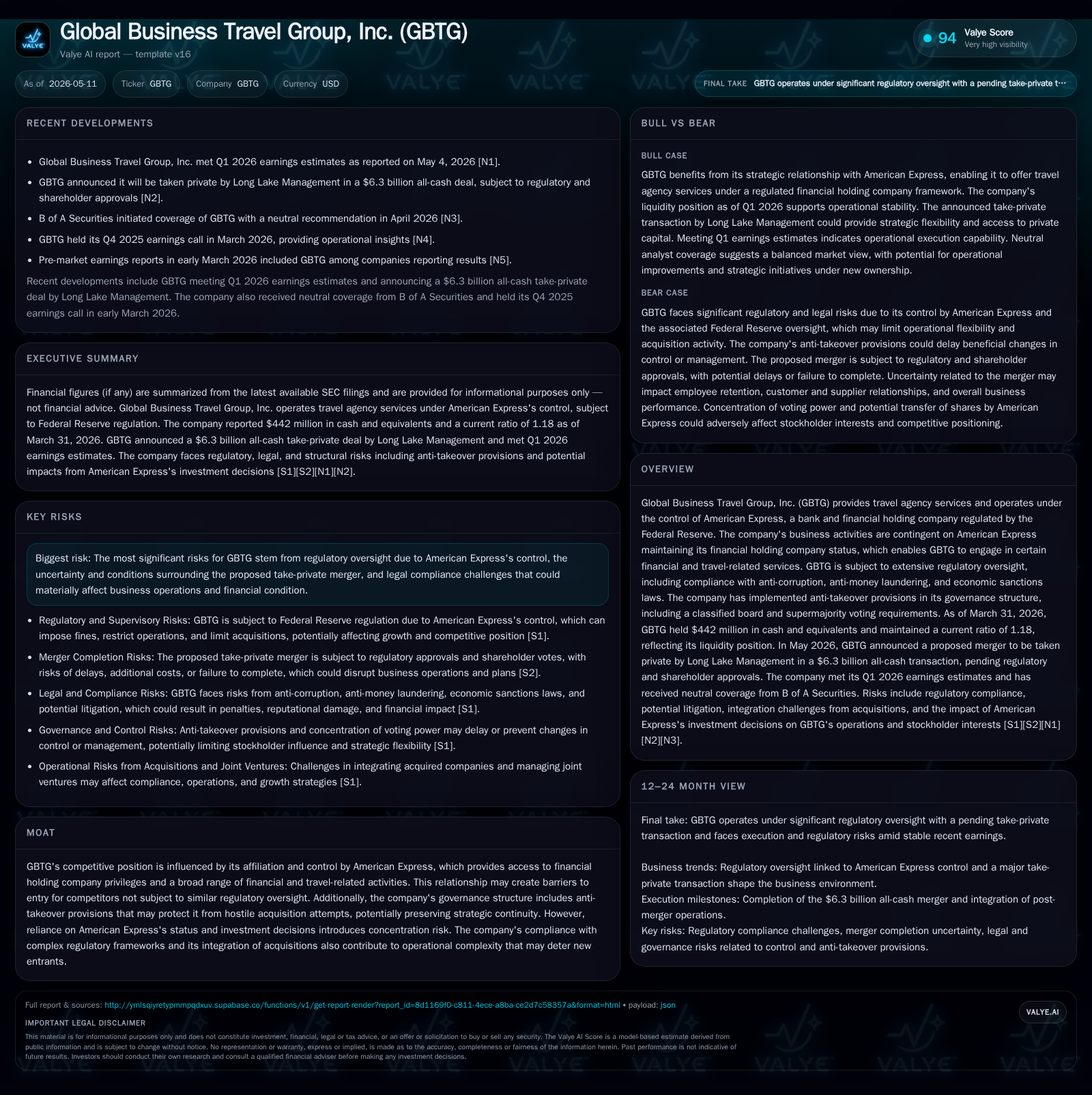
Global Business Travel Group, Inc. (GBTG) reported its latest quarterly results highlighting steady liquidity and operational continuity while navigating the complexities of an announced $6.3 billion take-private merger. The company's strong ties to American Express’s financial holding company status uniquely position it in the regulated travel services sphere but also impose constraints on growth and flexibility. The pending merger introduces significant regulatory hurdles and integration risks, which could affect business momentum and stakeholder confidence. Going forward, GBTG's evolution will depend heavily on the successful completion of the merger and the management of regulatory compliance alongside market demand for business travel services.
Recent Operating Update: Merger Announcement Alters Strategic Landscape
Global Business Travel Group, Inc. (GBTG) disclosed in its Q1 2026 filing on May 11 [S2] and in an event filing earlier in May [S3] that it has entered into an Agreement and Plan of Merger with Gaia Purchaser, Inc., an investor group led by Long Lake Management and Koch Equity Development LLC. The deal values GBTG at approximately $6.3 billion in an all-cash transaction designed to take the company private [N1]. This announcement represents a fundamental strategic inflection point given GBTG's prior status as a public company controlled by American Express.
Completion of the merger remains contingent upon several conditions including customary regulatory approvals—most notably from antitrust authorities—and shareholder approval [S2][S3]. The company acknowledges potential delays or failure to close that could adversely impact anticipated synergies or prolong transactional uncertainties [S2]. The merger agreement further imposes operational covenants limiting GBTG from pursuing certain business actions without consent from the acquirers until close [S2], potentially constraining flexibility amid dynamic market conditions.
The financing structure supporting the transaction includes $2.5 billion of committed debt financing from lenders plus committed equity funding from Long Lake and Koch Equity Development [S3]. This sizable leverage component will materially alter capital structure post-close.
Business Model: Regulated Travel Agency Services Leveraged by American Express Affiliation
GBTG primarily operates as a global travel management company serving corporations with integrated travel agency services [S1]. Its affiliation with American Express—a financial holding company regulated by the Federal Reserve—enables access to a distinctive operating license under regulatory frameworks that limit competitors without similar affiliations [S1]. This model blends traditional corporate travel booking with ancillary financial services aligned through co-brand licensing.
Revenue generation is principally fee-based from corporate clients who pay for travel management solutions including booking flights, accommodations, ground transportation, and managing complex itineraries. Revenue volumes are influenced by corporate travel demand cycles, contract terms with customers which often include volume commitments or negotiated pricing schedules, and geographic spread tied to global multinational firms.
Operating margins benefit from scale economies over a broad client base but can be sensitive to fluctuating demand given fixed cost structures inherent in service platforms. Product mix evolution toward technology-enabled solutions (e.g., digital booking tools) enhances customer stickiness but entails upfront investment cost increments.
GBTG’s governance incorporates anti-takeover provisions such as a classified board structure and supermajority voting requirements aimed at preserving strategic direction under current ownership [S1].
Industry Structure and Competitive Position
Global corporate travel management is concentrated among a few large providers with entrenched relationships across airlines, hotels, and ground transport partners. GBTG’s main competitors include other travel conglomerates like BCD Travel and Carlson Wagonlit Travel (CWT), which GBTG acquired recently [S7].
Competitiveness hinges on comprehensive global presence, technological platforms that facilitate ease of travel procurement and expense management for clients, responsive customer service models optimized for enterprise needs, as well as data analytics capabilities that optimize cost-efficiency.
GBTG’s integration within American Express provides barriers to entry related to regulatory compliances experienced by stand-alone travel agencies not operating inside financial holding companies [S1]. This lends uniqueness but also subjects GBTG to complex supervision limiting operational nimbleness compared to less regulated peers.
Growth Drivers
Post-Pandemic Recovery: Resumption of business travel after COVID-19 induced disruptions drives volume expansion opportunities; pent-up demand from multinational clients supports revenue growth.
Acquisition of CWT: Synergies derived from integrating CWT are expected to expand market share geographically and deepen client engagement while realizing expense efficiencies [S7].
Technology Investments: Deployment of digital tools enhances user experience for corporate travelers who increasingly prefer self-service portals married with personalized support.
Premium Co-Brand Agreements: Maintained licensing agreements with American Express enable premium service offerings exclusive within financial services ecosystems fostering stickiness.
Global Client Base Diversification: Exposure across industries cushions cyclicality risks associated with sector-specific downturns.
Risks & Watchpoints
Merger Execution Risk: Delays or failure to complete the take-private transaction could unsettle clients or suppliers delaying bookings or contractual renewals impacting near-term financials [S2][S3].
Regulatory Constraints: As a subsidiary controlled by American Express—subject to Federal Reserve oversight—GBTG faces stringent compliance obligations that may restrict certain business expansions or acquisitions [S1]. Failure by Amex to maintain financial holding company eligibility directly impacts GBTG’s permitted activities.
Operational Disruption: Transition uncertainties around employee retention or system integrations post-merger could impair service delivery quality affecting client satisfaction [S2].
Geopolitical & Macroeconomic Factors: Ongoing conflicts (Ukraine war, Middle East tensions) coupled with inflationary pressures and interest rate shifts could reshape global corporate travel budgets unpredictably [S7][S1].
Industry Competition & Technology Disruption: Emerging technology platforms challenging legacy agency models along with pricing pressures necessitate continuous innovation.
What To Watch Next
Regulatory Approvals & Timing: Monitoring announcements about Hart-Scott-Rodino approvals or other international antitrust consents will be critical indicators for anticipated closing timelines extending into late 2026 or early 2027 [S3][S22][S24].
Shareholder Vote Outcomes: Affirmative vote thresholds will influence execution confidence; dissenters may pursue litigation as hinted by risk disclosures potentially delaying closing.
Integration Milestones Post-CWT Acquisition: Measures of synergy realization including cost savings pace or cross-selling success will inform strategic momentum going forward.
Customer Retention Metrics Amid Transition: Early signs of corporate client commitment levels through contract renewals or bookings trajectory may signal stability or volatility.
Capital Structure Developments Post-Merger: Leveraging effects from new debt facilities combined with cash flow generation capabilities will drive credit profile changes closely watched by rating agencies.
Financial Profile Snapshot as of Q1 2026 [F1]
Latest financial snapshot
| Metric | Value | Period |
|---|---|---|
| Cash & equivalents | $442mm | |
| 2026-03-31 | ||
| Total debt | $1437mm | |
| 2025-12-31 | ||
| Net debt | $995mm | |
| 2025-12-31 | ||
| Current assets | $1757mm | |
| 2026-03-31 | ||
| Current liabilities | $1494mm | |
| 2026-03-31 | ||
| Current ratio | 1.18x | |
| 2026-03-31 |
Source: SEC companyfacts cache [F1].
Latest available total debt figure is end Q4 2025; no Q1 update disclosed yet.
The company has secured committed debt financing of $2.5 billion and equity commitments from Long Lake and Koch Equity Development to support the merger transaction [S3]. Given the current balance sheet metrics, the company maintains a current ratio of 1.18x as of Q1 2026, indicating moderate short-term liquidity coverage [F1]. Post-merger, the capital structure will incorporate the new committed financing packages detailed in recent event filings [S3].
Disclaimer:
This analysis is based solely on publicly available information up to May 11, 2026. It does not constitute investment advice or a recommendation regarding any securities issued by Global Business Travel Group Inc. Readers should perform their own due diligence or consult professional advisors before making any investment decisions.
Disclaimer: This is research-only, informational analysis and not investment advice. It may include AI-generated interpretation and general industry context. Always verify important details using primary sources.

Comments