
Copper Property CTL Trust Unwinds Portfolio with Legal Hurdles and Strategic Sales Shift
The Trust confronts near-term disruption following a terminated bulk sale agreement and ensuing litigation, pivoting to diversified asset disposition amid a challenging retail real estate market.
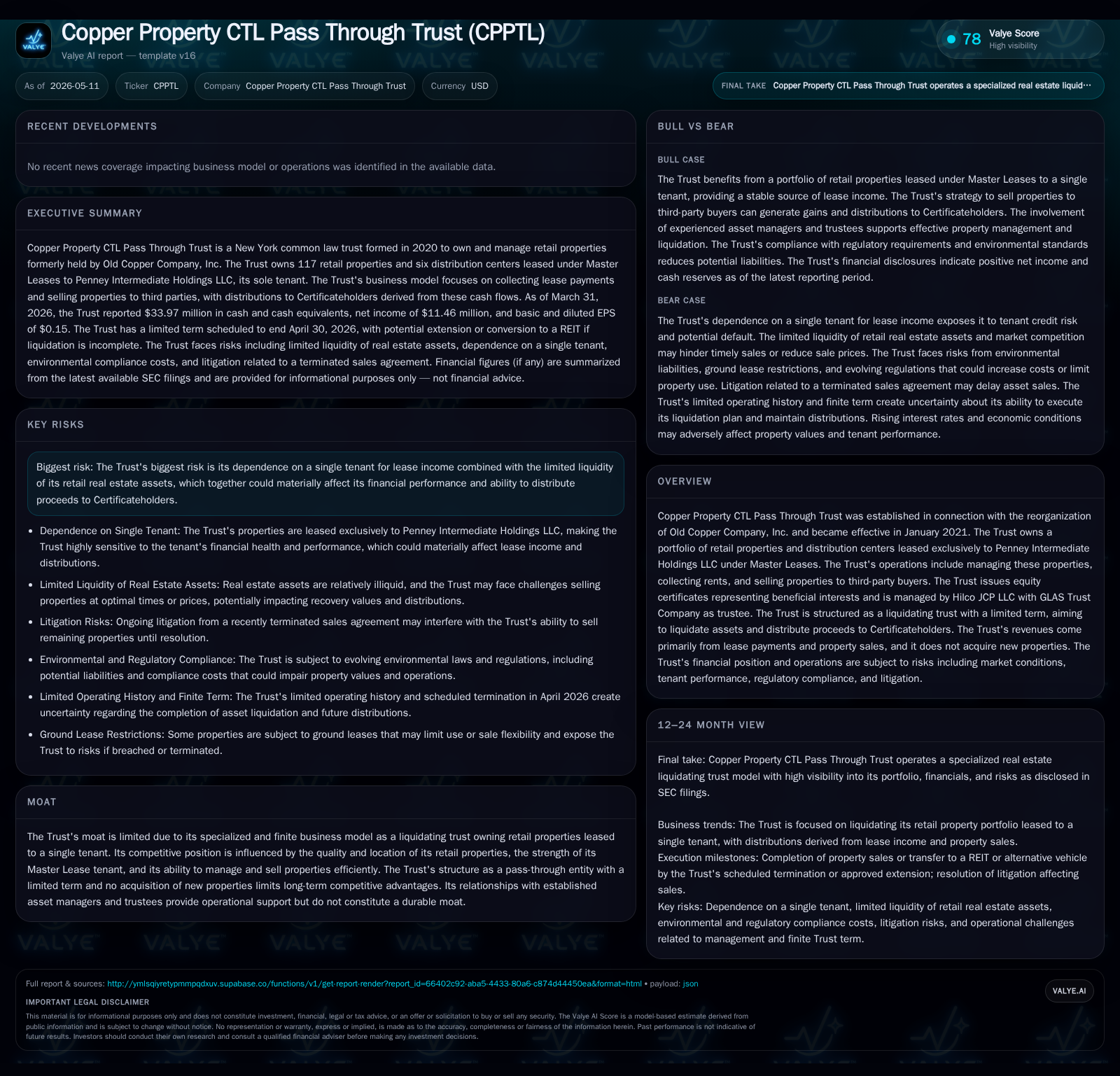
In its latest 10-Q filing dated May 8, 2026, Copper Property CTL Pass Through Trust disclosed the termination of its portfolio sale agreement with an affiliate of Onyx Partners and ensuing litigation initiated by the buyer. This development introduces legal complexity and delays in liquidity event realization, prompting the Trust to diversify its sales strategy across whole portfolios, sub-portfolios, and individual properties. As a liquidating trust owning retail real estate leased solely to Penney Intermediate Holdings LLC under Master Leases, CPPTL faces structural risks related to tenant concentration and retail asset illiquidity. The Trust’s ability to execute strategic property sales amid volatile capital markets will critically influence its distribution cadence and ultimate value capture for Certificateholders.
Quarterly Operating Update Highlights Sale Termination Impact
Copper Property CTL Pass Through Trust (CPPTL) reported in its May 8, 2026 10-Q filing [S2] that the previously announced Purchase and Sale Agreement with an affiliate of Onyx Partners, Ltd.—which encompassed the sale of the Trust's remaining retail property portfolio—was terminated on December 26, 2025 [S4]. The termination followed the Buyer’s failure to close despite the Trust satisfying all closing conditions. Subsequently, the Buyer filed suit against the Trust’s subsidiaries alleging breach of contract and seeking specific performance or damages. CPPTL management contests these claims as without merit and intends vigorous defense strategies.
This failed transaction introduces tangible operational risks: legal costs are escalating; management attention is diverted; and the timeline for asset monetization—and consequently distributions to Certificateholders—is uncertain. The Trust is actively pursuing recovery of disputed deposit funds totaling $3 million held in escrow alongside already received $2 million that was distributed at the start of January 2026 [S4]. In light of this setback, CPPTL has halted its prior marketing process but affirms that it is evaluating an array of strategic alternatives including whole-portfolio sales, segmented sub-portfolio dispositions, individual property sales, financing structures, or combinations thereof [S4]. Continued operations are maintained consistent with trust agreements as it methodically navigates this transition phase.
Business Model Overview: Liquidating Trust Structure and Single Tenant Lease Dynamics
Established in connection with Old Copper Company’s Chapter 11 reorganization effective January 2021 [S1], CPPTL operates primarily as a liquidating pass-through trust holding approximately 117 retail properties plus several distribution centers totaling over 15 million square feet across 35 U.S. states and Puerto Rico [S1]. All properties are leased exclusively under two Master Leases to Penney Intermediate Holdings LLC—a joint venture controlled by Simon Property Group and Brookfield Asset Management—serving as the sole tenant.
The Trust’s business model is purposefully finite: it does not pursue property acquisitions but instead focuses on managing existing assets, collecting lease rents from this single tenant source, selling properties opportunistically subjected to market conditions, and distributing proceeds to Certificateholders defined as holders of fractional beneficial interests through pass-through certificates issued at formation [S1]. Its managerial activities are outsourced to Hilco JCP LLC with GLAS Trust Company serving as trustee overseeing treasury functions [S1].
Revenue generation rests predominantly on two levers: stable rent payments under long-term Master Leases from Penney Intermediate Holdings LLC; and gains from the disposition of properties. The inherent limitation is acute dependence on one tenant's financial health combined with illiquid retail real estate assets structurally encumbered by leasehold rights.
Competitive Context: Specialized Retail Portfolio within a Challenged Real Estate Market
CPPTL sits squarely within a niche segment—owning retail real estate concentrated largely in established mall complexes tied by master leases to one corporate tenant. This concentration engenders both operational simplicity and strategic risk. The competitive environment features multiple counterparties vying for limited prime retail parcels in a sector grappling with shifting consumer behaviors amid digital commerce growth.
Real estate investors face constrained liquidity given high cap rates driven partly by elevated interest rates sustained since recent Federal Reserve hikes despite some easing moves in late 2025 [S1]. Additionally, the presence of leasehold rights limits buyer interest compared to fee-simple ownership alternatives. Many potential buyers seek less encumbered properties or more diversified tenant mixes offering higher cash flow visibility.
Hence CPPTL's competitive position hinges on efficient asset management execution plus adeptness in creative deal structuring to attract buyers valuing its unique asset base amidst volatile capital markets. Its limited term liquidating trust format precludes strategic repositioning or renovation investments that might otherwise enhance value.
Growth Drivers: Strategic Sales, Portfolio Marketing, and Alternative Transaction Paths
The linchpin for growth—or rather value realization—in CPPTL’s framework is effective liquidation of properties at favorable prices. After losing the bulk sale opportunity late last year [S4], management signals openness toward diverse pathways such as:
- Pursuing segmented or parcel-level sales allowing more tailored transactions suiting investor appetites,
- Exploring financing arrangements including sale-leasebacks or mezzanine structures that may unlock transaction flexibility,
- Investigating strategic partnerships which could facilitate off-balance-sheet transactions or joint ventures enhancing buyer pools,
- Revitalizing marketing initiatives while monitoring auction or brokered sale processes,
- Timing dispositions in alignment with cyclical price recovery prospects influenced by Fed policy signaling.
Though CPPTL's mandate prohibits property acquisition or expansion beyond liquidation objectives, proactive management of sales channels represents its sole lever to maximize recoveries for Certificateholders.
Key Risks: Tenant Concentration, Illiquid Assets, and Litigation Overhang
The most salient risk remains high dependence on Penney Intermediate Holdings LLC as single tenant—if this entity experiences material distress or defaults on lease obligations, CPPTL’s primary revenue stream would be jeopardized directly impacting certificate distributions [S1].
Legal proceedings arising from failed portfolio sale add complexity: ongoing litigation demands sizeable legal fees increasing operating costs while potentially delaying further monetizations [S24]. Distraction of trustees/managers amid lawsuits also reduces bandwidth for pursuing alternative sales strategies promptly [S24]. Although management believes adverse outcomes are unlikely materially impacting operations currently, unforeseen legal developments could alter this view unfavorably.
Finally, macroeconomic factors—including shifts in interest rates affecting capitalization rates—and sectoral transformation in brick-and-mortar retail consumption patterns serve as background risks constraining asset valuation upside.
Upcoming Milestones and Market Indicators to Monitor
Key near-term monitors include:
- Resolution progress or settlements related to Onyx buyer litigation and deposit recovery which would clear uncertainty over available funds,
- Announcement of reinitiated marketing campaigns targeting either portfolio-level buyers or segmented sales launching new transaction pipelines,
- Distribution declarations reflecting proceeds inflows thus indicating execution success,
- Macro factors such as Federal Reserve rate decisions impacting property cap rates and investor sentiment,
- Tenant financial reporting updates signaling stability or weakness within Penney Intermediate Holdings LLC influencing lease cash flow reliability.
Tracking these markers will provide clarity on trajectory toward achieving orderly liquidation central to the Trust’s charter.
Financial Snapshot: Liquidity Position and Cash Flow from Asset Monetization
As reported in the latest quarter ending March 31, 2026 per companyfacts data [F1] combined with disclosures in the May quarterly filings [S2], CPPTL maintains cash & equivalents totaling approximately $33.97 million. This liquidity base underpins ongoing administrative expenses including legal defenses against litigation claims while supporting cash distributions made monthly to Certificateholders evidenced by $0.08644 per certificate paid May 11th reflecting recent asset monetization inflows [S14].
This analysis synthesizes public SEC disclosures up to May 2026 complemented by Valye industry contextual expertise. It illuminates CPPTL’s specialized liquidating business model driven by a single-tenant Master Lease structure within evolving retail real estate challenges compounded by contractual disputes delaying portfolio exit proceedings. Ongoing monitoring should focus on legal resolution pace alongside revitalized disposition efforts shaping ultimate value capture capabilities for Certificateholders.
Disclaimer: This report is an analytical interpretation grounded solely in publicly filed regulatory documents without provision of investment advice.
Disclaimer: This is research-only, informational analysis and not investment advice. It may include AI-generated interpretation and general industry context. Always verify important details using primary sources.

Comments