
Aldel Financial II’s Latest Quarter Highlights Business Combination Challenges and Capital Position
The Q1 2026 10-Q updates Aldel’s capital resources, tax exposure on redemptions, and strategic progress toward a financial services merger.
Aldel Financial II remains a Cayman Islands-incorporated SPAC focused on identifying a financial services business combination. As of March 31, 2026, the company holds over $245 million in trust alongside a modest working capital cash balance of approximately $365 thousand, underscoring sufficient runway to continue its search. The recent quarterly filing flags potential excise tax implications tied to redemptions occurring in connection with a business combination, which may influence deal structuring. The SPAC’s ultimate value hinges on completing an acquisition, with near-term milestones including target selection and shareholder votes under regulatory scrutiny.
Latest Quarterly Update: Capital Status and Tax Implications Affecting Business Combination
The May 8, 2026 Form 10-Q positions Aldel Financial II firmly within the classic SPAC lifecycle stage: preparing for a business combination while holding substantial capital predominantly in trust. Liquidity details are consistent with ongoing search activities for a merger candidate.
Crucially, the filing discloses potential exposures to a newly enacted excise tax stemming from the Inflation Reduction Act of 2022. This federal tax imposes a 1% levy on fair market value of repurchases (redemptions) linked to business combinations or extension votes from January 1, 2023 onward. The extent of this excise tax liability depends on factors such as the deal structure, size of PIPE commitments, and magnitude of shareholder redemptions following transaction announcements. This presents an underappreciated consideration that could influence redemption incentives and negotiations with prospective targets or PIPE investors.
In addition to liquidity details, the company confirms adherence to fair value measurements aligning with observable market inputs per GAAP ASC guidelines. This methodological rigor ensures transparency in valuing assets underlying the trust portfolio during deal execution phases.
SPAC Business Model and Value Proposition
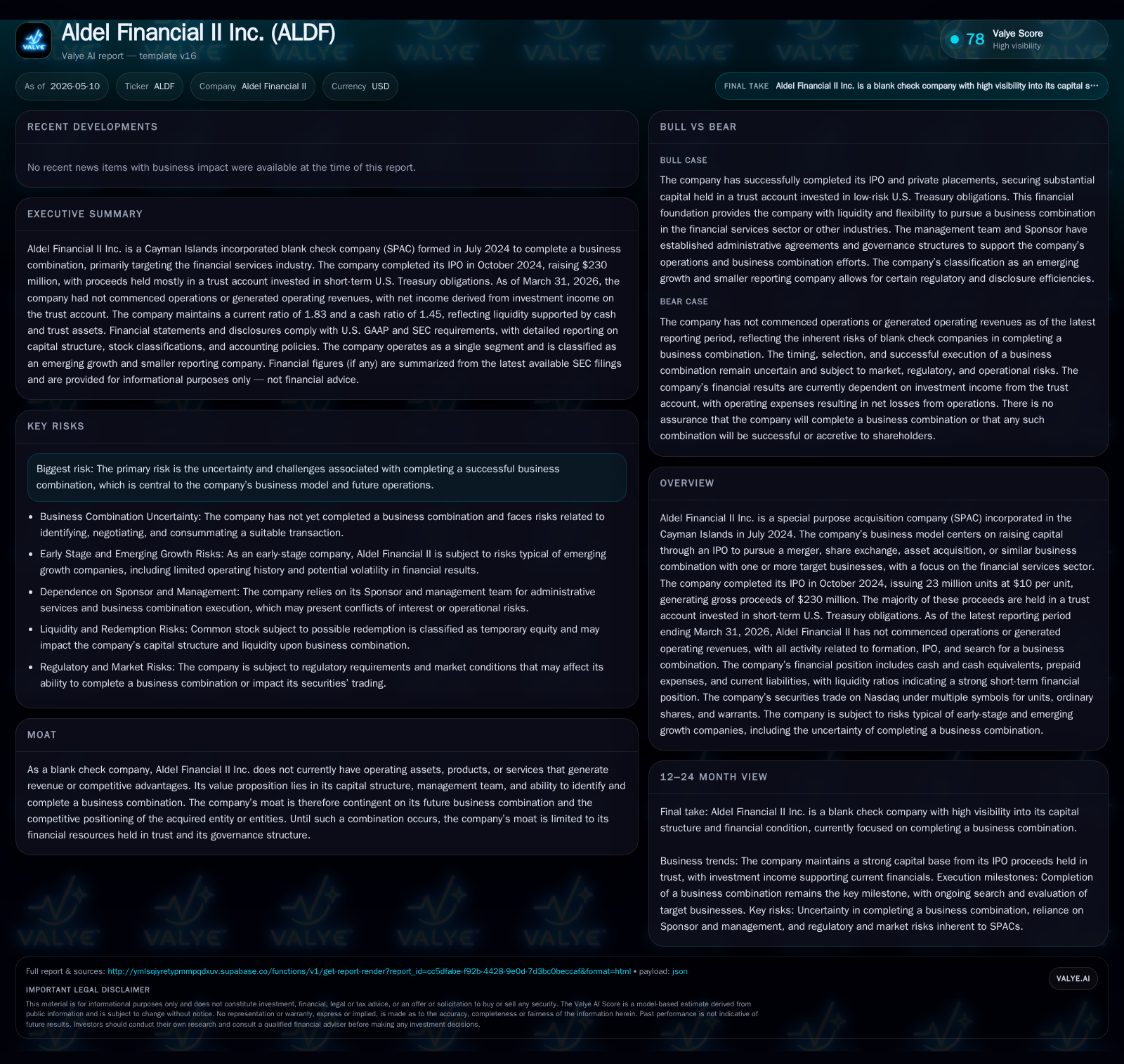
Established as a Cayman Islands exempted company in July 2024, Aldel Financial II is designed exclusively as a blank check vehicle to finance one or more business combinations primarily within the financial services industry. With IPO gross proceeds totaling $230 million from issuance of 23 million units priced at $10 each—and augmented by private placements—the company crystallized its capital base to seek appropriate acquisition targets.
To date, Aldel has not generated operating revenues; its entire operational footprint entailed administrative tasks related to formation, IPO completion, regulatory compliance, and target evaluation activities. Its governance infrastructure centers around a lean management team exercising oversight from Itasca, Illinois headquarters—maintaining an administrative agreement with its Sponsor at a fixed monthly fee. The absence of current commercial operations means the firm’s intrinsic value is dormant until it consummates an approved business combination.
This structure places premium importance on management track records in sourcing quality deals and executing complex financial transactions. The moat is ephemeral pending successful acquisition but rests currently on disciplined stewardship of trust funds and regulatory compliance frameworks.
Competitive Landscape and Industry Context in Financial Services M&A
Aldel operates within an environment crowded with comparable SPAC vehicles targeting financial services—a sector characterized by multifaceted valuation parameters including regulatory scrutiny over fintech innovations or traditional banking segments. Due diligence processes mandated before any transaction are extensive: historical financial audits, legal reviews, operational inspections at facilities (where applicable), interviews with management teams plus customers/suppliers highlight effort intensity before deal consummation.
Pricing dynamics are volatile; multiples applied depend heavily on credit market conditions influencing lending or asset management firms’ outlooks. Regulatory developments can introduce approval bottlenecks or additional disclosure requirements that delay deal closure or alter terms materially.
Sponsor affiliation networks thus become critical competitive advantages when negotiating exclusivity or sourcing proprietary deals amid these structural challenges.
Growth Drivers: Deal Pipeline, Market Conditions, and Sponsor Expertise
Key growth enablers for Aldel will be governed by its ability to identify high-quality financial services targets aligning with sponsor expertise areas and financiers’ risk appetites. As credit conditions have shown signs of stabilization following recent tightening cycles (analysis), companies seeking liquidity or exit routes through public markets may gain traction facilitating faster deal openings.
Moreover, success prospects improve if Aldel can secure robust PIPE commitments post-announcement—enhancing transaction certainty while signaling market confidence—thereby lifting pricing power in negotiation stages.
While quantitative KPIs like backlog or bookings do not apply pre-combination here, qualitative indicators such as exclusivity letters signed or preliminary term sheets executed will serve as proxy markers for assessing momentum once disclosed.
Risks and Constraints in Achieving Targeted Business Combination
The primary challenge remains Aldel’s dependency on consummating at least one business combination within prescribed regulatory timelines—failure triggers potential liquidation or extended shareholder consent requirements.
Valuation disagreements between Aldel’s board/shareholders and prospective targets could lead to widespread redemptions—which besides reducing net proceeds—introduce excise tax exposure detailed earlier. Market volatility might spur shareholders toward cautious stances ahead of votes or cause PIPE investors to hesitate.
Additional watchpoints include sponsor conflicts given potential time allocations elsewhere plus increased compliance costs arising from evolving SEC scrutiny on SPAC structures post-blank-check boom years.
Near-Term Milestones: What Investors Should Watch
Investors should monitor public announcements regarding tentative target identification coupled with exclusivity agreements becoming effective. Subsequent proxy filings triggering shareholder votes offer key timing signals potentially reshaping shareholder base composition via redemptions.
If deadlines near without secured combinations, extension votes contemplated under SEC regulations represent critical junctures wherein shareholders authorize prolongations of search periods—often accompanied by renewed strategic disclosures.
Registration rights exercised by founders or warrant holders may lead to share issuances impacting capital structure just prior to combinations—another event worth attention for its dilution or voting-power implications.
Financial Snapshot: Liquidity, Debt, and Capital Structure
Aldel carries minimal debt related primarily to legacy promissory notes from its Sponsor pre-IPO phase which appear fully manageable relative to cash reserves outside the trust account [F1][S2]. The sizeable cash held in trust remains ring-fenced specifically for future transaction funding or redemptions per SPAC structuring rules but serves as critical assurance supporting continuation beyond initial quarters till deal closure or return of funds if unsuccessful.
This analysis synthesizes information exclusively available through SEC filings dated up to May 8, 2026 ([S1][S2][F1]) without extrapolations beyond stated metrics. The valuation outlook for Aldel Financial II remains entirely contingent upon its ability to consummate a compliant business combination given current absence of operating revenues or commercial activities. Readers should regard this report as an informational framework absent investment recommendations.
Disclaimer: This is research-only, informational analysis and not investment advice. It may include AI-generated interpretation and general industry context. Always verify important details using primary sources.

Comments