
abrdn Precious Metals Basket ETF Trust Expands Shareholder Base with Cost-Efficient Physical Bullion Exposure
GLTR sees growth in shares outstanding and assets under management amid steady demand for physically backed precious metals exposure.
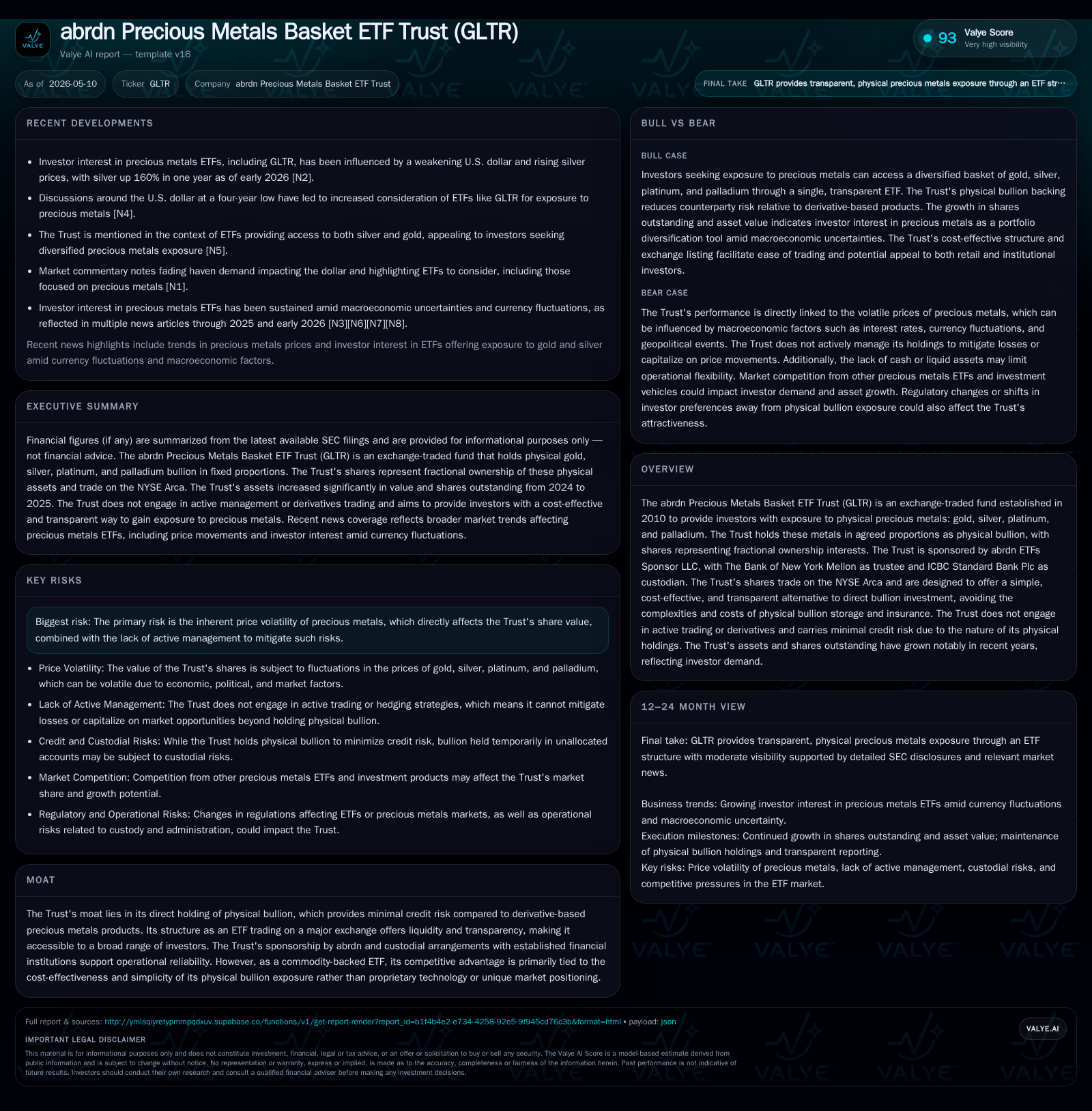
The abrdn Precious Metals Basket ETF Trust (GLTR) recently reported a significant increase in shares outstanding and net asset value as of its May 2026 quarterly filing, reflecting growing investor interest in physical precious metals via a cost-effective and transparent exchange-traded vehicle. GLTR’s business model centers on direct ownership of gold, silver, platinum, and palladium bullion, offering minimal credit risk compared to derivative-based alternatives. While industry pressures such as metal price volatility and a passive structure pose risks, demand for liquid, easily accessible bullion exposure continues to drive growth. Key upcoming metrics to monitor include continued share issuance trends and developments in underlying metal markets influencing valuation.
Latest Quarterly Highlights: Growth in Shares and Bullion Holdings
In its latest quarterly report dated May 8, 2026, the abrdn Precious Metals Basket ETF Trust (ticker: GLTR) detailed substantial growth markers underpinning its current operational momentum [S2]. The Trust’s shares outstanding climbed markedly to approximately 12.5 million by December 31, 2025 from 9.5 million at the end of 2024—up roughly 31%—driven by investor demand for simple exposure to a diversified basket of precious metals [S1]. Correspondingly, net assets surged from about $1.04 billion to $2.58 billion over the same period, underscoring successful scaling of net inflows invested directly into physical bullion holdings [S1]. No material changes were reported in risk factors since the annual filing earlier that year indicating stability in operating conditions relative to previously disclosed commodity price volatilities and regulatory frameworks [S2].
These figures provide a real-time lens into GLTR’s ability to attract capital primarily through share creation facilitated by authorized participants who exchange bullion contributions for blocks (baskets) of shares issued by the Trust. This mechanism maintains alignment with the underlying asset composition while expanding shareholder participation.
Trust Business Model: Direct Physical Bullion Ownership as a Core Differentiator
GLTR operates uniquely as a physically backed precious metals ETF offering fractional ownership interests directly tied to gold, silver, platinum, and palladium bullion held within the Trust’s vaults under stringent custodial arrangements with ICBC Standard Bank Plc—the designated custodian responsible for safekeeping the bars—and trustee oversight handled by The Bank of New York Mellon [S1]. This setup distinctly separates GLTR from derivative-laden competitors that rely on futures contracts or swap agreements which introduce counterparty risk.
Investors pay through share purchases on the NYSE Arca exchange where GLTR’s shares reflect pro rata claims on weighted allocations of these four metals based on prevailing LBMA benchmark prices daily calculated by the Trustee. The trust structure excludes active trading or speculative strategies; instead it passively holds physical bullion solely releasing metal only for covering sponsor fees or redemptions initiated through authorized participants exchanging baskets of shares for underlying bullion quantities [S1]. This design preserves minimal credit risk since bullion is not encumbered by third-party loans or derivative contracts.
Industry Structure and Competitive Landscape: ETF Alternatives for Precious Metals Exposure
Within the broad context of precious metals investing, GLTR competes primarily with other ETFs aiming to provide liquid access to bullion markets but distinguishes itself through direct physical custody versus synthetic exposures that rely heavily on derivatives markets regulated under CFTC rules—markets prone to counterparty default risks during extreme events [S1]. Furthermore, GLTR’s basket includes not just gold and silver—common in ETFs—but also platinum and palladium offering diversification across metals with differing industrial roots.
Market structure includes entities like miners, refiners, financial intermediaries, and institutional investors where each metal supply-demand balance varies substantially: gold flows strongly through jewelry (approx. 44% demand), investment bars/coins (~27%), and central bank activity; platinum demand has shifted toward automotive catalytic converters (43%) as jewelry demand wanes; palladium pricing recently experienced volatility due to trade tensions and supply constraints linked to South African production disruptions [S1][S28].
Investor preference favors ETFs like GLTR due to transparent fee structures—distinct sponsorship fees rather than embedded derivatives costs—and ease of trade execution paired with daily NAV disclosure enhancing price discovery. However, narrower spreads between physical holding premiums/demands can fluctuate based on global liquidity conditions.
Growth Drivers: Demand for Transparent, Liquid, and Cost-Effective Bullion Access
Investor appetite for GLTR correlates strongly with macroeconomic factors such as inflationary expectations fueling purchases in traditional safe-haven assets plus geopolitical instability augmenting diversification needs amid equity market turbulence [N1]. The Trust benefits from structural tailwinds including gradual secular declines in jewelry fabrication for certain metals while automotive demand grows especially in platinum and palladium segments where catalytic converter use remains essential even with incremental EV adoption pushing combustion engines toward stricter controls.
From distribution dynamics involving registered broker-dealers acting as authorized participants facilitating creation/redemption baskets of shares against actual bullion delivery—thereby bridging physical markets and securities exchanges—GLTR offers investors cost savings over direct bullion acquisition which requires independent storage insurance logistics [S1]. These efficiency gains help attract institutional investors seeking allocation vehicles resistant to counterparty credit risks.
Risks and Constraints: Market Volatility, Passive Structure, and Metal Price Sensitivity
The most salient risk impacting GLTR stems from direct linkage of share value fluctuations solely to underlying bullion prices—as these commodity values can exhibit wide swings due to economic cycles, currency valuation changes (notably USD fluctuations), interest rate movements impacting opportunity costs of holding non-yielding assets, speculative trading activities worldwide (hedge funds), and shifts in investor sentiment towards inflation hedges or alternative asset classes [S1]. Given GLTR’s purely passive approach with no hedging mechanisms or alpha-seeking overlays, investors are fully exposed to naked price volatility.
Additionally notable is that while physical custody reduces credit risk substantially relative to derivative products it introduces operational dependencies on custodial integrity; any failures in audit assurance or bullion segregation protocols could impact trust valuation confidence though no incidents have been reported recently [S22]. Fee structures growing proportionally alongside asset scale may pressure net returns modestly though current sponsor fees remain competitive vs peers [S9].[S2] Regulatory oversight remains stable with no new pending challenges documented.
Upcoming Milestones and Market Signals to Monitor
Ahead lies close attention toward subsequent quarterly filings updating shares outstanding data clarifying whether investor inflows towards this vehicle sustain post-2025 momentum or see moderation amid shifting precious metals price cycles. Similarly pivotal will be tracking gross asset volumes reflecting changes in underlying metal allotments responding to rebalancing needs driven by varying metal price differentials impacting basket weighting economics [S2].[N1]
Monitoring platinum and palladium pricing remains crucial given recent pronounced volatility fueled by supply supply-chain interruptions in South Africa combined with evolving automotive emissions standards influencing industrial demand volumes—a dynamic factor likely affecting GLTR’s balance sheet composition directly given fixed metal proportions maintained over time [S28].
Investors should also observe fee disclosures published alongside filings which can signal economies or diseconomies of scale within ongoing sponsor operations underpinning overall expense ratios impacting net returns even in low turnover structures.
Financial Overview: Supporting Evidence from Latest Reporting
Operationally supported by its reporting framework under SEC regulations filed timely via annual Form 10-K/A (March 2026) complemented by recent Form 10-Q (May 2026), GLTR showcases steady scale expansion evidenced through sponsor fee increases: approximately $9.54 million for full-year 2025 up from $6.06 million prior year reflecting asset base growth consistent with rising share issuance activity [S9].[F1] The absence of leverage or borrowing arrangements corroborates minimal financial risk lowering balance sheet complexity.[F1]
Cash balances remain negligible consistent with passive structure; no significant liquidity issues noted affirming resilience against short-term market disruptions.[F1] Expense controls encompassing custodian fees, trustee administrative costs, legal expenses capped annually near $100k maintain expenses proportionality aligned with industry standards.[S16]
Overall financial profile depicts a clean pass-through model focused on transparent asset custody minimizing capital deployment beyond essential operational outlays thereby facilitating straightforward valuation translation directly tied to metal market movement without layered credit exposures.
This analysis is based solely on information publicly available through abrdn Precious Metals Basket ETF Trust's recent SEC filings as of May 2026 along with supplementary market context references; it does not constitute investment advice or recommendations.
Disclaimer: This is research-only, informational analysis and not investment advice. It may include AI-generated interpretation and general industry context. Always verify important details using primary sources.

Comments