
KKR Strengthens Diversification with Stable Insurance Segment Amid Q1 Revenue Rise
KKR reported solid Q1 2026 results supported by diversified asset management and resilient insurance operations, while navigating market variability.
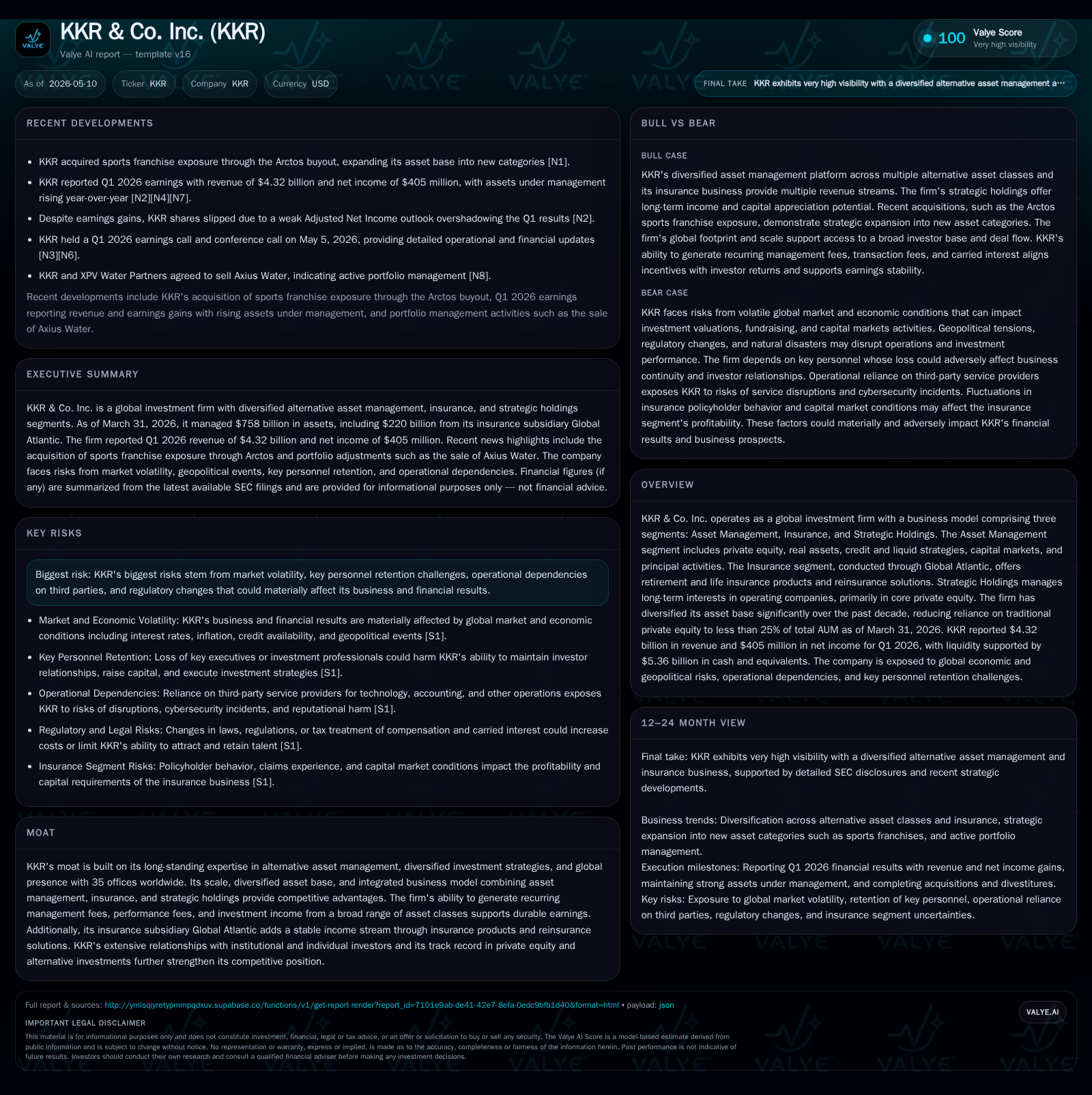
In its latest quarterly filing, KKR demonstrated continued diversification with $758 billion AUM, including a $220 billion insurance segment. The company’s Q1 2026 revenue rose to $4.32 billion with net income of $405 million, underpinned by investment gains despite lower realized investment income. Its insurance fixed maturity securities maintain strong credit quality, supporting stable earnings. KKR’s integrated business model across asset management, insurance, and strategic holdings positions it well amid market uncertainties. Risks remain from market volatility, personnel retention, and regulatory shifts.
Recent Operating Update: Q1 2026 Highlights
KKR’s most recent quarterly report filed May 8, 2026 [S2] reveals steady progress in its diversified alternative asset business. Revenue for the first quarter advanced to $4.32 billion with net income at $405 million. Despite a decrease in realized investment income—driven primarily by transaction volume variability—KKR successfully monetized select portfolio investments such as J.B. Chemicals & Pharmaceuticals and BrightSpring Health Services. The firm reported $5.36 billion in cash and equivalents maintaining liquidity flexibility.
Importantly, the Insurance segment showed stable credit quality in fixed maturity securities with 95% rated investment grade by the NAIC and NRSROs, consistent with year-end levels [S2]. New business flows in annuities and life insurance products remain foundational to recurring revenue generation amidst fluctuating volumes in block reinsurance transactions.
The firm also confirmed a dividend increase to an annual aggregate payout of $0.78 per common share and continued execution of its stock repurchase program with approximately $122 million remaining authorization [S4][S19].
Business Model Overview
KKR operates through three synergistic segments aligning closely with its long-term vision to drive durable earnings across complementary platforms [S1][S2].
Asset Management: Encompasses five principal lines—private equity, real assets, credit/liquid strategies, capital markets underwriting/syndication, and principal activities where KKR commits balance sheet capital. This segment has notably evolved beyond traditional private equity—once exceeding 70% of AUM—to a diversified base where private equity now constitutes less than 25% of total assets under management ($758 billion as of March 31, 2026) [S1]. Growth initiatives target high-demand alternatives like infrastructure and growth equity driven by the firm's global sourcing capabilities.
Insurance: Conducted via Global Atlantic launched in 2021 acquisition offers retirement products (annuities) and life insurance alongside reinsurance solutions. This segment adds a defensive ballast with steady fee income and actuarial margins insulated from typical market cycles, given the asset-liability matching approach underscored by rigorous hedging programs against interest rate and equity volatility [S1][S2]. The credit quality of held securities remains strong with approximately 95% investment grade as rated by NAIC and NRSROs, supporting risk-managed underwriting [S2].
Strategic Holdings: Reflects KKR’s proprietary investments in operating companies predominantly within core private equity sectors providing upside from operational improvements and exit opportunities.
Revenue drivers stem from multi-source fee streams including asset management fees based on committed/invested capital or AUM levels; performance fees tied to realized profits; underwriting fees; investment income on balance sheet interests; insurance premium flows; and associated policyholder deposits/reinsurance premiums.
Critical to KKR’s model is its capital allocation expertise enabling efficient deployment across these interconnected verticals leveraging deep industry knowledge and a collaborative culture fostering cross-segment synergies.
Industry Structure and Competitive Positioning
KKR maintains a leadership position among global alternative asset managers owing to scale ($758B AUM), geographical reach (35 offices worldwide), product breadth spanning illiquid assets (private equity, real assets) and liquid credit markets plus insurance solutions [S1]. Its pioneering role in leveraged buyouts historically cemented brand cachet facilitating access to premium deal flow.
Compared with peers concentrated largely on single asset classes or geographies, KKR’s vertically integrated platform captures value throughout the lifecycle—from fund origination through capital markets syndication to balance sheet investments—offering diversified revenue streams that temper cyclicality.
Strategic acquisition of Global Atlantic marked a distinctive pivot towards combining asset management with regulated insurance operations providing steady fee income less correlated to broader capital market swings [N3]. Furthermore, KKR’s capacity to raise capital even under constrained market conditions demonstrates institutional confidence fueled by robust risk governance frameworks.
Growth Drivers
Key growth catalysts reside in multiple dimensions:
- Continued diversification away from traditional private equity into fast-growing sectors like infrastructure, renewable energy investments aligned with ESG themes increasingly demanded by institutional clients.
- Expansion within credit markets including CLO issuance/management where KKR holds competitive advantages through proprietary origination capabilities and investor relationships [S2].
- Insurance segment expected to deepen product offerings addressing aging demographics globally driving demand for retirement solutions; actuarial innovation and product customization could further enhance margins.
- Capital markets business complements underwriting activity with syndicated debt/equity issuances benefiting from increased corporate funding needs amid economic cycles.
- Strategic Holdings may realize value through exits or operational enhancements providing episodic boosts to earnings.
- Leveraging proprietary technology platforms for data-driven investment decisions that improve sourcing efficiency and portfolio monitoring represents an ongoing innovation vector.
These drivers correspond closely to key metrics such as new capital commitments reflected in unfunded commitments which stood at $9.1 billion as of Q1 end including $2.7 billion for core private equity [S2][S13], indicating substantial latent deployment capacity.
Risks and Growth Constraints
Notwithstanding strengths, KKR faces notable challenges:
- Market volatility impacts valuations particularly for Level III investments employing discounted cash flow models sensitive to interest rate movements discussed extensively in February annual filing [S1]. Shifts can produce valuation mismatches affecting carried interest revenue recognition timelines.
- Retaining key investment talents is crucial given reliance on specialized teams managing distinct strategies across global offices; loss could impair deal execution agility.
- Regulatory scrutiny escalates across multiple jurisdictions affecting product approvals especially in the insurance business which must comply with state-level solvency standards potentially constraining product design flexibility [S15][S20].
- Credit market disruptions could hinder access to leverage financing critical for acquisitions or CLO warehousing reducing returns or deal flow velocity.
- Policyholder behavior including surrenders or premium deferrals introduces persistency risk affecting expected fee streams in insurance operations [S1][S2].
- Macroeconomic uncertainty including inflation pressures might increase costs across portfolio companies impacting earnings capacity indirectly influencing performance fees.
What To Watch Next
Investors should monitor upcoming milestones likely disclosed in subsequent quarterly updates:
- Progression on new fund closings particularly outside core PE areas signaling successful capital raising drives.
- Trends in Global Atlantic’s individual market sales volumes for annuities and life products providing insight into sustained growth or emerging headwinds [S2].
- Realization events or strategic disposals within Strategic Holdings segment driving realized gains impacting near-term profitability.
- Relative performance of credit strategies including CLOs amidst changing interest rates regime aiding margin visibility.
- Updates on regulatory developments affecting IAIG designation or group-wide capital standards which may materially alter insurance subsidiary operating constraints [S15].
- Any revisions in dividend policy or share repurchase programs reflecting confidence in cash flow stability [S19][S4].
Financial Profile Summary
This analysis synthesizes publicly available regulatory filings alongside contextual industry knowledge without offering investment guidance or recommendations. Readers should consider comprehensive disclosure documents before forming any opinions relating to KKR & Co. Inc.
Disclaimer: This is research-only, informational analysis and not investment advice. It may include AI-generated interpretation and general industry context. Always verify important details using primary sources.

Comments