
Customers Bancorp Leverages Diversified Lending to Seize 2026 Growth Opportunities
Strong Q1 earnings and active capital management underscore Customers Bancorp’s strategic momentum in specialty lending.
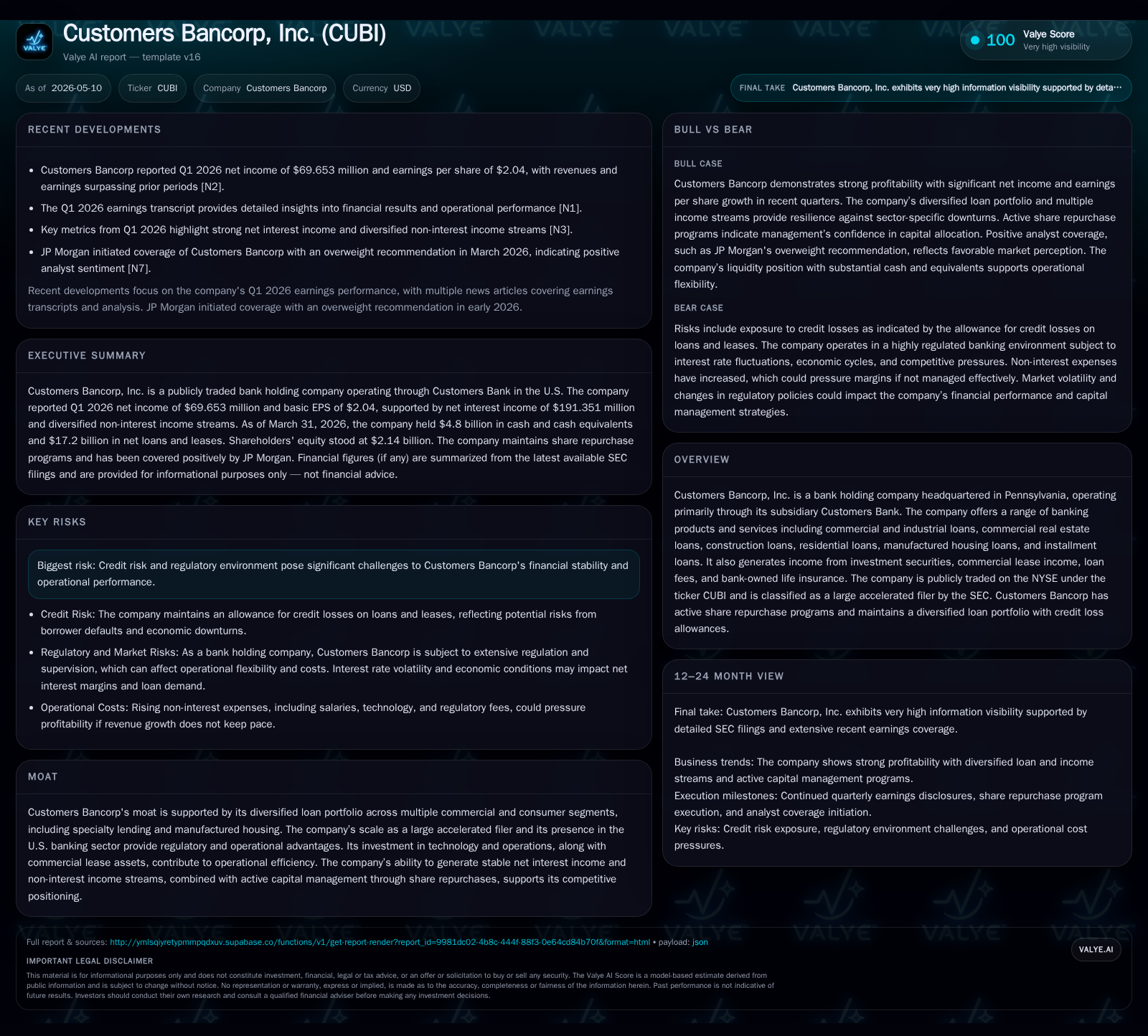
Customers Bancorp reported a significant rise in net income and net interest income in Q1 2026, driven by loan portfolio growth and higher yields, while maintaining disciplined expense control. Its diversified lending across commercial, residential, and specialty sectors, supplemented by stable non-interest income sources such as commercial lease revenue, underpins a resilient business model. Active share repurchase programs and technology investments enhance capital efficiency and competitive positioning amid evolving regulatory and credit risks.
Q1 2026 Operating Highlights: Momentum Building
Customers Bancorp’s first quarter of 2026 marked a clear inflection point in financial performance compared to the prior year period. Net income rose sharply to $69.7 million—more than fivefold improvement compared with $12.9 million for Q1 2025—anchored by an increase in net interest income that grew approximately 14% year-over-year to $191.4 million [S2]. This growth was primarily driven by a notable rise in loan and lease interest income to $258.7 million from $231.0 million a year earlier, indicating robust loan portfolio expansion alongside rising yields.
Despite higher interest income, the firm managed to contain interest expense on deposits at $126.1 million versus $131.3 million previously, reflecting stable cost of funds monitoring amid a generally elevated rate environment. This careful balancing of funding costs contributed to a healthy net interest margin trajectory after accounting for provisions for credit losses that declined slightly versus prior periods ($23.4 million vs $28.3 million) [S2].
Non-interest income swung from a loss in Q1 2025 (-$24.5 million) into positive territory at $34.3 million this quarter. The driver was a substantial increase in commercial lease income which rose over 44% YoY to $15.4 million alongside a rebound in loan fees ($10.5 million vs $7.2 million) and contributions from mortgage finance transactional fees [S2]. These diversified revenue streams provide a buffer against fluctuations in traditional banking margins.
The company continues active capital management through share repurchase programs authorized most recently in early 2026 following the prior initiative launched in 2024 [S2,S3]. These programs highlight management’s focus on optimizing the equity base alongside organic growth efforts.
Customers Bancorp Business Model and Product Strengths
At its core, Customers Bancorp operates via its subsidiary Customers Bank providing multi-faceted banking services centered on its diversified loan portfolio strategy detailed in the annual filing [S1]. The primary revenue mechanism is net interest income generated chiefly from:
- Commercial & Industrial Loans: Targeting middle-market businesses with customized lending solutions.
- Commercial Real Estate Loans: Including owner-occupied and non-owner occupied properties offering secured financing.
- Construction Loans: Financing short-term development projects with higher-risk premium returns.
- Residential Loans: Broad-based mortgages with inclusion of manufactured housing loans—a specialty segment less exposed to typical regional market cycles.
- Installment Loans: Consumer-focused products extending credit for durable goods or refinancing needs.
This segmentation allows for risk distribution across borrower types and economic cycles while preserving pricing power through specialized underwriting disciplines particularly in manufactured housing lending where competition is more limited [S1].
Additionally, the company leverages non-interest income sources effectively:
- Investment Securities Income: Yield from held-to-maturity securities supplements core lending returns.
- Commercial Lease Income: Ownership of leased commercial properties enhances fee-based revenue streams.
- Loan Fees: Origination and servicing fees stabilize top-line revenue absent direct interest spread.
- Bank-Owned Life Insurance: Provides tax-advantaged earnings although subject to market valuation volatility.
Operationally, Customers Bancorp has invested considerably in technology platforms enhancing credit risk assessment accuracy and customer interface experiences. These initiatives improve scalability as volumes grow without commensurate cost inflation—evidenced by modest non-interest expense growth despite rising salaries and expanded lease depreciation related to growing asset base [S2,S1].
Competitive Standing Within the Banking Sector
Positioning as a large accelerated filer imparts scale benefits to Customers Bancorp unseen among smaller regional peers lacking both market presence and regulatory bandwidth [S1]. In comparative terms:
- The company has carved out niche leadership in specialty lending areas such as manufactured housing loans where pricing power remains intact due to fewer directly competing lenders with equally tailored underwriting capabilities.
- Investment in operational technology contrasts favorably with legacy manual processes common among many regional banks, fostering better risk-adjusted growth opportunities through improved loan origination efficiency.
- Capital programs including share repurchases demonstrate disciplined allocation tendencies favoring return of capital balance against strategic reinvestment needs [S2,S3]. This supports shareholder value enhancement beyond pure organic expansion.
The firm nevertheless competes against both traditional banks focused on commoditized offerings as well as emerging fintech entrants increasingly encroaching upon consumer segments; however, strong historical asset quality control combined with diverse product mix limits vulnerability relative to more concentrated peers operating within single-sector dependencies or thin deposit franchises [S1].
Key Growth Drivers Fueling Future Expansion
Several observable vectors underpin Customers Bancorp’s growth outlook:
- Loan Portfolio Yield Expansion: Continued increases in short-to-medium term interest rates have lifted loan yields substantially during early 2026 while deposit costs have stabilized or declined modestly. This spread expansion fuels net interest margin gains critical for earnings leverage [S2,N2].
- Manufactured Housing Market Penetration: As an underserved niche with structural supply-demand imbalances favoring lenders able to apply specialist knowledge and tailored products, strong demand is expected to persist providing sustainable volume growth opportunities [S1,N1].
- Commercial Lease Asset Growth: Accretion of high-quality leased property assets enhances recurring non-interest income while potentially appreciating capital base values adding optionality beyond banking spreads [S2].
- Digital Platform Scaling: Investments improving customer onboarding funnel efficiency alongside enhanced underwriting analytics facilitate prudent expansion into new commercial clients and smaller consumer segments without proportionate operational scaling costs [N1,S1].
- Active Capital Management: Reinvestment via ongoing share repurchase programs authorized through 2026 adjusts equity base dynamically supporting return metrics even amid cyclical headwinds or incremental funding needs [S2,S3].
Combined together these drivers suggest scalable profit pools anchored on both volume/mix gains plus improved operating leverage realizable through technology adoption while maintaining balanced risk-taking parameters.
Risks and Constraints Facing Customers Bancorp
The company faces several watchpoints that could constrain growth or pressure margins:
- Credit Risk Volatility: Diversified loan portfolios require ongoing monitoring as allowance for credit losses may fluctuate materially depending on economic cycles impacting sectors such as construction or manufactured housing which can be more sensitive to localized conditions [S1,S2].
- Regulatory Environment Uncertainty: As a large accelerated filer subject to comprehensive compliance regimes including capital adequacy standards potentially tightening further under evolving Basel norms or U.S.-specific rulemakings may increase operational complexity and capital charge burdens constraining profitability or lending capacity [S1].
- Interest Rate Sensitivity: While recent rate hikes have benefited loan yields, rapid shifts upwards could adversely impact credit quality or push deposit costs higher than current stable ranges limiting margin upside potential despite product diversification [S2,N3].
- Competitive Pressures from Fintechs: Incursion by fintech lenders capable of lowering barriers for consumer borrowing combined with changing payment technologies could erode certain consumer-originated lines unless countered effectively by product innovation and customer experience enhancements [S1,N3].
- Operational Expense Inflation: Salaries & employee benefit costs rose notably quarter-over-quarter due partly to wage inflation; sustaining cost discipline while investing for growth remains challenging amidst competitive markets for talent particularly technology-skilled labor pools [S2].
Maintaining proactive balance sheet management alongside vigilant reserve calibrations will be essential guiding prudence amid these risks.
Upcoming Catalysts and Monitoring Points
Key near-term events that will provide insight into the durability of recent operating momentum include:
- The next quarterly earnings report which will reveal whether loan yield improvements continue versus cost pressures on deposits remain contained; updated guidance on net interest margin development also critical [S3,N2].
- Progress on execution scale within the newly authorized 2026 share repurchase program indicating confidence levels around earnings trajectory supporting capital return policies [S2,S3].
- Quarterly updates on credit quality metrics including delinquencies/internally graded exposures especially within construction and specialty housing portfolios providing forward-looking signals of impairment trends given cyclical elements involved [S2].
- Regulatory notifications around changes impacting bank capital buffers or compliance requirements signaling adjustments needed either in loan mix strategies or capital allocation frameworks affecting operational limits [S1,S3].
- Adoption rates for digital platform enhancements drawing measurable customer acquisition/retention KPIs shedding light on sustainable franchise expansion potential beyond commodity lending realms [N1,N2].
Monitoring these factors will offer timely perspectives on whether Customers Bancorp can sustain recent earnings rhythm while advancing strategic objectives sustainably.
Financial Snapshot: Recent Performance Metrics
The company’s balance sheet shows cash and cash equivalents of approximately $4.8 billion as of March 31, 2026, reflecting strong liquidity [S2]. While total debt details are not explicitly stated in the latest filings, the company’s funding structure continues to rely primarily on stable deposit bases with controlled funding costs supporting efficient deployment into earning assets such as loans and investment securities [S2].
Net income reached an impressive $69.7 million this quarter up sharply versus last year’s Q1 figure translating into basic earnings per common share of $2.04 evidencing profitable scale leverage on maintained margin dynamics despite moderate expense increases mainly linked to growing personnel costs reflecting business scaling investments [S2].
It does not constitute investment advice but serves as an informed review grounded in disclosed operating data.
Disclaimer: This is research-only, informational analysis and not investment advice. It may include AI-generated interpretation and general industry context. Always verify important details using primary sources.

Comments