
FirstSun Capital Bancorp Extends Regional Footprint with Strategic Mergers and Steady Deposit Expansion
The completion of First Foundation merger broadens FirstSun’s multi-state presence, while deposit growth and loan deployment sustain its community banking momentum.
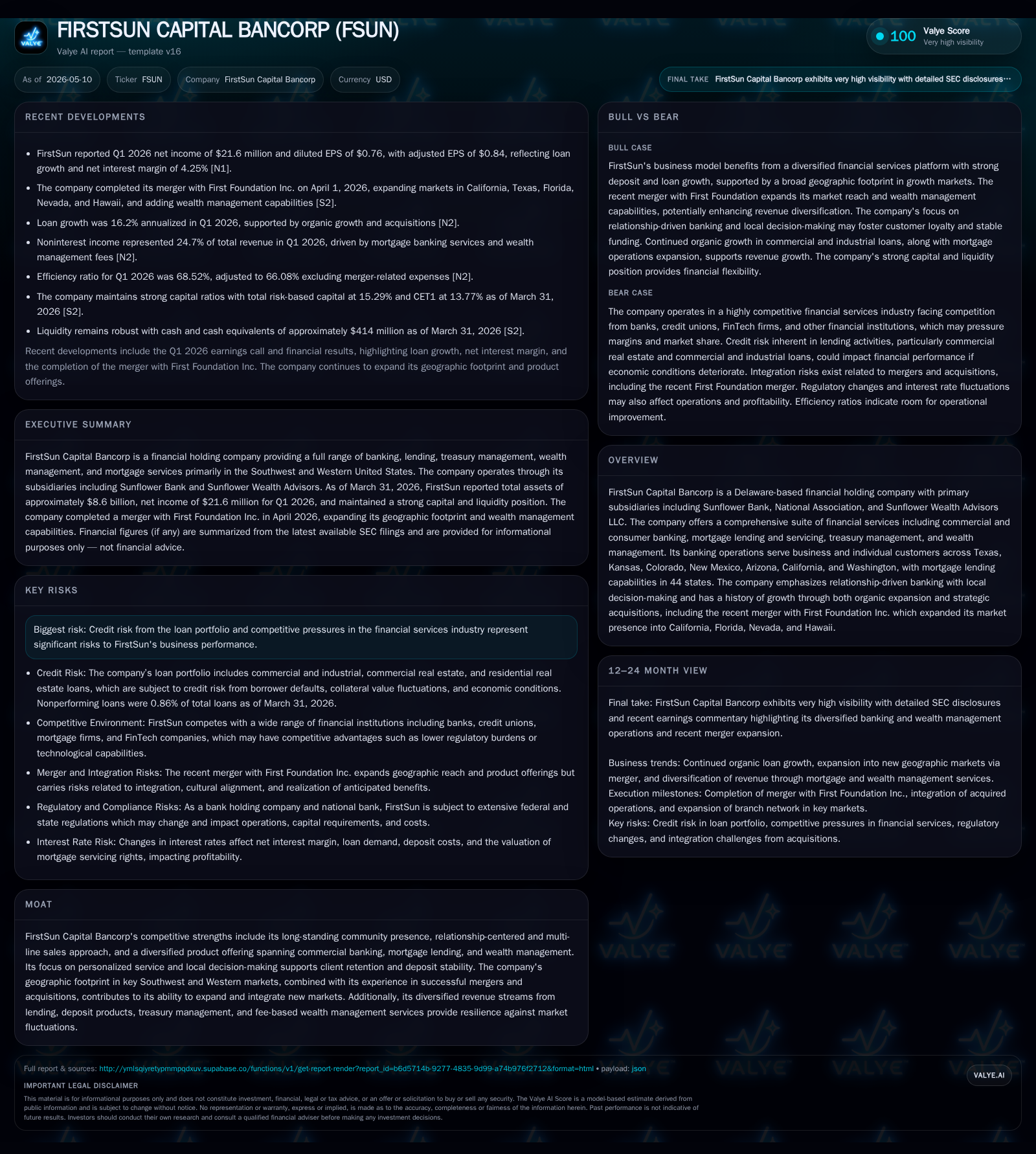
FirstSun Capital Bancorp finalized the acquisition of First Foundation Inc. after quarter-end, significantly expanding its footprint into California, Florida, Nevada, and Hawaii. Despite the merger closing post March 31, the bank displayed strong underlying operating trends in Q1 2026, marked by a rising loan-to-deposit ratio reflecting effective balance sheet utilization amid sustained customer deposits. The company’s diversified financial services—from commercial banking to wealth management—underpin a resilient business model with stable funding sources and growth-driven by geographic expansion and product cross-selling. However, credit risk management and competitive pressures remain material considerations as integration progresses. Upcoming milestones include full financial integration of First Foundation’s results and assessment of synergy capture.
Latest Quarter Insights: Merger Integration and Deposit Dynamics
In the first quarter ending March 31, 2026, FirstSun Capital Bancorp completed its strategic merger with First Foundation Inc. on April 1, shortly after quarter-end. This transaction notably extends FirstSun’s market footprint beyond its established Southwest base into high-growth areas like Southern California, Florida, Nevada, and Hawaii through the acquired banking and wealth advisory platforms [S2]. Because the merger closed post-quarter close, the financial results of First Foundation are not yet reflected in reported Q1 consolidated numbers but are expected to materialize in subsequent periods.
Meanwhile, operational metrics within Q1 evidence robust organic momentum. Most saliently, the loans-to-deposits ratio rose markedly to 97.9% at March 31 from 93.9% at December 31, highlighting greater utilization of stable funding sources to fuel asset growth [S2]. Customer deposits continue serving as the bedrock for liquidity; deposits showed steady increases underpinning this expansion. Complementing deposit funding are secured borrowing lines via membership in the Federal Home Loan Bank system and Federal Reserve discount window facilities—both contingent on pledged assets—which provide additional structural flexibility [S2].
The company also refined its deposit classification practices regarding NOW accounts due to changes in reserve requirement calculations; these reclassifications had no material income or equity impact but reflect evolving regulatory nuances [S2].
Business Model and Franchise Strengths
FirstSun operates as a diversified financial holding company anchored by Sunflower Bank N.A., offering extensive community banking products across business lines including commercial/industrial loans (with emphasis on small- to medium-sized enterprises), commercial real estate financing, residential mortgages across 44 states through an expansive platform, as well as consumer lending [S1]. Complementing lending services are treasury management solutions aiding businesses’ cash flow optimization.
Wealth management forms a strategic pillar via Sunflower Wealth Advisors LLC alongside recently added First Foundation Advisors after the merger. This multi-line approach aims to deepen client relationships through cross-selling while ensuring revenue diversification that tempers reliance on interest income alone—a significant moat feature given banking sector cyclicality.
A core distinctive element is localized decision-making granting frontline bankers autonomy to tailor solutions responsive to community-specific needs—an advantage boosting client retention and deposit stickiness amid broader industry consolidation trends favoring scale over personalization [S1]. The company’s geographic concentration in rapidly expanding Southwest and Western states complements this philosophy by leveraging regional economic growth drivers.
Competitive Positioning Within Regional Banking
Within competitive dynamics encompassing myriad players from national banks to fintech mortgage originators and credit unions, FirstSun asserts itself through relationship-centric sales precepts linking mortgage lending capabilities with local commercial banking expertise backed by an array of fee-based wealth offerings [S1][N1]. This integrated ecosystem builds switching costs for clients valuing personalized advisory over transactional interactions.
Regulatory environment shifts have somewhat eased intensity following deregulation advances but continue to impose compliance overheads especially post-merger—a fairly typical mid-sized regional bank challenge requiring sustained investments in cybersecurity (such as dedicated CISO-led governance) and risk management frameworks discussed in annual disclosures [S1].
Against peers largely confined geographically or product-wise, FirstSun’s recent market extensions via acquisition signal a deliberate strategy balancing organic growth with opportunistic inorganic expansion enhancing franchise scale across relevant markets.
Key Growth Drivers Across Markets and Products
FirstSun's near-term growth vectors clearly include:
- Expanded California Presence: The acquisition positions the company in one of the largest mortgage lending markets nationally plus access to affluent clientele conducive to wealth advisory upsell。
- Texas Market Momentum: Organic loan growth continues prominently in Texas markets like Dallas where previous acquisitions reshaped competitive stance; continued origination activity supports pipeline strength.
- Mortgage Lending Scale: Servicing capabilities span 44 states offering flexibility to capitalize on diverse housing market dynamics supporting steady volume potential despite headwinds facing national mortgage originators。
- Deposit Stability Framework: Sustained customer deposits provide low-cost liabilities fueling net interest margin uplift opportunities combined with efficient capital deployment evidenced by increasing loan-to-deposit ratios [S2][F1].
- Cross-Selling Wealth Management: Leveraging newly enlarged client base for increased fee income generating segments with synergies post-merger complementing overall revenue mix health.
These drivers contribute to reported Q1 metrics showing adjusted net income stability ($23.7 million) alongside noninterest income rising as a proportion of total revenues (24.7%), underscoring diversification success [S2].
Risks and Operational Constraints Ahead
Material risks stem mainly from:
- Credit Risk: Loan portfolio growth trends accompanied by elevated provisions for credit losses ($8.3 million in Q1 versus $3.8 million prior year) require vigilant underwriting especially given exposures in commercial real estate sectors vulnerable to economic fluctuations.[S2][S16]
- Competitive Pressures: Intense competition persists both from digital mortgage lenders capturing retail segments along with larger regional banks consolidating market share necessitating continued differentiation via service quality.
- Cost Pressures Amid Integration: Merger-related expenses plus regulatory compliance demands may pressure operating efficiency ratios which modestly increased versus prior year (68.5% vs. ~65%) indicating integration execution costs affecting margins short-term.
- Interest Rate Sensitivity: Asset-liability management complexity heightened by changing rate environments could influence net interest margins given mix shifts between variable/fixed rate loans.[S18]
Monitoring these risk elements remains crucial for sustaining profitability during scaling phases ensuing merger effects.
Monitoring Milestones: What Investors Should Watch Next
Important forward-looking points include:
- Q2-Q3 Earnings Releases: Expect inclusion of full First Foundation financials impacting top-line expansion metrics; close scrutiny of margin dynamics plus expense synergies realization success will be critical.
- Deposit Retention & Growth Trends: Measuring how newly acquired deposit bases hold up amid competitive landscapes will inform liquidity stability outlook.
- Credit Quality Metrics Evolution: Tracking allowance coverage ratios alongside nonperforming asset trajectories will provide signals on portfolio health amid loan portfolio expansion.
- Fee Income Trajectory: Progression in wealth management revenue generation reflecting cross-selling effectiveness post-merger offers insight into diversification robustness.
- Operational Integration Updates: Updates around cultural alignment initiatives and technology platform mergers can offer early readouts on potential cost rationalization or risks.[N1][S2]
These milestones tie directly into validating strategic hypotheses underpinning recent corporate moves.
Supporting Financial Highlights from Q1 2026
Financially, Q1 showcased substantial improvements supportive of operational narratives: net interest income rose by $8.3 million year-over-year reaching $82.8 million driven largely by increased loan volume (+6.8%) alongside improved net interest margin expanding to 4.25% (up from 4.07%) partly due to reduced interest expense costs despite some yield compression on earning assets [S22]. Noninterest income grew reflecting higher mortgage banking activity and wealth fees augmenting total revenue composition toward diversification benchmarks (~24.7% contribution) [S24].
Provision for credit losses doubled relative to prior year reflecting cautious risk posture amid loan book expansion but remained well-covered within overall asset quality parameters indicated by stable nonperforming loan ratios below historical peaks (0.86%) [S10][S22]. Liquidity remains solid with $414 million cash equivalents buffering balance sheet supported by strong deposit bases totaling approximately $7.09 billion—showcasing ongoing funding stability aligning with strategic objectives [F1][S25].
Overall capital adequacy is preserved with equity rising modestly sequentially providing latitude for continued organic growth executions alongside acquisition-related expenditures without immediate capital constraints.
Disclaimer: This analysis is based solely on publicly available SEC filings and disclosed corporate communications as of May 2026 without speculative assumptions or forward-looking advice.
Disclaimer: This is research-only, informational analysis and not investment advice. It may include AI-generated interpretation and general industry context. Always verify important details using primary sources.

Comments