
FTAI Infrastructure Expands Strategic Footprint with Robust Q1 Results
FTAI Infrastructure showcases operational resilience and strategic asset deployment in its latest quarter amid evolving infrastructure demands and macro challenges.
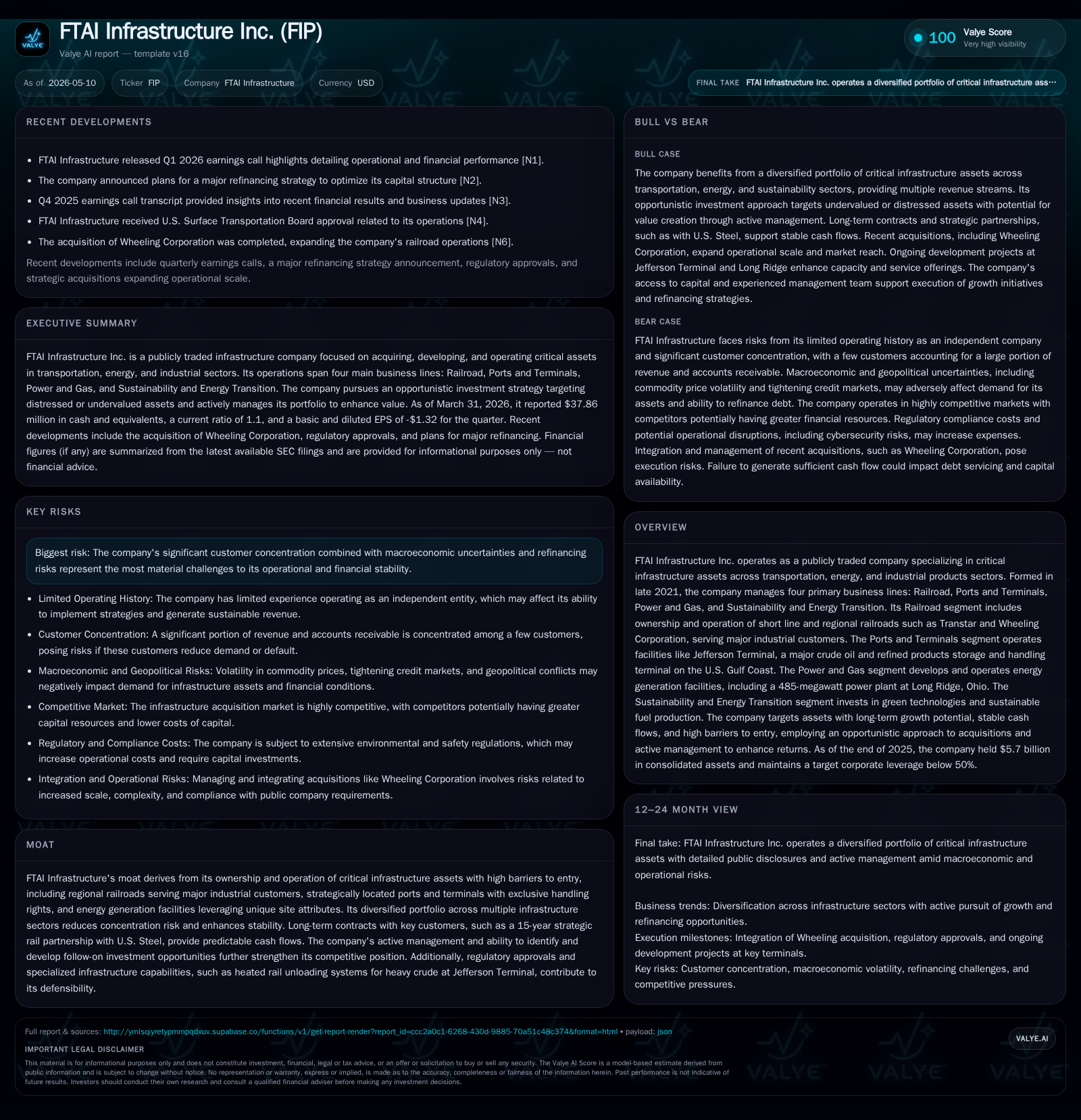
In its Q1 2026 filing, FTAI Infrastructure demonstrated stable revenue generation from its diversified infrastructure portfolio across railroads, ports, power, and sustainability sectors. The company capitalized on its critical assets such as short line railroads and Gulf Coast terminals to maintain cash flow visibility despite customer concentration risks and macroeconomic headwinds. Its strategy of opportunistic acquisitions and follow-on investments positions it to leverage growing North American heavy crude production and energy transition trends while managing leverage carefully. Monitoring contract renewals, capex execution, and refinancing efforts will be key in the near term.
Latest Quarterly Operating Update: Highlights and Implications
FTAI Infrastructure’s Q1 2026 results filed on May 8 revealed steady operational traction across its core segments [S2]. Revenue contributions were well balanced with the Railroad segment accounting for roughly one-third of total revenue, supported by ongoing volume from contracts such as the long-term partnership with U.S. Steel [S1]. Ports & Terminals posted growth attributable to increased activity at Jefferson Terminal, a strategically positioned crude oil storage and handling hub on the U.S. Gulf Coast, benefiting from surging volumes of heavy Canadian and Utah crude transported via rail owing to pipeline capacity constraints [S1][N1].
The Power and Gas segment recorded consistent output from its key asset, the 485 MW Long Ridge combined cycle gas plant in Ohio. The company continues evaluating hydrogen blending initiatives in collaboration with GE to align with decarbonization trends [S19]. Meanwhile, the Sustainability and Energy Transition division advanced investments in green technology firms aiming to expand its foothold in emerging sustainable infrastructure markets.
Importantly, customer concentration dynamics saw some moderation in Q1: one largest Railroad customer contributed approximately 22% of revenues compared to over 40% a year prior, indicating improved diversification but still material exposure [S15]. Similar patterns held for Jefferson Terminal’s top client at about 7%. These contracts provide predictable cash flows but require close monitoring amid market uncertainty.
Capital deployment remained active as the company pursues follow-on investments to enhance terminal throughput capabilities aimed at hitting long-term targets of close to 545,000 barrels per day throughput at Jefferson [S3][S18]. Operational efficiency initiatives focus on maintaining margins despite inflationary pressures.
Business Model and Segment Overview: Asset Diversity as a Competitive Edge
FTAI Infrastructure operates an integrated portfolio across four segments: Railroad, Ports & Terminals, Power & Gas, and Sustainability & Energy Transition [S1]. This diverse mix mitigates sector-specific cyclicality while leveraging synergies around energy transportation and generation.
The Railroad segment owns short line railroads such as Transtar and Wheeling Corporation that serve major industrial clients including steel producers under multi-year contracts facilitating predictable revenue streams [S4]. Its positioning enables transport of heavy crude oils unsuitable for pipelines due to viscosity or wax content—railcar logistics remain crucial given regional takeaway constraints.
Ports & Terminals centers around Jefferson Terminal along the Gulf Coast which handles crude oil, refined products, and clean fuels storage with specialized offers like heated unloading systems for heavy crude—an asset-level differentiation that erects barriers against new entrants [S25]. Repauno complements with industrial property development supporting energy sectors.
Power & Gas includes Long Ridge plant whose location adjacent to industrial hubs provides dispatch flexibility; ongoing evaluation of hydrogen blending represents strategic pivot toward lower-carbon power solutions [S19].
Lastly, the Sustainability segment encapsulates growth aspirations in green tech investments that complement traditional infrastructure holdings by addressing client carbon footprint reduction goals through emerging technologies.
Corporate strategy emphasizes acquisition of undervalued or distressed infrastructure assets where active management can unlock value alongside reasonable leverage discipline targeting consolidated capital structure below 50% debt [S12][S16].
Industry Context: Competition, Barriers to Entry, and Regulatory Dynamics
Competition within infrastructure asset acquisition is intense involving traditional players like regulated utilities and ports operators alongside new private equity entrants attracted by long-duration cash flows [S4][S25]. However, regulatory approvals pose significant hurdles particularly in energy infrastructure sectors demanding compliance with environmental standards increasingly tightened due to climate change policies [S15][S26].
Additionally, high switching costs related to rail logistics services stem from physical network constraints, safety certifications, and tailored equipment (e.g., heated rail terminals), which protect incumbents such as FTAI’s railroad holdings. Similarly, port terminals’ locational advantages on the Gulf Coast near refineries configured for heavy crude processing create economic moats difficult for newcomers to replicate quickly [S25].
The power generation market likewise operates under regulatory regimes affecting permitting for fuel blends or emissions controls; Long Ridge's pioneering work on hydrogen-blended gas firing may ease future transitional risks versus competitors reliant solely on natural gas [S19].
Growth Catalysts: Infrastructure Demand and Energy Transition Opportunities
Structural growth drivers underpin demand for FTAI’s core offerings. The increasing production of North American heavy crude outstrips pipeline capacity compelling higher usage of crude-by-rail logistics that favor FTAI’s railroad network and Jefferson Terminal throughput [S1][N1]. This trend supports sustained volume expansion alongside associated fee-based revenues.
Electrification trends among industrial sectors near Long Ridge enhance baseload power demand prospects. Furthermore, sustainability-oriented clients seeking emissions reduction foster demand within FTAI’s green technology investments offering potential for profitable adjunct income streams [N1].
Incremental capex is planned to boost terminal utilization rates toward targeted volumes supporting adjusted EBITDA improvement estimates communicated publicly [S18]. The company's proactive reinvestment into existing assets exemplifies its strategy of value creation beyond mere acquisition plays.
Key Risks and Constraints: Customer Concentration and Macroeconomic Exposure
Despite diversification efforts, a significant portion of FTAI’s revenue arises from a small number of customers—one top Railroad client alone accounted for approximately 22% of Q1 revenues while three large customers represent over 40% of accounts receivable—posing potential revenue volatility if contracts are renegotiated unfavorably or diminished due to external shocks [S15][S4].
Macroeconomic uncertainty—including commodity price swings influenced by geopolitical tensions such as Middle East conflicts impacting shipping lanes—could depress transportation volumes or delay terminal expansions harming utilization rates [S2][S25]. Debt servicing presents another watchpoint given total indebtedness near $3.84 billion offset modestly by roughly $38 million cash on hand ([F1]). Liquidity buffers appear limited relative to current liabilities resulting in a current ratio around 1.1x which constrains financial flexibility during downturns or refinancing cycles [F1][S2].
Environmental compliance could impose new cost burdens or project delays especially concerning redevelopment projects at Long Ridge or Repauno sites constrained by regulatory approvals or litigation risk [S26][S25]. Cybersecurity threats also remain pertinent across operational IT systems potentially disrupting critical business functions [S6][S7].
Upcoming Milestones and What to Watch
Key upcoming milestones include management updates at subsequent quarterly earnings releases regarding progress toward full terminal throughput utilization targets at Jefferson as well as contract renewals or negotiations with major railroad customers whose volume commitments significantly influence cash flow visibility [S2][N1]. Capital expenditure pacing on follow-on investments should be monitored given their importance for margin expansion.
Any announced strategic acquisitions or divestitures would signal the firm’s intent toward portfolio reshaping aligning with longer-term industry shifts toward sustainability either through bolt-on green tech companies or further energy transition assets entering the roster [N1][S3]. Refinancing outcomes relative to existing debt facilities will be telling on balance sheet health amid broader credit market conditions.
Financial Snapshot: Balance Sheet, Liquidity, and Leverage
Latest financial snapshot
| Metric | Value | Period |
|---|---|---|
| Cash & equivalents | $38mm | |
| 2026-03-31 | ||
| Total debt | $3.8bn | |
| 2026-03-31 | ||
| Net debt | $3.8bn | |
| 2026-03-31 | ||
| Current assets | $398mm | |
| 2026-03-31 | ||
| Current liabilities | $362mm | |
| 2026-03-31 | ||
| Current ratio | 1.1x | |
| 2026-03-31 |
Source: SEC companyfacts cache [F1].
| Metric | Value |
|---|---|
| Cash & Equivalents | $37.9 million |
| Total Debt | $3.84 billion |
| Net Debt | $3.80 billion |
| Current Assets | $397.6 million |
| Current Liabilities | $361.7 million |
| Current Ratio | 1.1 |
As of March 31, 2026, FTAI Infrastructure exhibits substantial leverage reflecting capital intensity typical for asset-heavy infrastructure firms yet holds sufficient working capital coverage albeit tight liquidity buffers requiring prudent financial management going forward ([F1], [S2]). The modest cash reserves relative to total debt underscore refinancing risk sensitivity especially should market conditions tighten further ([S9],[S23]). Nonetheless, stable asset cash flows from contracted counterparts underpin debt service capabilities.
This analysis integrates disclosures from FTAI Infrastructure's recent SEC filings through May 2026 combined with sector-specific insights relevant to infrastructure investment quality. It reflects nuanced consideration of growth opportunities against embedded risks within infrastructure markets undergoing transformation under energy transition imperatives without offering any investment advice or recommendations.
Disclaimer: This is research-only, informational analysis and not investment advice. It may include AI-generated interpretation and general industry context. Always verify important details using primary sources.

Comments