
abrdn Silver ETF Trust Climbs on Physical Silver Backing and Cost Efficiency
Latest quarterly disclosures affirm growth fueled by direct silver holdings and efficient fee structure amid volatile silver markets.
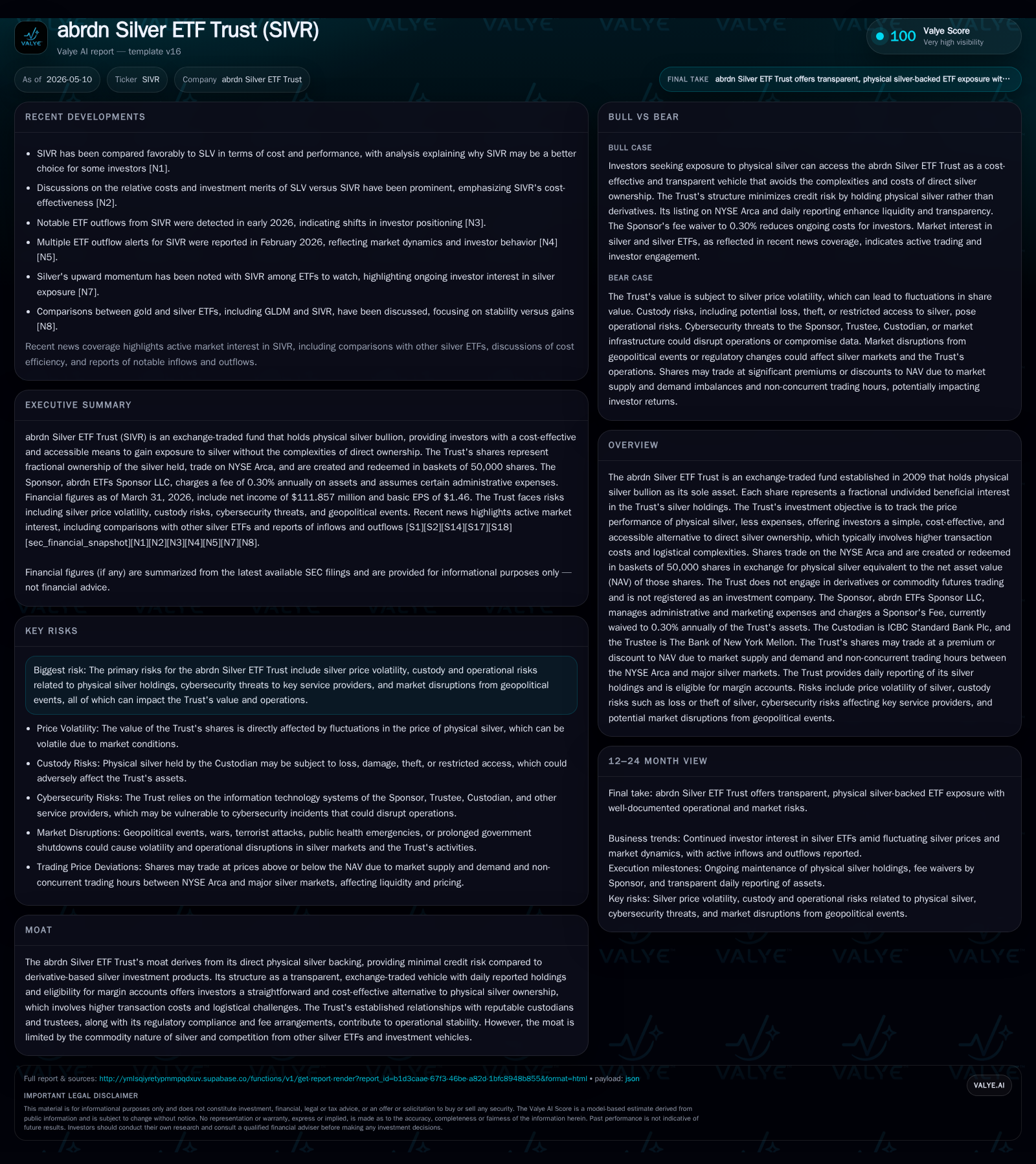
The abrdn Silver ETF Trust's May 2026 quarterly report highlights steady demand expansion, with shares outstanding climbing significantly, underpinning assets and NAV growth. As a purely physically-backed silver trust, it offers investors a transparent, cost-effective alternative to other silver exposure vehicles reliant on derivatives, supported by reputable custodians and daily asset reporting. However, the Trust remains vulnerable to silver price volatility, operational risks related to custody of physical bullion, and geopolitical uncertainties. Going forward, tracking share issuance, silver price trends, and any changes to fee arrangements will be critical to assessing its growth trajectory.
Latest Quarterly Operating Update: Growth and Stability Confirmed
The latest quarterly report reiterates that there are no changes to previously disclosed risk factors related to the Trust’s operation or its underlying asset class ([S2]), indicating stable regulatory compliance and operational status. There is no mention of disruptions or liability events surrounding custodial or trustee functions.
Trust Structure and Business Model Overview
Established in July 2009, the abrdn Silver ETF Trust is designed as a passive holding vehicle that aims to mirror the performance of physical silver bullion's price less expenses ([S1]). Each share signifies fractional undivided beneficial interest in the underlying silver owned by the Trust. The Trust holds no other assets beyond physical silver bars.
Shares are created or redeemed exclusively in baskets of 50,000 shares against corresponding deliveries or receipts of physical silver at net asset value (NAV), enabling authorized participants—registered broker-dealers and financial institutions—to arbitrage discrepancies between market price and NAV ([S1]). This redeemable-creation mechanism supports tight tracking and provides liquidity.
Importantly, the Trust avoids derivatives or futures contracts entirely ([S1]), sidestepping counterparty credit exposure common among other silver ETFs like SLV. Custody is handled by ICBC Standard Bank Plc with trustee oversight by The Bank of New York Mellon (BNYM) ensuring segregation and safekeeping of holdings ([S1]).
The Sponsor—abrdn ETFs Sponsor LLC—charges an annualized fee based on adjusted net asset value (ANAV) at a rate normally set at 0.45% but currently waived down voluntarily to 0.30% through February 28, 2027 ([S18]). This fee covers marketing, Trustee fees, Custodian fees, regulatory filings, audits and limited legal expenses while ensuring operational continuity.
Competitive Positioning Within the Silver ETF Ecosystem
In comparison with rivals like iShares Silver Trust (SLV), abrdn's SIVR distinguishes itself primarily through lower expense ratios driving cost efficiencies for investors ([N1], [N2]). Nasdaq analyses emphasize that SIVR's ongoing fee waiver creates meaningful savings over time versus SLV’s standard fee structure ([N1]).
Moreover, SIVR offers transparency advantages: daily publicly reported holdings fully backed by audited physical inventory reduce complexity compared with derivative-reliant vehicles that embed counterparty risk. The Custodian's practice of holding allocated physical bars free from borrowing arrangements fortifies creditworthiness (, [S1]).
The trading listing on NYSE Arca grants broad market access with eligibility for margin accounts further enhancing institutional appeal (). Investors benefit from streamlined acquisition via brokerage accounts rather than managing physical holdings directly which entails costs such as assay verification, storage insurance and transport ([S1]).
Growth Drivers: Physical Asset Backing, Cost Advantages, and Market Access
Investor appetite for pure metal exposure without derivative risk underpins expanding demand for SIVR shares evidenced by rising outstanding share counts reported annually ([S1]). The product appeals both to retail buyers seeking inflation hedges or portfolio diversification—given silver's dual role as a precious metal and industrial commodity—and to institutional players leveraging margin account eligibility.
Cost leadership reinforced by the ongoing Sponsor fee waiver enhances price competitiveness versus peers while maintaining operational funding. Continuous marketing efforts deployed by abrdn ETFs Sponsor LLC aim to broaden market penetration (, [S1]).
Notably, the convenience of exchange-traded accessibility combined with physical metal custody reduces investor friction associated with direct bullion ownership’s logistical complexities—a structural advantage sustaining long-term growth potential.
Risks: Price Volatility, Operational Dependencies, and Geopolitical Factors
Silver’s intrinsic volatility remains an overarching risk as its price responds sharply to macroeconomic cycles—including recessions reducing industrial demand—and speculative investment flows ([S1]). The Trust’s investment objective subjects shareholders directly to fluctuations in spot market prices.
Operationally, reliance on third-party custodians and trustees introduces audit-quality control risks as well as cybersecurity vulnerabilities inherent in modern financial infrastructure platforms (). While ICBC Standard Bank Plc maintains safeguarded allocated accounts segregated from general assets,[S1] residual risks persist relating to potential system failures or fraud.
Geopolitical events causing supply chain interruptions or regulatory shifts could disrupt physical metal availability or redemptions thereby impairing NAV stability.
Key Milestones to Watch: Shares Outstanding, Silver Prices, and Fee Dynamics
Silver spot price moves remain fundamental drivers shaping NAV performance directly influencing share valuations ([S21]). Any upward momentum enhances investor returns whereas sharp declines pressure them equivalently.
Sponsor communications regarding continuation or modifications of current fee waiver arrangements scheduled through early 2027 will impact competitive positioning and cost structure relevance moving forward ([S18]). Observers should also monitor if rebates for large institutional holders become more prevalent as tools to stabilize asset size.
Financial Snapshot: Profitability and Balance Sheet Context
While the Trust itself holds no employees nor generates traditional corporate profits—the economic model chiefly involves collection of Sponsor fees netted against operational expenses—the latest available net income attributable figure stands at roughly $2.84 billion as of December 31, 2025 per companyfacts data ([F1]), reflecting gross sponsor fee accruals tied closely to ANAV scale.
Consistent with its structure as a passive trust holding only silver bullion equivalents, reported cash balances read zero historically since inception reflecting no cash pooling activity nor leverage use ([F1]).
This analysis is based solely on publicly available filings up to May 8, 2026, including quarterly Form 10-Qs (S2), annual Form 10-K amendments (S1), company facts databases (F1), and recent industry commentary from Nasdaq (N1,N2). No investment advice is offered herein; readers seeking decisions involving abrdn Silver ETF Trust securities should consider independent professional consultation.
Disclaimer: This is research-only, informational analysis and not investment advice. It may include AI-generated interpretation and general industry context. Always verify important details using primary sources.

Comments