
Farmers & Merchants Bancorp Consolidates Regional Niche with Steady Q1 Momentum
FMCB’s Q1 2026 report underlines its enduring focus on regional commercial banking amid a competitive and regulated landscape.
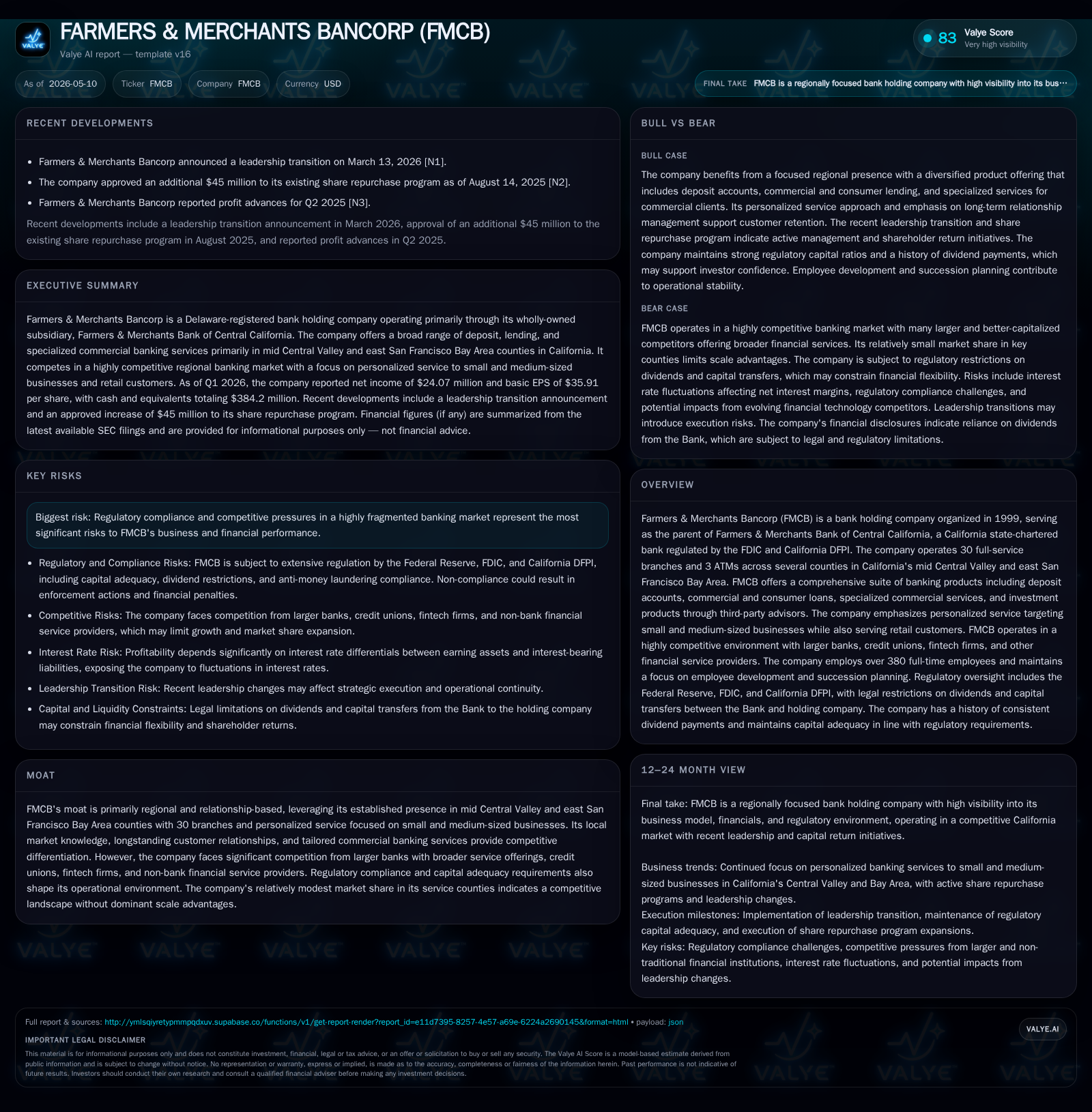
In Q1 2026, Farmers & Merchants Bancorp demonstrated stable operational continuity driven by its entrenched regional presence in California’s mid Central Valley and east San Francisco Bay Area. The company reinforces a business model centered on relationship-driven banking for small and medium-sized businesses, navigating ongoing competitive pressures from larger banks and fintechs alongside regulatory complexities. Growth remains supported by localized lending and deposit activities, while risks persist related to deposit concentration, regulatory capital requirements, and macroeconomic uncertainties. FMCB's solid liquidity position and disciplined risk management validate its steady positioning within a fragmented market.
Latest Quarterly Operating Insights
Farmers & Merchants Bancorp’s most recent quarterly report for Q1 ended March 31, 2026 [S2] reveals a continued steady operating environment characterized by stable deposit inflows and measured loan book health. Deposits remained solid without significant volatility, reflecting persistent customer loyalty within its regional footprint. The loan portfolio maintained consistent credit quality metrics amid modest growth in commercial lending activity. No material changes in funding sources or capital structure were disclosed, underscoring financial stability during the quarter.
The company reaffirmed no new material risk factors beyond those previously disclosed [S2]. This operating update serves as an essential anchor showing FMCB's ability to preserve operating balance amid ongoing macroeconomic uncertainties and sector-wide competition.
Business Model Overview: Personalized Regional Banking
Organized in 1999 as a holding company for Farmers & Merchants Bank of Central California [S1], FMCB offers traditional banking through a network of 30 branches across California's mid Central Valley and the eastern San Francisco Bay Area. Focused on serving small to medium-sized businesses as well as retail consumers, the company emphasizes personalized relationship banking—an approach aimed at gaining customer trust through local knowledge and tailored services.
Revenue arises primarily from interest income on loans made to commercial clients (including agricultural enterprises) and consumer borrowers, complemented by fees from deposit accounts and ancillary investment products offered through third-party advisors [S1]. The regional strategy enables a responsive customer engagement model but limits scale advantages common to larger competitors.
FMCB also benefits from legacy brand recognition dating back several decades, which contributes to customer retention and cross-selling opportunities. However, legal restrictions govern dividend flows from the bank subsidiary to the holding company, necessitating careful capital management efforts [S1].
Competitive Dynamics and Industry Environment
Despite the moat derived from regional proximity and client relationships [S17], FMCB operates in a highly fragmented marketplace faced with competition from much larger national banks possessing broader product offerings and superior access to capital markets. Additionally, credit unions compete aggressively on deposit pricing, while fintech firms increasingly capture digital-savvy customers with alternative payment platforms and lending technologies.
Regulatory dynamics impose further complexity. The bank is subject to heightened compliance costs stemming from Basel III norms, anti-money laundering directives, fair lending laws, consumer protection statutes, and evolving FDIC supervisory frameworks [S1,S6,S16,S26]. These requirements increase the operational burden disproportionately for midsize players like FMCB compared with scale economies enjoyed by larger institutions.
Capacity constraints are inherent given limited physical branch expansion opportunities within the established service area. Pricing power appears modest but sustainable due to sticky customer relationships; however, overall competitiveness forces disciplined margin management.
Growth Drivers Enhancing Local Market Penetration
FMCB’s principal growth avenues include expanding its commercial lending footprint within targeted small- to mid-sized business segments. The company’s deep understanding of local market nuances—particularly in agricultural financing—facilitates this penetration [S1,S2].
Integration of third-party investment products supports cross-selling that enhances fee-based revenues beyond traditional interest margins [S1,S3]. Recent filings indicate ongoing emphasis on delivering customized banking solutions backed by personalized advisory services.
Economic recovery trends within California’s core service counties provide structural tailwinds supporting demand for working capital loans, real estate finance (carefully monitored for concentration risks), and deposit accumulation [S2,S3]. The company's cautious approach towards acquisition development loans maintains credit discipline within cyclical segments.
Investment in employee expertise—over 380 full-time staff—and technology infrastructure modestly bolsters execution capabilities but remains balanced against cost control imperatives [S1].
Risks and Constraints Impacting Strategy Execution
A predominant risk relates to significant uninsured deposits estimated at approximately $2.6 billion as of year-end 2025 [S1,S5]. Such concentration poses liquidity vulnerability should confidence or market conditions deteriorate.
Regulatory capital requirements under Basel III/Basel IV frameworks demand stringent adherence to minimum ratios; failure could trigger dividend restrictions or growth limitations [S12,S15]. Furthermore, evolving definitions of "unsafe or unsound practice" by regulators may compel operational adjustments or curtail divisive activities [S11,S18].
Competition-induced pressure on pricing compresses revenue opportunities especially vis-à-vis large-scale competitors capable of deploying digital innovations more aggressively. Compliance costs tied to AML/BSA laws entail recurring expense increases potentially impacting net margins [S16,S26].
Additionally, exposure to localized economic downturns—especially in real estate or agricultural sectors heavily represented in the loan portfolio—may affect asset quality adversely if the macro environment weakens materially [S19]. The protracted Federal Reserve monetary policy uncertainty compounds forecasting difficulty for interest margin management.
Upcoming Milestones and Indicators to Monitor
Key near-term monitoring points include subsequent quarterly updates covering asset quality trends particularly in CRE (Commercial Real Estate) lending concentrations which currently remain below FDIC guidance thresholds but are cyclically variable [S19].
Regulatory developments surrounding capital adequacy definitions and supervisory interpretations of "unsafe or unsound practices" warrant close attention given potential implications for FMCB's operating flexibility [S18].
Local economic data releases—involving employment rates, agricultural output stability, real estate market conditions—will influence borrowing demand patterns across FMCB’s core markets. Furthermore, any shifts in depositor confidence reflected through changes in uninsured deposit levels will be critical liquidity signals.
Watch also includes possible amendments in state or federal consumer protection laws that could alter compliance cost profiles or geographic service parameters relevant to future branch operations [S13,S24].
Concise Financial Position and Liquidity Snapshot
As of March 31, 2026, FMCB holds approximately $384 million in cash and equivalents [F1], illustrating strong liquidity reserves supporting operational needs absent reliance on Federal Home Loan Bank advances or Federal Reserve borrowings which were reported at zero at last fiscal year-end [S5].
Capitalization metrics classify the company as "well-capitalized" based on regulatory standards with no indications of breaches or remediation directives reported [S15]. Dividend eligibility from the bank subsidiary totaled around $131 million as of December 31, 2025 providing conduit cash flow support for holding company obligations including shareholder distributions, repurchases reported earlier [S17].
No material new debt issuances or refinancing events were noted recently indicating stable debt posture aligning with conservative balance sheet management philosophy [S7,S8]. This financial conservatism underpins confidence amidst competitive pressures.
This analysis is based solely on publicly available information as referenced. It does not constitute investment advice but aims to provide a reasoned assessment grounded in verified SEC disclosures regarding Farmers & Merchants Bancorp's operational status and strategic outlook consistently with Valye News policies.
Disclaimer: This is research-only, informational analysis and not investment advice. It may include AI-generated interpretation and general industry context. Always verify important details using primary sources.

Comments