
Osprey Bitcoin Trust Recasts Bitcoin Exposure with Recent Quarterly Update
The Q1 2026 report reveals meaningful contractions in net assets and shares outstanding, underscoring the impact of Bitcoin volatility on OBTC’s regulated investment vehicle.
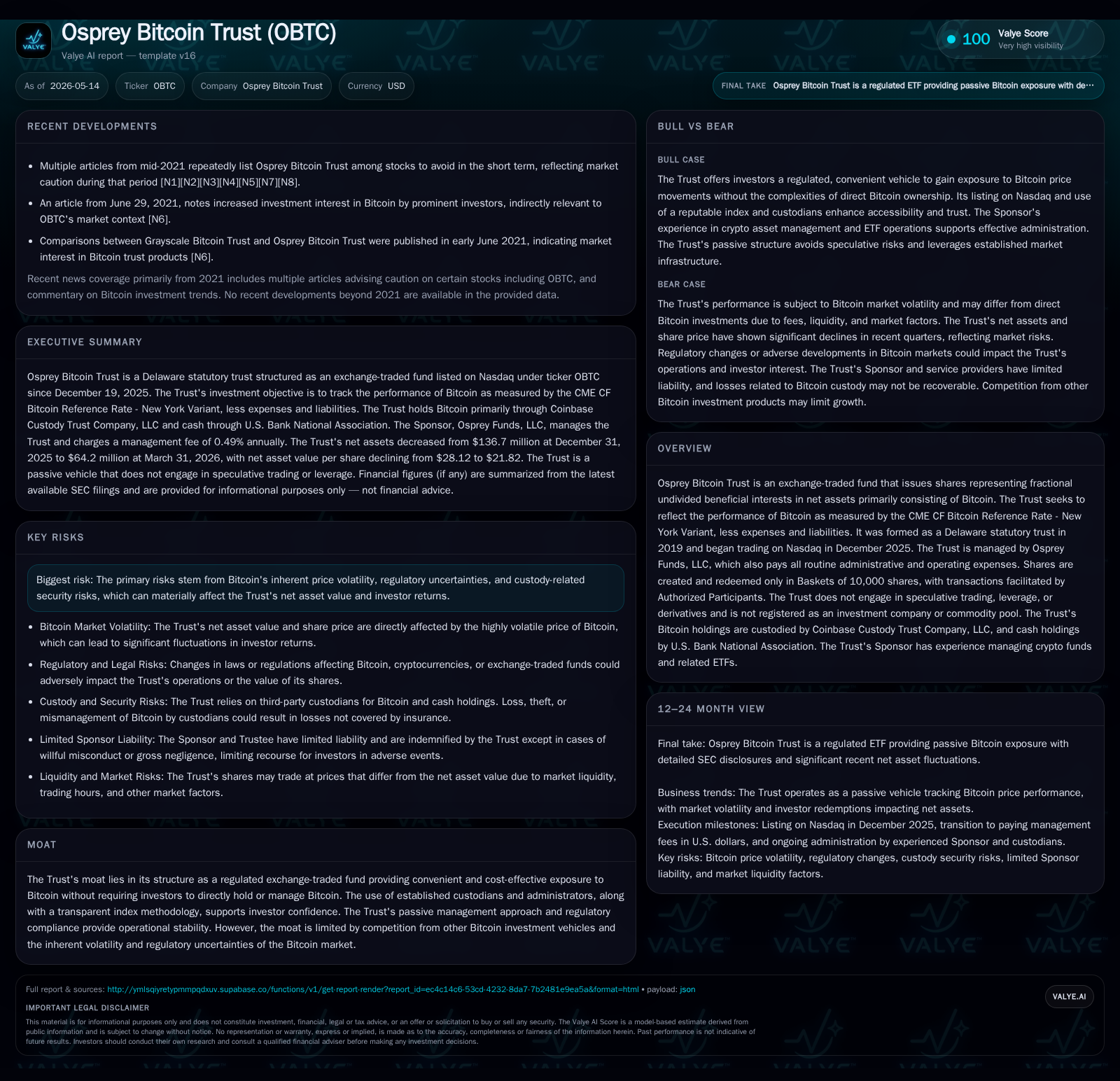
Osprey Bitcoin Trust’s latest quarterly filing shows a significant decline in net assets from $136.7 million to $64.2 million driven primarily by the fall in Bitcoin prices during the first quarter of 2026. Shares outstanding dropped sharply from approximately 4.86 million to 2.94 million, indicating notable redemption activity by investors. The Trust continues to operate under a conservative, passive investment strategy without leverage or derivatives and maintains custody via Coinbase Custody Trust Company, reinforcing operational stability amid persistent market volatility and regulatory uncertainty. Positioned as a convenient ETF proxy for direct Bitcoin exposure, OBTC benefits from a regulated Nasdaq listing and institutional custodianship but faces structural risks tied to Bitcoin’s price swings and evolving regulatory frameworks.
Latest Quarterly Highlights and Operational Shifts
In its Q1 2026 Form 10-Q filed May 13, 2026 [S2], Osprey Bitcoin Trust (OBTC) reported a dramatic adjustment in its asset base reflecting heightened market volatility during the period. Net assets dropped from approximately $136.7 million at December 31, 2025 to $64.2 million as of March 31, 2026—a contraction closely aligned with the quarter's depressed Bitcoin prices and resultant impact on net asset value (NAV) per share [S2].
The NAV per share correspondingly declined from $28.12 to $21.82 over the same period [S2]. These figures underscore how OBTC’s fortunes remain tightly interlinked with underlying Bitcoin price dynamics despite a passive management approach designed solely to track the CME CF Bitcoin Reference Rate (New York Variant). The Trust confirmed the ongoing use of Coinbase Custody Trust Company, LLC as its exclusive custodian for digital assets [S2], maintaining segregated storage well-aligned with institutional best practices and mitigating counterparty risks amid regulatory headwinds.
This operating picture reaffirms OBTC’s positioning as a vehicle directly impacted by volatile cryptocurrency markets but bolstered by transparent governance structures and established custody partnerships.
Business Model and Product Structure
Osprey Bitcoin Trust operates effectively as an exchange-traded fund delivering fractionalized ownership tied exclusively to Bitcoin holdings secured on behalf of shareholders [S1]. The Trust issues shares that represent undivided beneficial interests in its net assets composed primarily of actual Bitcoins held by Coinbase Custody Trust Company [S1]. Importantly, the Shares trade publicly on Nasdaq under ticker "OBTC", providing liquidity and accessibility typical of regulated ETFs.
Collections and redemptions occur exclusively via large "Basket" units of 10,000 shares facilitated through Authorized Participants—registered broker-dealers who enable market makers and institutional investors to transact at scale without burdening retail shareholders directly with complex custody responsibilities [S1].
Critically, OBTC eschews leveraged positions or derivative overlays; it undertakes no speculative trading or futures contracts aiming instead for passive replication of the CME CF Benchmark Index less expenses [S1][S20]. Such design lowers structural risk while simplifying compliance across securities laws since neither the Trust nor its Sponsor is registered under Investment Company Acts or Commodity Exchange Acts [S1][S20]. This architecture provides investors exposure to institutional-quality Bitcoin ownership sanitized from direct wallet management challenges and avoids complexities around commodity pool regulations.
Industry Environment and Competitive Positioning
Within the broader crypto investment landscape, Osprey Bitcoin Trust competes against an ecosystem of vehicles—spot BTC trusts like Grayscale BTC Trust (GBTC), futures-based ETFs such as ProShares BITO, closed-end funds, physically backed ETFs launched more recently in global markets, alongside emerging decentralized finance (DeFi) instruments offering alternative exposures [S1].
OBTC distinguishes itself through its regulatory-compliant structure as a Delaware statutory trust listed on Nasdaq starting December 2025 [S1], leveraging Coinbase’s established custody framework—recognized as one of the most secure custodial offerings in crypto markets—with insurance protections aligning with institutional standards. This positions it favorably versus less-regulated products or OTC trusts where discount-to-NAV pricing historically prevailed.
However, relentless competition persists on pricing efficiency (expense ratios), ease of access (share liquidity), structural transparency (index methodology disclosures), and regulatory positioning—especially given ongoing U.S. SEC scrutiny over spot crypto ETFs relative to futures-based vehicles [S5]. Regulatory uncertainty imposes an operational ceiling wherein emerging legislation might force product amendments or elaborate compliance burdens should bitcoin be reclassified under additional securities or commodities laws [S23][S24]. These factors simultaneously create barriers protecting incumbents like OBTC from new entrants yet constrain rapid product innovation.
Growth Drivers and Market Opportunities
OBTC’s future growth hinges significantly on expanding institutional interest in regulated crypto asset exposure without custodial complications inherent in direct holdings [S1]. As increasingly diverse portfolios integrate digital assets as store-of-value instruments akin to "digital gold," demand for transparent exchange-traded proxies may grow structurally over economic cycles rather than merely responding to speculative waves.
Mainstreaming is further supported by technological enhancements facilitating more efficient Basket creations/redemptions reducing spreads between NAV and market prices for shares—a core frictions point historically limiting retail participation in OTC trusts. Additionally, political acclimatization evidenced post-2024 U.S. election rallies suggests upward momentum around digital asset legislations aimed at clarity rather than restriction which could underpin persistent inflows if realized favorably [S1].
Other growth catalysts include corporates diversifying treasury reserves into crypto assets amidst inflationary environments; progressing blockchain infrastructure enhancing custody ecosystem robustness; incremental global regulatory harmonization enabling cross-border fund flows; all potentially creating tailwinds for greater AUM accumulation by OBTC.
Risks and Governance Considerations
Despite operational rigor, several risks persist prominently:
- Volatility: The extreme price swings embedded in Bitcoin markets materially influence NAVs leading to unpredictable investment returns for shareholders [S1]. Historic drawdowns over 70% highlight vulnerability despite digital gold narratives.
- Regulatory Ambiguity: Pending classification debates over cryptocurrencies as securities versus commodities pose existential threats if adverse rules impose registration burdens leading potentially to forced liquidation scenarios disadvantageous to shareholders [S23][S24].
- Custody Risks: While Coinbase Custody offers leading security protocols including insurance coverage for physical breaches or hacks, no solution eliminates risk fully; uninsured loss incidents elsewhere spotlight residual systemic vulnerabilities afflicting all crypto SSTs (Segregated Storage Trusts) [S9][S13].
- Taxation Complexity: Blockchain phenomena such as hard forks can generate taxable events complicating shareholder tax liabilities unpredictably unless proactively addressed by Sponsor policies [S17].
- Market Liquidity: Large scale redemption waves triggered by negative sentiment or liquidity crises could exacerbate discounts away from NAV despite robust Authorized Participant programs [S2].
The Trust maintains solid governance featuring indemnification provisions anchoring Sponsor responsibilities while limiting Shareholder direct influence aside from key material amendments requiring majority vote—a setup promoting operational expediency but concentrated decision-making power within Sponsor entities [S10][S14]. Legal proceedings are absent currently enhancing confidence but continuous monitoring remains essential.
Key Near-Term Catalysts and Watchpoints
Investors should carefully monitor several upcoming variables revealing trajectory signals:
- Quarterly Share Metrics: Further movements in shares outstanding will indicate prevailing sentiment shifts whether inflows resume or redemptions persist post Q1's substantial withdrawal phase [S2].
- Regulatory Developments: Any SEC pronouncements clarifying spot crypto ETF approvals or constraints would materially affect OBTC's future viability and potential product adjustments [S18].
- Index Methodology Updates: Changes from CF Benchmarks Ltd., which administers the CME CF Bitcoin Reference Rate used by OBTC could impact NAV tracking fidelity influencing market spreads and investor confidence [S26].
- Bitcoin Network Events: Hard forks or other technical disruptions necessitate Trustee decisions on asset classifications impacting taxable events or Shareholder distributions per previously established policies [S17].
- Macroeconomic Indicators: Inflation trends, monetary policy pivots, geopolitical developments shaping general risk appetite towards alternative assets including cryptocurrencies contribute indirectly but meaningfully.[F1]
In sum, while short-term headwinds remain palpable given Q1 results reflecting elevated market stress factors, Osprey Bitcoin Trust retains foundational strengths centered on regulatory compliance, robust custody partnerships, streamlined ETF mechanisms, and growing broader acceptance of digitally native asset classes acting as structural undercurrents beyond transient market turbulence.
Disclaimer: This analysis is provided solely for informational purposes based on publicly available filings; it is not investment advice or a recommendation regarding any securities.

Comments