
Petros Pharmaceuticals Pursues OTC Switch Innovation Despite Near-Term Liquidity Strains
The latest quarterly filing reveals persistent liquidity challenges for Petros while highlighting its strategic focus on a proprietary platform facilitating prescription-to-OTC switches under emerging FDA regulations.
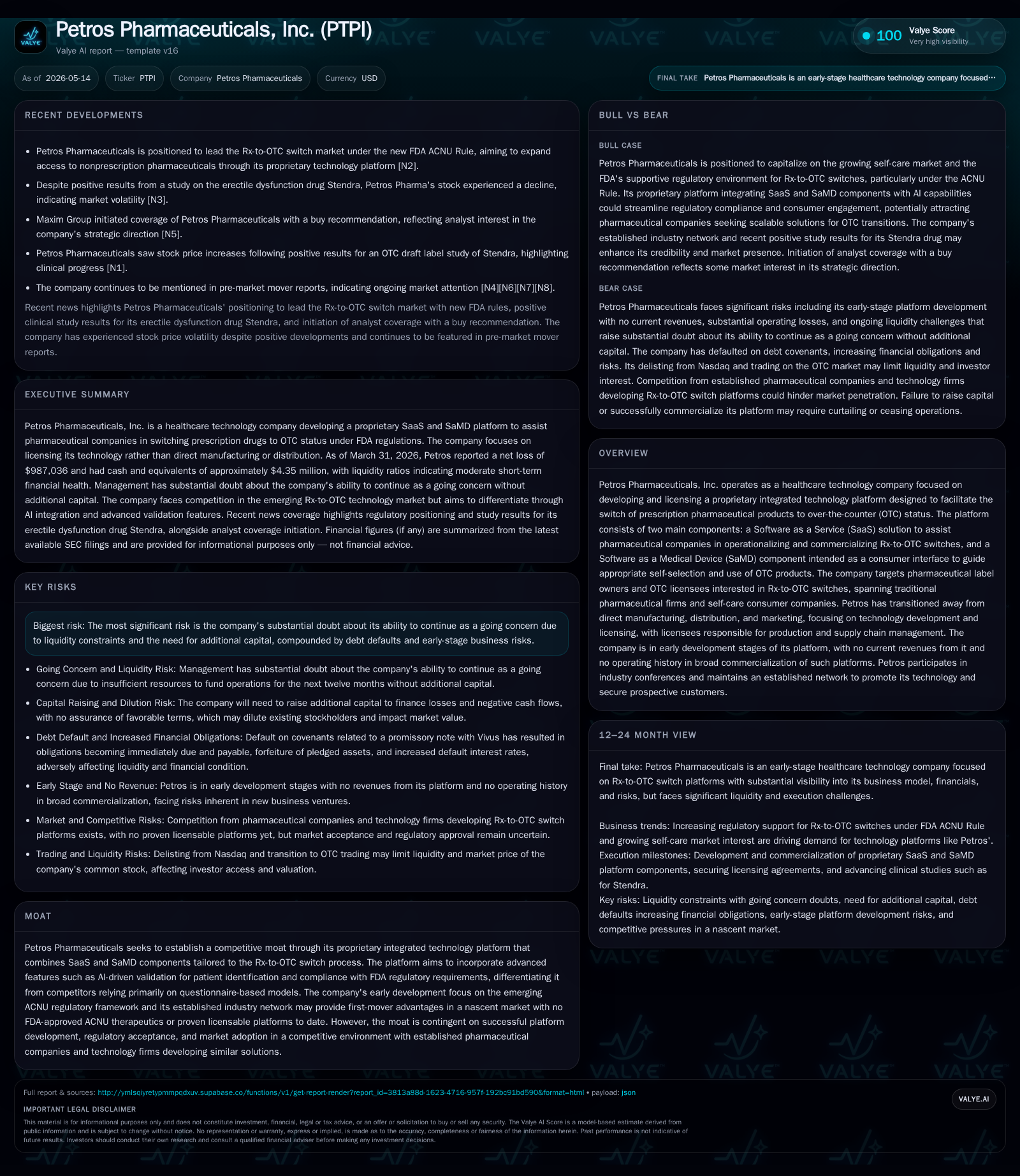
Petros Pharmaceuticals reported $784K in operational cash burn in Q1 2026, leaving approximately $4.35 million in cash and raising substantial doubt about the company's ability to continue as a going concern without additional capital. The company has shifted its business model from pharmaceutical manufacturing and distribution to developing a dual-component technology platform—combining SaaS for pharmaceutical partners and Software as a Medical Device (SaMD) for consumers—to streamline and commercialize Rx-to-OTC switches, especially leveraging the FDA's new ACNU regulatory framework. Despite promising technology and potential first-mover advantages, Petros faces significant execution risk, intense competition from established pharma and tech companies, and urgent capital requirements.
Latest Quarterly Operating Review: Cash Burn and Going Concern Remain Key Issues
Petros Pharmaceuticals’ May 13, 2026 quarterly filing ([S2]) underscores persisting financial strains despite continued platform development efforts. The company reported operating cash outflows of $784,272 during Q1 2026, reducing cash reserves to roughly $4.35 million as of March 31, 2026 ([F1]). Management explicitly identified "substantial doubt" about Petros' ability to maintain operations over the next twelve months without immediate capital infusion. This marks a continuation of the tight liquidity profile noted in the April 2026 annual report ([S1]).
No new unregistered equity sales occurred in the quarter, nor were there defaults on senior securities ([S2]), indicating no immediate covenant breaches but highlighting an urgent dependence on new financing rounds to bridge the operational runway. The current ratio stands at a modest 1.68 ([F1]), signaling an acceptable but fragile short-term liquidity position given zero net revenue streams to offset burn.
Business Model and Platform Overview: Integrated SaaS and SaMD for Rx-to-OTC Switches
Transitioning away from traditional pharmaceutical manufacturing and direct product marketing, Petros has repositioned itself as a healthcare technology licensor focusing on its proprietary integrated platform ([S1], [S4]). This platform bifurcates into two synergistic components:
Software as a Service (SaaS) tailored for pharmaceutical companies pursuing Rx-to-OTC switches. It offers secure data exchanges, regulatory compliance management (notably FDA guidance), labeling updates, usage instructions, and commercialization workflow support designed specifically to overcome the complex operational hurdles inherent in such switches.
Software as a Medical Device (SaMD) intended as a consumer-facing digital interface facilitating appropriate self-selection or deselection decisions when purchasing OTC products under the newly codified ACNU rule framework ([S4]). This SaMD requires FDA governance compliance and aims to use clinically validated algorithms rather than simpler questionnaire models.
The model monetizes through technology licensing rather than drug sales or distribution margins. Licensees handle production and supply chain responsibilities while Petros focuses on technology development, platform operation, cybersecurity safeguards, and cloud hosting infrastructure ([S11]).
Competitive Positioning within Emerging ACNU Regulatory Environment
Petros is situating itself as an early innovator aligned with recent FDA initiatives designed to expand nonprescription drug accessibility under Additional Conditions for Nonprescription Use (ACNU) regulations ([S4]). Its platform’s AI-driven validation engine—aiming to objectively qualify consumers against medically necessary criteria—is intended as a competitive differentiator compared to legacy digital self-assessment tools relying heavily on subjective questionnaires.
While this AI-backed approach could establish initial moat advantage by addressing FDA’s evolving expectations for safety and efficacy in self-care contexts (), the company remains at an embryonic stage with no FDA-approved SaMD authorization yet achieved ([S4]). Established pharmaceutical firms are simultaneously investing in their own digital transformation capabilities either internally or via acquisitions. Further pressure comes from emerging health tech startups targeting similar OTC switch opportunities.
Therefore, Petros’ competitive durability hinges critically on successful regulatory clearance of its SaMD component coupled with rapid adoption by pharmaceutical innovators seeking seamless Rx-to-OTC pathways under the TEFCA framework and related health data interoperability standards promoted by HHS ([S4]).
Growth Opportunities: Capitalizing on FDA’s New Self-Care Initiatives and Label Owner Demand
Market demand drivers include rising consumer interest in self-care pharmacotherapies amid cost-conscious healthcare trends and expanded FDA pathways promoting nonprescription options through ACNU products ([S1], [S4]). Pharmaceutical companies view Rx-to-OTC switches as compelling growth vectors enabling greater product accessibility, direct consumer engagement, and differentiated brand positioning.
Petros’ technological proficiency addresses key barriers—complex regulatory navigation, compliance assurance, market access logistics—that traditionally slowed OTC transitions. By simplifying these processes with scalable SaaS tools backed by machine learning-enabled consumer interfaces (SaMD), Petros hopes to unlock new revenue streams for itself via licensing fees.
Key milestones that will influence growth trajectory involve gaining FDA acceptance of the SaMD component as a valid self-selection instrument; securing licensing deals across diverse label owner profiles; establishing partnerships with major self-care consumer companies interested in digital enhancements; and demonstrating clinical algorithm accuracy that can mitigate safety risks while satisfying regulators ([S25], ).
Risks and Constraints: Capital Dependency, Early-Stage Development, and Competitive Pressure
Technical execution challenges remain substantial given early-stage software development complexity inherent in achieving FDA compliance for SaMD offerings. Delays or failures in software engineering or regulatory approval could materially impair commercialization timelines.
Further risks stem from intensifying competition by incumbent pharmaceutical companies leveraging their existing portfolios or partnering with established digital health vendors. Regulatory ambiguity surrounding artificial intelligence in medical device contexts augments uncertainty over eventual approval standards or requirements ([S24]).
Potential shareholder dilution looms if equity raises occur under distressed pricing conditions.
Investor Watchlist: Upcoming Milestones for Platform Development and Capital Acquisition
Close monitoring should focus on:
- Progression through FDA regulatory milestones regarding SaMD approval demonstrating clinical validation compliance.
- Announcement of initial commercial license agreements with pharmaceutical label owners or OTC licensees validating market adoption.
- Beta launches or pilot programs evidencing technology readiness and efficacy of AI-driven patient identification modules.
- Any financings detailing size, terms, timing crucial for extending operational runway beyond calendar 2026.
- Updates concerning negotiations with strategic partners aiming to integrate with health information exchanges under TEFCA schemes.
These indicators will serve as vital signals regarding Petros’ ability to transform its innovative concepts into commercialized offerings capable of attracting sustained client engagement.
Financial Snapshot: Current Liquidity, Debt, and Operational Burn
Latest financial snapshot
| Metric | Value | Period |
|---|---|---|
| Cash & equivalents | $4.35mm | |
| 2026-03-31 | ||
| Current assets | $4.39mm | |
| 2026-03-31 | ||
| Current liabilities | $2.62mm | |
| 2026-03-31 | ||
| Current ratio | 1.68x | |
| 2026-03-31 |
Source: SEC companyfacts cache [F1].
Despite owning nearly twice the current assets over current liabilities suggesting moderate short-term solvency ([F1]), Petros’ lack of revenue generation imposes high reliance on continuous equity or debt issuance. The latest disclosed total debt figure at approximately $1.74 million is dated September 2021; therefore updated leverage evaluation is limited ([F1]). Operating losses persist with annual operating income deeply negative ($-4.64 million at FY-end December 2025) supporting management’s concerns surrounding sustainability absent capital replenishment ([F1]).
This analysis synthesizes Petros Pharmaceuticals’ latest filed disclosures emphasizing how its pioneering technological approach offers structural potential within evolving regulation yet confronts acute near-term liquidity constraints alongside execution complexity typical of early-stage healthtech ventures.
Investors should weigh these factors carefully while tracking critical regulatory approvals and subsequent commercial traction that will dictate longer-term viability.
This is an analytical report based solely on publicly filed information as of the dates cited above without any investment recommendation.
Disclaimer: This is research-only, informational analysis and not investment advice. It may include AI-generated interpretation and general industry context. Always verify important details using primary sources.

Comments