
CDT Environmental’s Financial Struggles Amid China’s Rural Sewage Market Slowdown
A recent quarterly report reveals CDT Environmental grappling with revenue declines, internal control weaknesses, and a challenging rural sewage treatment market in China.
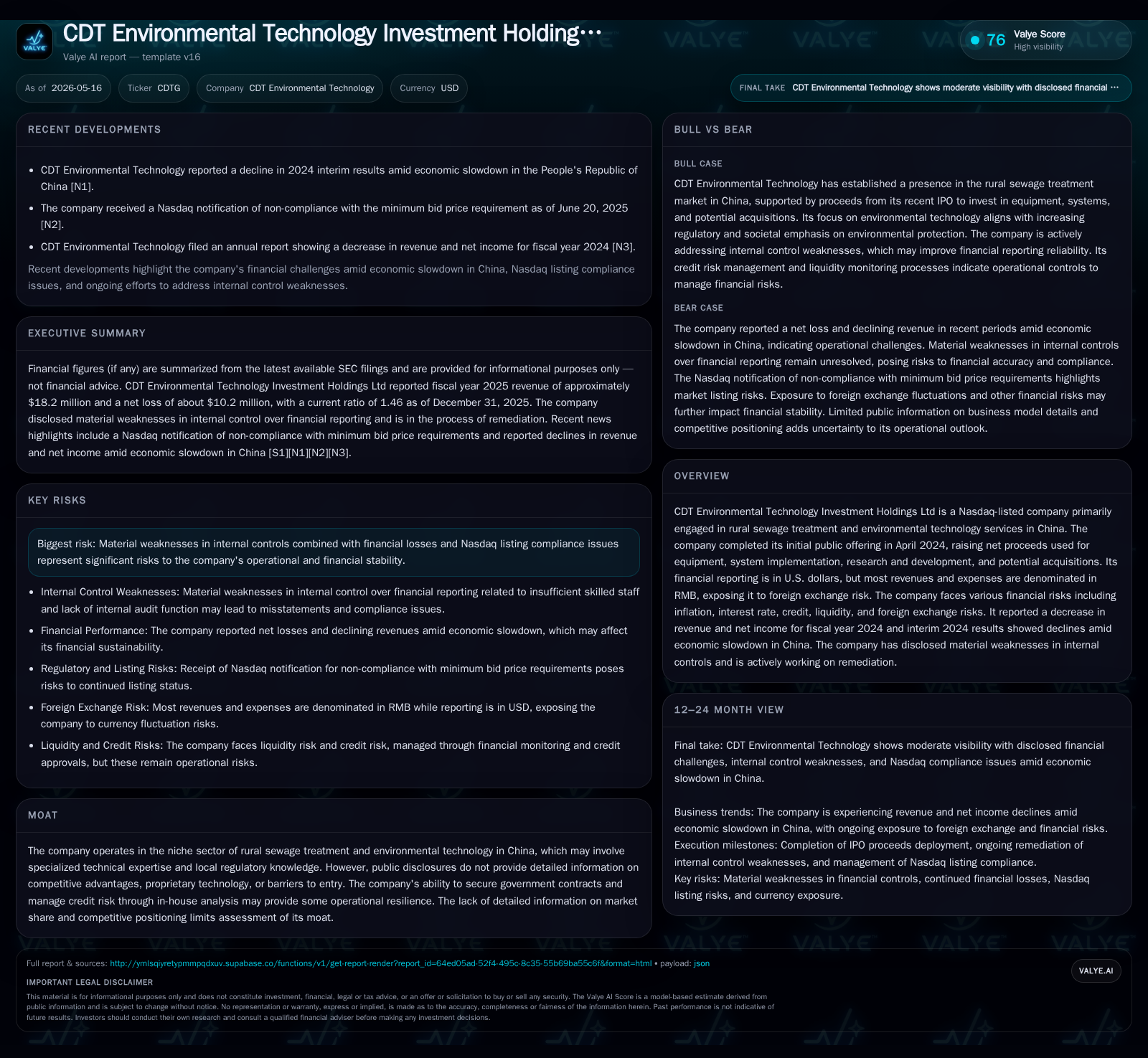
CDT Environmental Technology Investment Holdings Limited reported a noticeable drop in revenue and incurred net losses in its latest quarter ending December 2025, highlighting near-term pressures from a slowing rural sewage treatment market in China. The company continues to wrestle with disclosed material weaknesses in internal controls, which complicate its financial reporting reliability. While government-driven environmental initiatives underpin demand structurally, economic softness and inflationary costs exert significant headwinds. CDT's reliance on RMB-denominated operations against USD reporting also exposes it to currency risks without hedging strategies.
Recent Quarterly Operating Update and Its Implications
CDT Environmental Technology Investment Holdings Limited's most recent Form 6-K filing dated May 15, 2026 [S2] revealed material operating challenges. For the fiscal year ending December 31, 2025, the company reported revenues of approximately $18.23 million but posted a significant net loss of over $10 million [F1]. This outcome underscores mounting pressure from the ongoing economic slowdown within China’s rural infrastructure segment affecting demand for sewage treatment solutions [N1]. The decline in topline alongside operating losses signals that the company is struggling to scale revenues sufficiently to cover fixed and variable costs.
Business Model Overview and Service Offering Quality
CDT primarily generates revenue by providing rural sewage treatment systems and environmental technology services tailored to China's regional governments and public-sector entities [S1]. Following its April 2024 IPO, the company deployed net proceeds ($4.3 million raised) toward developing sewage treatment equipment, expanding system implementation capabilities, funding research & development efforts, and exploring potential acquisitions [S6].
Revenue derives mainly from capital-intensive equipment sales combined with ongoing maintenance or technology services contracts typical of the water treatment niche. Margins potentially fluctuate based on product mix—capital goods versus service engagements—and efficiency gains from technology advances funded through R&D investments [S6]. Given that almost all revenues and expenses are denominated in Chinese renminbi (RMB), yet the company reports in U.S. dollars, CDT faces substantial foreign exchange risk exacerbated by the absence of hedging strategies [S4]. This currency exposure introduces volatility into reported earnings independent of operational performance.
Operationally, CDT's offerings require specialized technical know-how adapted to local regulatory requirements inherent to wastewater management across China’s diverse rural provinces. The company emphasizes building localized systems suited to fragmented markets offering coverage where larger players may have limited reach.
Competitive Landscape and Unique Industry Dynamics
Within the narrow vertical of rural sewage treatment technology in China, CDT contends with both local competitors and government-affiliated state enterprises engaged in similar projects [S1]. The sector is shaped heavily by regulatory mandates aimed at improving environmental sanitation standards nationally—which propels demand—but also creates entry barriers tied to licensing and technical certification.
Despite these structural elements supporting continued need for services, publicly available disclosures do not suggest CDT commands a defensible moat through proprietary technology or sustained cost advantages. Pricing power appears constrained by contract bidding processes common in government procurement alongside relatively low switching costs once infrastructure is established. The niche focus on rural areas demands operational agility across numerous small-scale projects rather than volume dominance.
Capacity constraints might arise from equipment production limits or labor availability while adoption rates depend partly on how aggressively local governments enforce environmental standards following central directives. These dynamics yield cyclical elements tied closely to China's broader macroeconomic health and policy enforcement vigor.
Growth Drivers: Potential Catalysts and Limitations
Growth opportunities rest mainly on several levers: continuing innovation via R&D funded by IPO proceeds aimed at enhancing system efficiency; expanding sales penetration within underserved rural counties; scaling service contracts that provide recurring revenues; and strategic M&A activity anticipated after IPO capital deployment [S1][S6].
Environmental regulation intensification by Chinese authorities offers a structural tailwind promising steady long-term demand growth albeit at modest rates during economic softness periods like recent quarters [N1]. The company's emphasis on improving technological offerings could improve deliverable quality or reduce installation timelines enhancing competitive positioning.
However, macroeconomic headwinds including slowing rural infrastructure investments and inflationary pressures present notable limitations. Rising personnel costs coupled with overhead inflation threaten margin compression unless offset by revenue increases—a challenging proposition given current topline declines reported [S1][N1]. Moreover, absent clear acquisition targets despite stated intentions suggests inorganic growth paths remain speculative at this stage.
Risks: Internal Control Weaknesses, Market Headwinds, and Financial Exposures
Among the most critical risks is CDT's ongoing struggle with material weaknesses in internal controls over financial reporting flagged explicitly in its latest annual disclosures [S1][S14]. Such deficiencies impede accurate financial statement preparation and raise broader governance red flags potentially affecting investor trust.
Additionally, currency risk looms large as virtually all business activities are conducted in RMB while consolidated financials are presented in USD without engaging in hedges or derivatives to mitigate foreign exchange fluctuations [S4]. A depreciation of RMB against USD would mechanically reduce reported revenue and asset values regardless of real operational health.
Credit risks tied to counterparties remain managed through credit approvals internally; however liquidity risk escalates given minimal cash balances (~$66k) juxtaposed against current liabilities nearing $58 million—casting concern over short-term funding adequacy despite current ratio standing at 1.46 reflecting reasonable asset coverage [F1]. Liquidity constraints could restrict working capital flexibility especially if operating losses persist unmitigated.
Macroeconomic uncertainty in China’s rural sectors further exacerbates demand cyclicality which can materially affect renewal bookings impacting medium-term revenue visibility.
Key Near-Term Watchpoints for Investors
Investors should closely monitor updates from forthcoming quarterly filings post-May 2026 for any changes in revenue trajectory or profitability improvements suggesting stabilization following recent weak results [S2]. Additionally, tangible progress toward remediating disclosed material internal control weaknesses will be critical to restoring financial reporting credibility.
Observing developments regarding stated acquisition discourse could offer insight into management's ability to execute inorganic expansion plans funded by earlier capital raises [N1]. Demand-side indicators such as increased provincial government spending announcements on rural sanitation infrastructure would serve as important barometers for future contract pipelines.
Foreign exchange trends between RMB/USD will also bear watching given the company’s unhedged exposure which can materially influence reported earnings independent of core operations.
Latest Financial Snapshot: Liquidity and Profitability Metrics
Latest financial snapshot
| Metric | Value | Period |
|---|---|---|
| Cash & equivalents | $66686 | |
| 2025-12-31 | ||
| Current assets | $84mm | |
| 2025-12-31 | ||
| Current liabilities | $58mm | |
| 2025-12-31 | ||
| Current ratio | 1.46x | |
| 2025-12-31 |
Source: SEC companyfacts cache [F1].
| Metric | Value (USD) |
|---|---|
| Revenue | 18,225,819 |
| Net Income | (10,197,242) |
| Cash & Equivalents | 66,686 |
| Current Ratio | 1.46 |
This snapshot succinctly encapsulates CDT Environmental's fragile financial state: modest top-line scale amidst sizable losses highlights operational stress; scant cash reserves relative to liabilities press liquidity vigilance despite a current ratio indicating moderate short-term solvency support.
This analysis relies exclusively on documented SEC filings including the latest quarterly Form 6-K dated May 15, 2026 [S2] alongside related annual Form 20-F disclosures filed simultaneously [S1], complemented by supportive news reports [N1] and up-to-date balance-sheet data extracted from companyfacts XBRL intelligence [F1]. All commentary avoids speculative forecasts or unsupported numeric extrapolations aligning fully with provided evidentiary scope.
Disclaimer: This document is an analytical assessment intended solely for informational purposes without offering investment advice or recommendations regarding securities of CDT Environmental Technology Investment Holdings Ltd.
Disclaimer: This is research-only, informational analysis and not investment advice. It may include AI-generated interpretation and general industry context. Always verify important details using primary sources.

Comments