
SOS Ltd’s Transition to Hosting Cryptocurrency Miners Highlights Commodities Trading Challenges
The recent auditor change and operating loss spike underscore SOS Ltd's strategic pivot from direct crypto mining to hosting services amid volatile commodity markets.
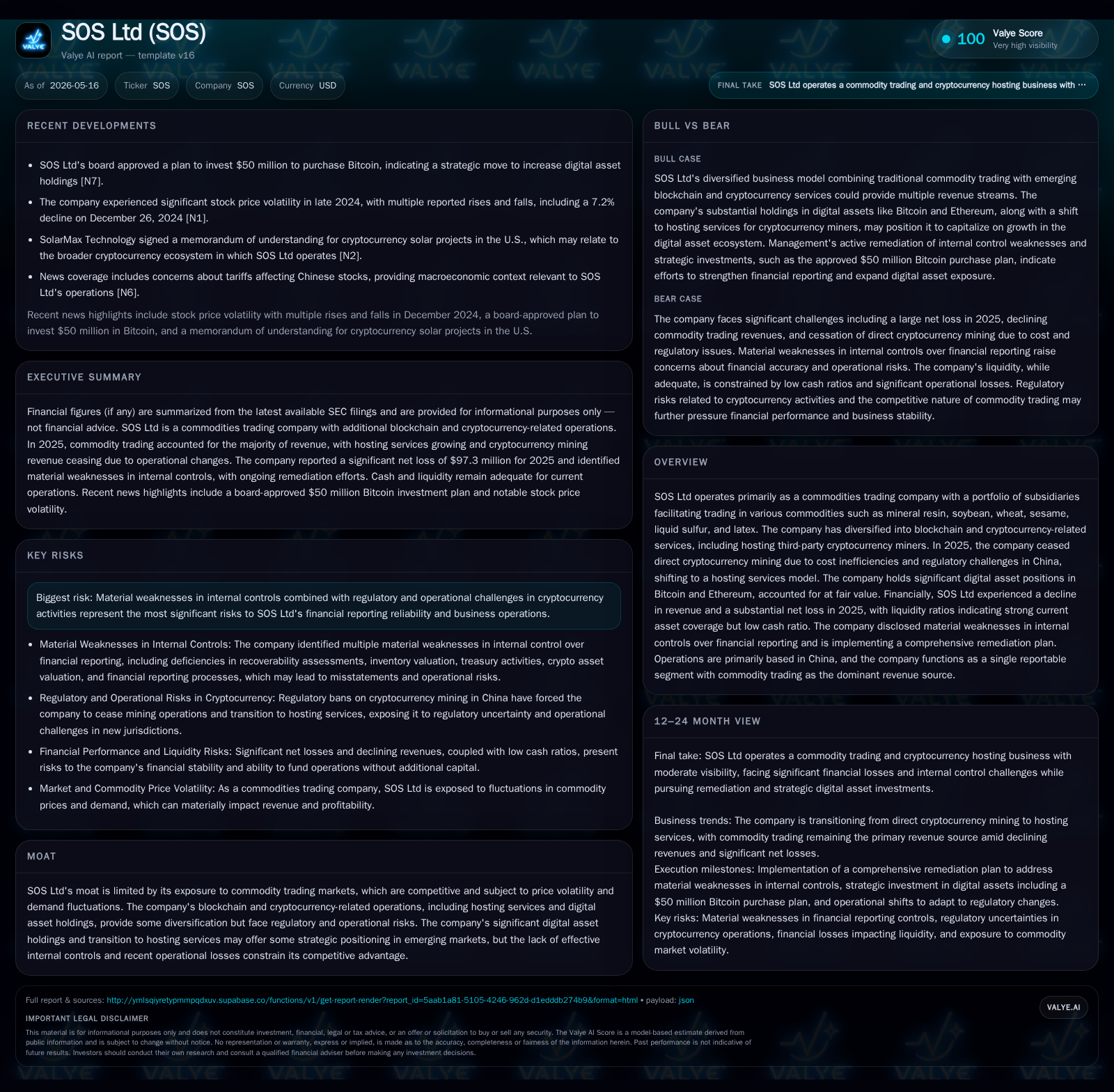
SOS Ltd’s latest quarterly filing reveals a significant operational shift marked by an auditor change and a deepening operating loss. The company has exited cryptocurrency mining, pivoting to hosting third-party miners against a backdrop of declining commodity trading revenues. While hosting services and sizeable digital asset holdings present potential growth avenues, the core business faces structural volatility and regulatory risks. Material weaknesses in internal controls further constrain execution and transparency, making near-term operational milestones critical to monitor.
Recent Quarterly Update and Auditor Transition: Signals to Watch
SOS Ltd disclosed a significant governance development with the February 25, 2026 appointment of Assentsure PAC as its new independent registered public accounting firm, replacing Audit Alliance LLP effective for the fiscal year ended December 31, 2025. The transition followed no disputes or disagreements with the prior auditor but comes at a crucial juncture amid mounting operating losses and strategic shifts [S2]. This auditor change often hints at increased scrutiny or management’s intent to reinforce financial oversight.
The most recent quarterly filings confirm the company’s operational pressures: an operating loss surged to $98.6 million in 2025 from $21.6 million in the prior year, while net loss widened similarly to $97.3 million. Within this period, SOS fully halted direct cryptocurrency mining due to rising cost inefficiencies—exacerbated by China's evolving regulatory environment—and redirected efforts toward providing hosting services to third-party miners generating fee income [S3]. Concurrently, commodity trading remains the majority revenue driver but experienced a material slowdown impacting overall financial results.
This sequence—governance overhaul accompanying deepening losses and business pivots—frames SOS’s near-term challenges and strategic recalibration.
SOS Ltd’s Business Model: Core Commodities Trading Meets Crypto Hosting
Historically anchored in commodities trading, SOS operates through several subsidiaries managing assets like mineral resin, soybean, wheat, sesame, liquid sulfur, and latex [S1]. Revenues primarily come from buying and selling these commodities under fluctuating market conditions. The company retains considerable inventories awaiting favorable sales timing which exposes it to price volatility risks inherent in global commodity cycles.
Digital diversification emerged as SOS ventured into blockchain-related activities including cryptocurrency mining. However, in response to cost unsustainability and tightened regulations within China—a major operational geography—the company ceased direct mining activities in 2025 and shifted exclusively to a hosting services model. This approach involves leasing data center space and power infrastructure to external crypto miners who retain operational control over hardware while SOS earns recurring fees based on hosted capacity utilization. This move reduces capital expenditure risks intrinsic to mining hardware ownership while exposing the firm to client retention dynamics.
SOS also maintains substantial digital asset holdings: approximately 802.77 Bitcoins valued at $70.3 million USD plus roughly 2,949.79 Ethereum with a fair value of $8.8 million USD as of year-end 2025 [S1]. These are accounted for at fair value every period with unrealized gains or losses flowing through earnings, thereby introducing notable earnings volatility linked directly to cryptocurrency markets.
Thus, SOS’s revenue streams hinge on: (a) commodity trading volume and margins susceptible to cyclical factors; (b) crypto hosting fee revenues driven by miner demand; and (c) valuation changes in digital asset reserves tied to market sentiment.
Industry Positioning: Competition, Volatility, and Regulatory Headwinds
The core commodities sector where SOS operates is intensely competitive with limited differentiation among participants generally competing on price and supply chain efficiencies. Market prices for soybeans or mineral resin fluctuate with global production conditions, trade policies, inventory levels, and logistics capabilities exerting outsized influences. Such dynamics compress margins unpredictably—SOS’s own reported decline in trading revenues illustrates such cyclicality [S1][S17].
Parallelly, the shift into blockchain hosting introduces exposure to a nascent but complex industry segment facing headwinds from stringent Chinese cryptocurrency restrictions that effectively halted local mining activity by mid-2021 [S11]. Regulatory ambiguity around energy usage caps and licensing complicate expansion plans for data center capacity dedicated to crypto mining clients.
Operational capacity constraints also affect service scalability given significant capital required for high-powered electrical infrastructure needed by hosting centers [S1]. Customer adoption is tied closely to crypto market health since miners optimize operations aggressively during downturns leading to variable utilization rates impacting SOS-hosted equipment fees.
Collectively these conditions limit sustainable pricing power across both segments—core commodities remain vulnerable to external price shocks while crypto hosting revenues depend on volatile customer demand under complex regulatory regimes.
Growth Drivers: Digital Asset Holdings and Hosting Revenue Potential
Despite prevailing challenges, SOS possesses strategic potential growth catalysts rooted in its blockchain exposure:
Digital Asset Appreciation: The net fair value of Bitcoin and Ethereum holdings at approximately $79 million creates a financial lever that could enhance earnings during bull markets though equally presents downside risk during downturns [S1]. Fair value accounting offers real-time earnings impact insights tied directly to macro digital currency trends.
Hosting Service Expansion: By pivoting from capex-heavy direct mining toward fee-based hosting arrangements for external miners operating equipment onsite, SOS stabilizes cash flows through recurring service revenues less sensitive to full crypto cycle swings [S1][S3]. Measurable KPIs such as hosting volume growth rates or miner client retention will be primary indicators reflecting expansion success.
Product Innovation & Blockchain Applications: The company’s R&D initiatives including blockchain-based inventory management systems hint at future use cases leveraging decentralized technology within its commodity supply chains enhancing traceability value propositions; though still early stage these could yield differentiated service offerings eventually contributing incremental revenue streams [S15].
Ultimately measuring the rate of growth hinges on capturing sustainable volume increases within crypto hosting contracts alongside favorable market trends elevating digital asset valuations.
Operational Constraints and Key Risk Factors
The company's performance is tempered by several weighty risks:
Material Internal Control Weaknesses: Disclosed deficiencies in financial reporting controls pose ongoing challenges for transparency as well as audit risk which may complicate investor confidence or regulatory reviews if unresolved [S11].
Margin Pressure From Commodity Volatility: Sharp declines in commodity prices coupled with inventory valuation uncertainties directly compress gross margins—a fundamental constraint obvious from steep revenue declines juxtaposed with high absolute current assets balances implying inventory accumulation rather than liquidation efficiency [F1][S1].
Regulatory Uncertainty on Crypto Hosting: Although the company exited direct mining due to Chinese governmental prohibitions on energy intensive crypto operations, ongoing regulation creates unpredictability around data center approvals or electricity pricing which are central cost drivers for sustained miner attraction [S11].
Foreign Exchange Exposure: Revenue denominated primarily in RMB against consolidated reporting currency USD subjects results to FX rate volatility unrelated to operating performance that could distort reported earnings figures absent hedging strategies [S11].
These factors collectively restrain margin recovery prospects while elevating execution risk behind any attempts at scaling new initiatives swiftly.
Forward-Looking Indicators: What to Monitor Next
Investors seeking insight into SOS’s trajectory should watch several key metrics:
- Revenue Mix Trends: Quarterly breakdowns distinguishing commodities trading versus crypto hosting will indicate whether diversification efforts are progressing meaningfully beyond core cyclical dependency [S2][S3].
- Digital Asset Valuation Fluctuations: Changes in reported fair values of Bitcoin/Ethereum reserves each quarter will materially sway profitability highlighting exposure magnitude [S3].
- Audit Committee Commentary & Control Remediation Progress: Updates regarding enhancements or resolution of internal control weaknesses will be important governance signals affecting risk profile perception [S2].
- Hosting Contract Bookings & Utilization Rates: Signs of robust miner customer additions or increased facility utilization would validate hosting business model viability under evolving industry cycles.
- Capital Expenditure Announcements: Investments aimed at expanding data center capabilities or upgrading blockchain tech platforms may presage longer-term strategic shift outcomes.
Tracking these operational KPIs relative to corporate goals will help discern whether SOS can navigate immediate pressures toward sustainable growth paths.
Financial Snapshot: Liquidity, Revenues, and Profitability Overview
Latest financial snapshot
| Metric | Value | Period |
|---|---|---|
| Cash & equivalents | $3.2 million | |
| 2025-12-31 | ||
| Current assets | $463.4 million | |
| 2025-12-31 | ||
| Current liabilities | $41.9 million | |
| 2025-12-31 | ||
| Current ratio | 11.05x | |
| 2025-12-31 |
Source: SEC companyfacts cache [F1].
| Metric | Value (USD millions) |
|---|---|
| Revenue | 154.3 |
| Operating Income | -98.6 |
| Net Income | -97.3 |
| Cash & Cash Equivalents | 3.2 |
| Current Assets | 463.4 |
| Current Liabilities | 41.9 |
| Current Ratio | 11.05 |
At fiscal year-end December 31, 2025, SOS reported steep revenue contraction from previous years alongside substantially elevated operating losses reflecting margin deterioration principally in commodity trading businesses combined with cessation costs associated with prior crypto mining operations [F1][S3]. However, the relatively low cash balance of $3.2 million compared to total current assets of $463.4 million indicates significant inventory holdings, which may present challenges in converting assets to cash efficiently under stressed market conditions.
While management asserts adequacy of liquidity for near-term operational funding needs inclusive of growth initiatives, the narrow cash balance after major outflows calls for disciplined cash management vigilance especially if commodity markets fail to recover promptly or if capital is needed for scaling hosting infrastructure expansion projects [S3].
Disclaimer
This report summarizes publicly available SEC filings without offering any investment recommendations or market predictions. It focuses on observed operational developments grounded in sourced regulatory disclosures as of mid-2026 compliance dates. All financial figures are extracted directly from official statements supported by relevant citations.
Disclaimer: This is research-only, informational analysis and not investment advice. It may include AI-generated interpretation and general industry context. Always verify important details using primary sources.

Comments