
Maris Tech's Shift to Full-System Defense Solutions Strains Near-Term Revenues Amid Strategic Expansion
Significant 2025 revenue decline reflects longer sales cycles as Maris Tech pivots from OEM components to integrated video edge computing assemblies for defense platforms.
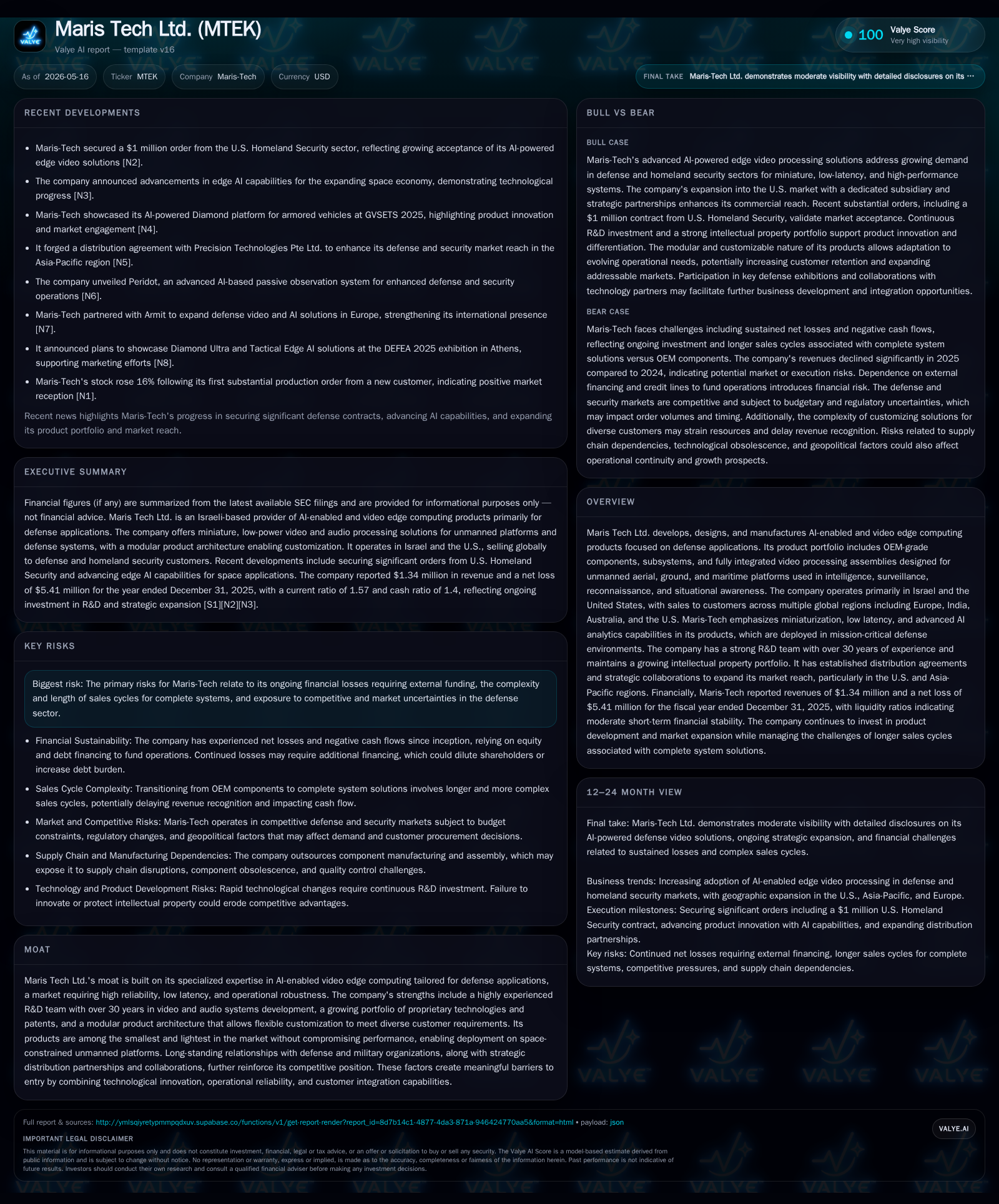
Maris Tech Ltd. reported a sharp 78% drop in 2025 revenues to $1.34 million, driven by a strategic pivot towards selling complete AI-enabled video processing systems rather than standalone OEM components. This shift has led to lengthier sales cycles impacting near-term topline but positions the company for higher-value contracts in defense unmanned platforms globally. Despite increased R&D and sales investments supporting new system development and geographic expansion, losses widened significantly, underscoring financial sustainability challenges. Maris Tech’s competitive moat is anchored in its miniaturized, low-latency AI video solutions tailored for mission-critical defense applications with strong IP protection and established international partnerships.
Recent Operating Update
Maris Tech Ltd.'s latest quarterly disclosures culminate in the annual results announced on May 15, 2026, marking a pivotal operational transition year. The company's full-year 2025 revenue plummeted by approximately 78% to $1.34 million from $6.08 million in 2024, primarily due to its deliberate strategic pivot from selling individual OEM components towards delivering fully integrated AI-powered video edge computing assemblies tailored for defense unmanned platforms [S2][S1]. This shift entails longer and more complex sales cycles that have delayed recognition of revenues.
A key commercial validation of this transition is the receipt of its first serial production order from a Singapore defense customer announced earlier in May 2026. This contract exemplifies market acceptance of the company's move up the value chain into complete systems beyond subsystems or parts [S3]. However, this evolution imposes interim operational strain reflected in shrinking topline and increased expenditures as Maris Tech ramps up sales efforts and R&D initiatives.
Business Model
Maris Tech operates a B2B model providing highly specialized intelligent video transmission and processing hardware embedded with advanced AI acceleration algorithms optimized for low power consumption and minimal latency. The company designs both modular OEM-grade components and fully integrated video processing assemblies deployed mainly on unmanned aerial vehicles (UAVs), unmanned ground vehicles (UGVs), and maritime surveillance drones used for intelligence, surveillance, reconnaissance (ISR), and situational awareness in defense contexts [S14].
Revenue generation hinges on selling these products directly to defense platform manufacturers or through distributors/resellers globally. Contracts include off-the-shelf standalone units or custom-engineered solutions developed jointly with customers to meet stringent operational criteria. Pricing derives from complexity level, integration scope—OEM components command lower average selling prices versus complete systems—and volume commitments from military entities.
Margins are pressured during transitional phases to integrated systems due to upfront R&D investment and less favorable fixed cost leverage when unit volumes are nascent. The mix shift towards higher-end but lower-volume system sales temporarily depresses gross profit as fixed manufacturing costs persist despite reduced shipment volumes [S1].
The company’s intellectual property strategy heavily relies on trade secrets alongside selective patent filings to protect technological know-how in AI-accelerated video edge computing without disclosing critical capabilities via patents that competitors might exploit [S19]. This protects the proprietary software-hardware synergy crucial in mission-critical environments.
Industry Structure and Competitive Position
Operating within a niche yet highly demanding sector at the intersection of defense electronics, AI-driven edge computing, and unmanned systems, Maris Tech competes against specialist firms developing ruggedized embedded video processors with advanced analytics capabilities. The sector demands extremely high reliability, low latency performance under constrained size-weight-power (SWaP) envelopes, where few vendors can tailor solutions precisely de-risked for military deployment.
Maris Tech’s moat is based on its deep R&D experience — boasting over three decades of collective expertise — along with modular architectures allowing flexible customer-specific customization without reengineering core technology stacks. Its portfolio targets geographies including Israel (home base), the United States (strategic hub since late-2024), Europe (notably Eastern Europe), India, Australia, and other allied nations with robust defense budgets and growing UAV adoption [S22].
Dispositionally focused on non-civilian applications narrows competitive fields but also aligns product development tightly to regulatory compliance frameworks governing sensitive technologies across multiple jurisdictions.
The company’s recent success securing a serial-order contract with Singapore's defense illustrates its ability to penetrate new markets that demand ultra-reliable video processing hardware married with real-time AI analytics—a fast-growing demand driver amid global military modernization programs emphasizing ISR enhancements.
Growth Drivers
Expansion into Full System Delivery: The principal growth vector lies in transitioning from selling passive components toward vertically integrated onboard video processing assemblies enhanced with AI features enabling real-time actionable intelligence extraction at the edge. This transition promises larger contract sizes per sale albeit accompanied by lengthier engagement durations summarized by complex certification processes intrinsic to defense procurement [S14].
Geographic Diversification: Establishing Maris U.S. as a dedicated operational hub enables localized support essential for winning North American government business while deepening partnerships with U.S.-based integrators broadens addressable opportunities notably among unmanned systems OEMs focused on situational awareness upgrades [S22]. Concurrent efforts extend into India’s expanding defense market as well as reinforcing presence across Europe—including high-demand Eastern European states exposed to geopolitical tensions fostering urgent ISR modernization cycles.
R&D Pipeline Innovation: Continued significant reinvestment into R&D marked by a 38% spending increase supports several emerging products like Emerald-Light raw-video recorders designed for miniature tactical drones integrating deep learning capabilities; Topaz thermal imaging AI systems leveraging Jupiter technology; wearable surveillance solutions such as Ruby Light; and scalable wide-area observation platforms like Peridot series optimized for multi-camera day-night operations [S23][S20].
Strategic Partnerships: Collaboration agreements with distributors and technology integrators amplify market reach while co-development projects incorporating navigation modules or complementary sensor fusion technologies accelerate comprehensive solution offerings enhancing competitive differentiation.
Risks / Watchpoints / Growth Constraints
Extended Sales Cycles: Compared to component sales which are transactional, full system engagements require multi-phase qualification trails including demonstration contracts often spanning many quarters or even years before volume production orders materialize. This inherently delays near-term revenue streams contributing to marked volatility observed between fiscal years [S1].
Financial Sustainability: Persistent operating losses escalated sharply from approx -$1.3 million operating loss in 2024 to over -$5.2 million in 2025 due primarily to curbed revenues alongside increased R&D and marketing investments raise ongoing funding dependence risk despite manageable debt levels (~$12k total) paired with a solid cash base just above $2.5 million providing only limited runway without infusions or revenue acceleration [F1][S1].
Competitive Pressures: The specialized nature of product requirements does not wholly insulate Maris Tech from competition among established global defense electronics suppliers investing heavily into next-gen AI-enabled edge computing architectures potentially eroding technological advantages unless innovation pace is maintained.
Geopolitical Uncertainties: Defense procurement budgets are subject to governmental political decisions influenced by broader geopolitical risk factors such as trade restrictions and export controls impacting multinational sales opportunities particularly relevant given sensitivity surrounding dual-use technologies embodied in Maris Tech products.
What To Watch Next
- Revenue Recognition Trends: Monitoring quarterly order intake versus backlog conversion rates offers insight into how effectively the company converts technical wins into booked revenues amid longer sales cycles.
- New Contract Announcements: Additional serial production orders akin to the Singapore deal signal expanding acceptance of full-system offerings.
- R&D Progress Milestones: Updates concerning deployment readiness of pipeline products like Emerald-Light or Topaz indicating successful commercialization efforts.
- Capital Raise Activities: Given net cash burn trends plus minor total debt exposure, announcements regarding equity or convertible note issuances will reveal management’s approach toward financing growth versus dilution concerns.
- Partnership Expansions: New distributor or systems integrator agreements especially targeting North America or Asia-Pacific would reflect scaling strategy execution effectiveness.
Financial Profile Summary
Latest financial snapshot
| Metric | Value | Period |
|---|---|---|
| Cash & equivalents | $3mm | |
| 2025-12-31 | ||
| Current assets | $6mm | |
| 2025-12-31 | ||
| Current liabilities | $4mm | |
| 2025-12-31 | ||
| Current ratio | 1.57x | |
| 2025-12-31 |
Source: SEC companyfacts cache [F1].
Despite severe pressure on revenue growth translating into substantial operating losses amplified by elevated investment outlays across R&D and marketing domains in pursuit of long-range strategic goals focused on full system provision for military customers worldwide.[F1] Liquidity remains adequate presently but requires vigilant capital management amid deficit broadenings.
This analysis is provided strictly for informational purposes without any investment recommendation or advice concerning securities of Maris Tech Ltd.
Disclaimer: This is research-only, informational analysis and not investment advice. It may include AI-generated interpretation and general industry context. Always verify important details using primary sources.

Comments