
21Shares Dogecoin ETF Updates Position After Latest Quarterly Filing
The Trust’s May 2026 10-Q confirms operational steadiness amid persistent crypto market and regulatory uncertainties.
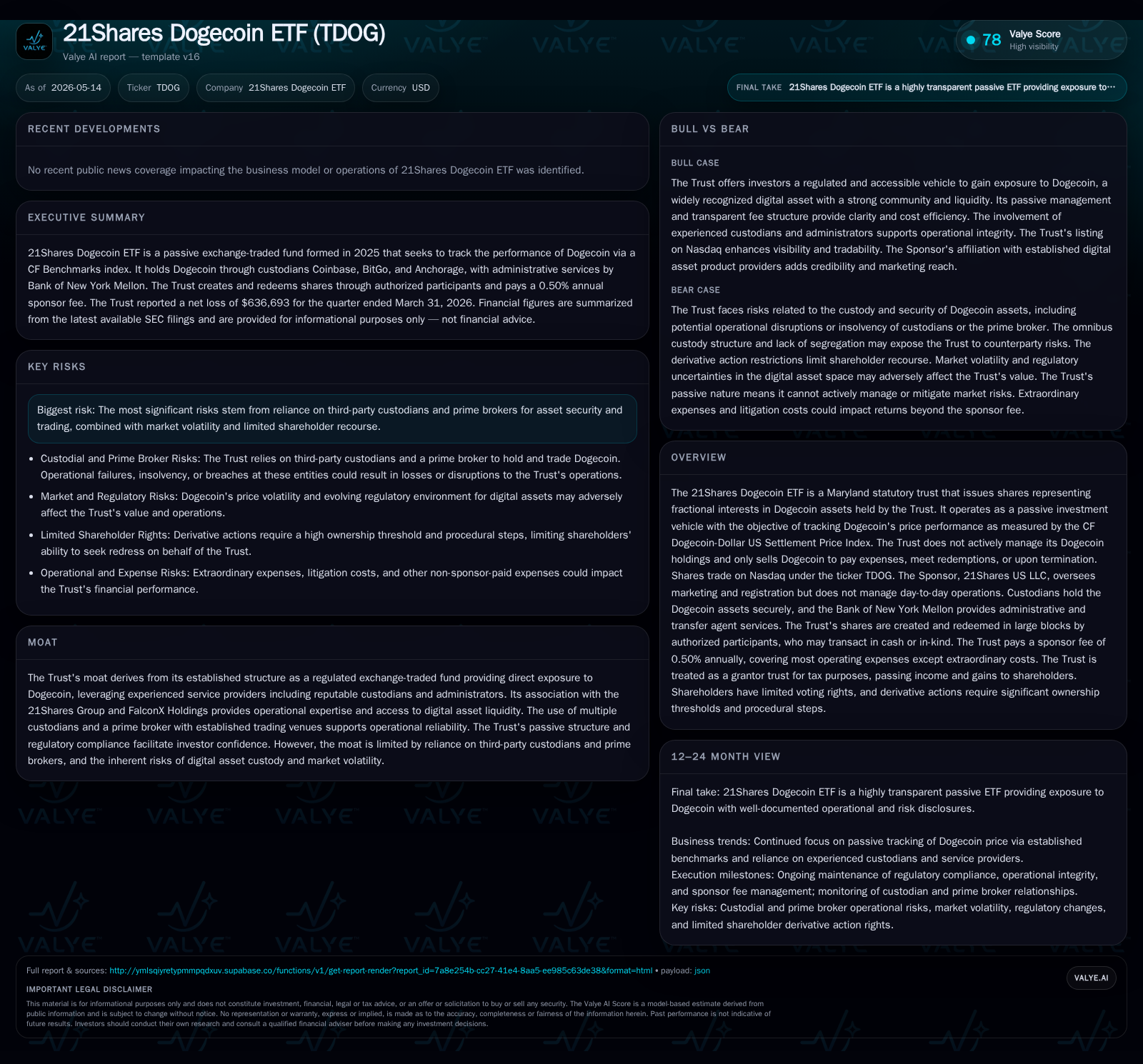
21Shares Dogecoin ETF (TDOG) maintains its passive exposure model to Dogecoin via the CF Dogecoin-Dollar US Settlement Price Index, with no material changes reported in its latest quarterly filing. The Trust’s structure leverages multiple custodians and a prime broker to secure assets and facilitate share creation/redemption, but remains vulnerable to inherent meme-coin volatility and evolving regulatory landscapes. Growth is primarily tethered to retail demand for meme-coin exposure through regulated ETFs, while risks include custody dependencies and limited shareholder litigation rights.
Latest Quarterly Update and Operational Overview
The most recent quarterly report filed on May 13, 2026 [S2] reiterates that the 21Shares Dogecoin ETF continues to operate without material changes in risk factors or operational structuring from its March 2026 annual filing [S1]. The Trust remains committed to its passive investment objective—tracking the price performance of Dogecoin as reflected by the CF Dogecoin-Dollar US Settlement Price Index.
No new litigation or regulatory developments affecting the Trust were disclosed. Notably, Shareholder rights concerning derivative actions remain heavily restricted under the Trust Agreement as clarified in this filing [S2], requiring significant ownership thresholds (10% combined ownership among non-affiliated shareholders) before legal action can be initiated on behalf of the Trust.
This quarterly stability underscores a period of operational stasis where TDOG maintains its core mandate absent strategic or structural shifts amidst an otherwise dynamic crypto regulatory backdrop.
Business Model and Product Structure of the 21Shares Dogecoin ETF
TDOG functions as a Maryland statutory trust issuing shares that represent fractional interests in actual Dogecoin held by custodians [S1]. Its investment objective is straightforward: mirror the price movements of Dogecoin net of fees through physical token holdings rather than derivatives exposure.
Shares trade on Nasdaq under ticker "TDOG", with creation and redemption processes conducted exclusively via authorized participants—registered broker-dealers bound by agreements with the Sponsor [S13]. These participants can transact shares either in cash or in-kind basket exchanges of Dogecoin tokens equivalent in value to shares issued or redeemed.
The fee structure is transparent: an annual sponsor fee of 0.50% accrues daily and is paid weekly in Dogecoin from the Trust's assets [S11]. The trust does not employ leverage or active trading strategies. It only sells Dogecoin when necessary for redemptions, expense payments, or upon termination [S5].
This lean management style reduces complexity but places substantial sensitivity on underlying Dogecoin price dynamics—an inherently volatile memecoin with price swings driven by factors beyond traditional asset classes.
Custody and Administrative Framework Ensuring Asset Security
Asset security relies on a triad of established custodians: Coinbase Custody Trust Company, BitGo Bank & Trust, and Anchorage Digital Bank—all holding the Trust's Dogecoin [S5]. This multi-custodian approach mitigates single point-of-failure risks but sustains residual third-party operational risk.
The administrative mantle falls to Bank of New York Mellon, which acts as Transfer Agent, Administrator, and Cash Custodian [S5]. BNY Mellon is contractually obligated to a professional standard of care typical for ETF custodians but carries limited liability except in cases of bad faith or gross negligence [S14][S15].
Coinbase also functions as the Prime Broker facilitating trading activities associated with share creations/redemptions [S5][S14]. However, past legal challenges faced by Coinbase entities raise potential operational continuity concerns, although these have not materially impacted TDOG thus far [S21].
Overall, TDOG’s custody framework reflects industry best practices balancing security and operational efficiency but cannot fully insulate against systemic crypto infrastructure risks or evolving regulatory pressures on service providers.
Competitive Environment and Industry Positioning
Within the US crypto ETFs sector, TDOG is amongst a select few vehicles offering direct regulated exposure to Dogecoin—a memecoin characterized by high retail investor interest yet pronounced volatility. Its principal moat stems from being exchange-listed with regulatory oversight absent in many unregulated crypto investment channels.
Affiliation with the experienced 21Shares Group and FalconX Holdings provides access to technological infrastructure and liquidity sourcing advantageous relative to emergent competitors lacking scale or expertise.
Nevertheless, reliance on third-party custodians and brokers limits structural defensibility. Unlike traditional asset ETFs that benefit from mature ecosystems and established investment mandates, TDOG confronts skepticism tied to meme-coin legitimacy and uncertain regulatory treatment—introducing existential ambiguity compared to broader crypto ETFs that track larger-cap coins like Bitcoin or Ethereum.
Further constraining competitive differentiation is TDOG’s passive reliance on direct Dogecoin asset holdings rather than synthetic exposures or actively managed strategies that might appeal to sophisticated investors seeking alpha generation alongside price tracking.
Key Growth Drivers and Market Expansion Potential
Growth prospects hinge chiefly on expanding retail investor appetite for meme-coin exposure via formally regulated vehicles. Broader crypto ETF acceptance trends provide a tailwind enabling easier access for mainstream investors hesitant toward direct wallet ownership or spot exchanges.[S1]
Marketing efforts orchestrated by the Sponsor aim to build awareness among target demographics familiar with Dogecoin’s cultural footprint. Incremental Authorized Participant additions foster liquidity enhancement aiding efficient share arbitrage between NAVs and market prices.
That said growth remains circumscribed by continued macroeconomic pressures influencing crypto enthusiasm at large alongside dogecoin-specific cyclicality induced by social media sentiment shifts or celebrity endorsements. TDOG’s pure-play exposure profile means demand fluctuations map closely onto dogecoin USD price moves rather than broader diversification benefits found in more composite digital asset ETPs.
Risk Factors and Structural Challenges
Investing in TDOG entails multiple idiosyncratic risks:
- Custodial Dependency: Although employing reputed custodians reduces risk granularity, all share mismanagement or security breaches could irreparably harm asset integrity due to lack of recourse against third parties beyond contractual indemnifications [S5][S15].
- Regulatory Uncertainty: Despite current informal SEC staff positions suggesting memecoins are not securities [S7], future regulatory reclassifications could spur mandatory registrations under the Investment Company Act or force liquidation scenarios severely depressing value [S18][S23].
- Volatility: Dogecoin’s memecoin classification renders it susceptible to outsized price swings driven by speculative behavior rather than fundamental adoption metrics [S1][S6]. These swings directly affect NAV stability and create potential dislocations between Shares' market prices versus fair NAV values.
- Limited Shareholder Litigation Rights: The Trust Agreement restricts derivative actions severely requiring at least two non-affiliated shareholders holding collectively 10% of shares before suit initiation can proceed—imposing high barriers to investor recourse against fiduciary failures or sponsor misconduct [S2][S20].
- Market Liquidity Concerns: Authorized Participant reliance for basket redemption introduces counterparty risk should participants exit or cease operations abruptly affecting Trust liquidity profiles.
Outlook: What to Monitor Going Forward
Key developments warranting close observation include:
- Regulatory Developments: Any shift in SEC interpretations regarding memecoins’ securities status will materially influence TDOG’s operational viability or trigger forced adaptations such as registration or liquidation mandates.
- Custodian/Prime Broker Stability: Legal outcomes involving Coinbase Prime or other custodial entities providing services to TDOG must be tracked given potential disruptive impacts on operations.[S21]
- Authorized Participant Activity: Expansion or contraction in authorized participants affects liquidity design efficiency; monitoring related announcements could signal demand tides.
- Market Pricing Behavior: Persistent premiums/discounts versus NAV may reflect arbitrage mechanism stress revealing structural imbalances worthy of scrutiny.
- Fee Structure Adjustments: Any modifications communicated via future filings impacting sponsor fees will influence gross returns net of expenses.[S11]
The next quarterly report due November 2026 will likely shed light on evolving fee expense dynamics alongside any incremental material risk disclosures reflecting changing market conditions.
Disclaimer: This analysis presents an objective examination based solely upon reported SEC disclosures and verified company facts as of May 2026. It is intended for informational purposes without offering investment recommendations or advice.
Disclaimer: This is research-only, informational analysis and not investment advice. It may include AI-generated interpretation and general industry context. Always verify important details using primary sources.

Comments