
REE Automotive’s Software-Defined Vehicle Platform Faces Funding and Market Hurdles
REE Automotive advances a strategic review while managing a production pause amid liquidity and competitive pressures.
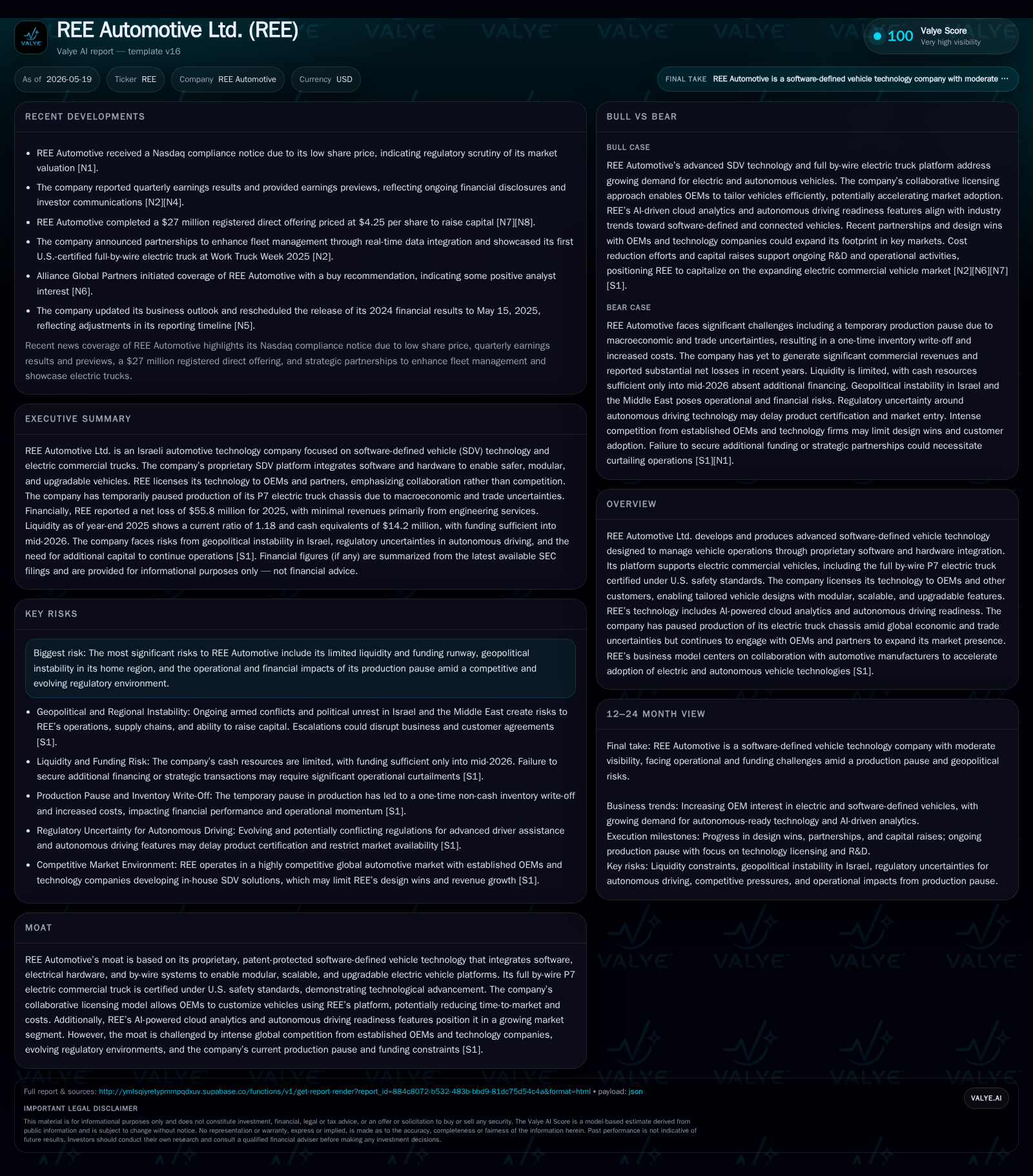
In its latest quarterly filing, REE Automotive highlighted the continuation of its temporary production pause for its P7 electric truck platforms due to macroeconomic and trade uncertainties, coupled with an expedited strategic alternatives review aimed at maximizing shareholder value. The company's proprietary software-defined vehicle (SDV) technology, which integrates modular by-wire hardware and cloud-based AI analytics, positions it uniquely in the EV commercial vehicle segment, but progress is constrained by limited liquidity and intense industry competition. Growth opportunities hinge on expanding OEM partnerships and technology licensing across international markets. Critical near-term risks include funding challenges, geopolitical issues affecting its UK subsidiary, and the operational impact of paused production. Upcoming milestones focus on the outcome of the strategic review process, potential resumption of manufacturing, and compliance with Nasdaq listing requirements.
Latest Operating Developments: Strategic Review and Production Status
REE Automotive's most recent Form 6-K filing dated May 15, 2026 [S2] confirms continuation of the temporary production pause on their P7-S Strip Chassis and P7-C chassis variants first announced in May 2025 [S1]. This suspension is attributed primarily to significant uncertainty in global macroeconomic conditions and evolving U.S. trade policies impacting the automotive supply chain. Despite this pause halting revenue-generating manufacturing operations, REE has simultaneously embarked on an expedited strategic alternatives review initiated earlier in May 2026 [S3]. This review process includes consideration of potential sales of the company or its assets, mergers or business combinations, reverse mergers, strategic partnerships, or licensing opportunities aimed at maximizing shareholder value.
The Board has appointed TD Securities (USA) LLC as financial advisor to guide this comprehensive exploration. CEO Daniel Barel emphasized a commitment to streamlining operations alongside this search for a sustainable path forward that benefits shareholders while supporting existing technology partners [S3]. Such dual-track efforts underscore the company's acknowledgment of near-term operational challenges but retain focus on long-term corporate viability.
Also notable is REE Automotive UK Limited’s entry into administration proceedings as of early May 2026 [S16], indicating restructuring within key subsidiaries likely connected to cost efficiencies or financial distress roots.
Innovative Software-Defined Vehicle Technology and Business Model
REE Automotive's core value proposition revolves around its proprietary software-defined vehicle (SDV) platform integrating hardware (modular electrical components) with advanced software controls based on a fully by-wire architecture certified under Federal Motor Vehicle Safety Standards (FMVSS) [S1]. The flagship product signaling this innovation is the P7 electric commercial truck chassis that offers OEMs a scalable, flexible architecture designed for quick adaptation through open APIs that facilitate extensive customer tailoring.
The business model primarily licenses this SDV tech to original equipment manufacturers (OEMs), mobility-as-a-service providers (MaaS), dealers, logistics companies, and other stakeholders within the EV ecosystem—entities seeking to reduce development time and costs while elevating functionality such as advanced driver assistance systems (ADAS), over-the-air updates via REEai Cloud analytics launched in early 2025 [S1], and autonomous driving integration readiness.
This 'complete not compete' approach positions REE as an enabler rather than a traditional vehicle manufacturer competing head-on with OEMs. By focusing on software-hardware integration layers underpinning future mobility solutions rather than full vehicles themselves, REE seeks to streamline partner product launches while accumulating recurring licensing revenue streams once volume scales.
Competitive Position and Industry Dynamics in Electrification and SDVs
The industry backdrop for REE is one characterized by rapidly increasing adoption of electric vehicles globally driven by environmental regulation stringency, consumer demand shifts toward sustainable transport modes, improved battery technologies reducing range anxiety, and expansive charging infrastructure buildouts. Meanwhile, software-defined vehicles are emerging as a pivotal domain with McKinsey-quoted projections estimating SDVs capturing nearly 90% of new vehicles produced by end-of-decade.
Nevertheless, competition intensifies from legacy automotive giants who are simultaneously developing integrated EV platforms featuring proprietary software stacks alongside tech entrants partnering with OEMs on digital mobility solutions. Examples include joint ventures among Rivian, Volkswagen Group; General Motors’ Cruise subsidiary; Ford’s pivot emphasizing electrification combined with software-centric architectures—all of which exert pressure on specialized vendors like REE for market share and innovation leadership.
REE's moat lies in its patent-protected integration of zonal architecture facilitating modular design flexibility that can be customized rapidly via software layering—capabilities that may reduce total cost of ownership (TCO) for licensee fleets while accelerating their time-to-market relative to ground-up vehicle development cycles. However, the technological edge requires capital-intensive scaling investments paired with successful client integrations to translate into sustainable commercial traction against entrenched competitors [S1].
Growth Prospects Driven by OEM Partnerships and Technology Licensing
Looking ahead, REE’s principal growth drivers rest upon expanding collaborative efforts within international markets notably Europe, Japan, and India where regulatory support for electrification meshes with escalating fleet electrification demand trends [S1]. The licensing model inherently leverages scalability advantages whereby additional customers can adopt the platform without proportionate increases in direct manufacturing expenditures.
Such flexible modularity enables fleet operators or OEMs to invoke Voice-of-Customer feedback through collaborative APIs directly influencing vehicle feature sets tailored to distinct operational needs—ranging across logistics-focused vans to heavy-duty trucks—potentially fostering high customer retention but contingent on successful commercialization.
The launch of REEai Cloud incorporating AI-powered analytics further widens value proposition scope from hardware alone towards integrated smart fleet management solutions capable of predictive maintenance forecasting or operational efficiency enhancements—factors instrumental for MaaS providers requiring continuous evolution amidst volatile market dynamics.
Commercial realization remains phased; while prototype projects exist, significant volume ramp for direct revenue generation remains pending until production recommences post-pause scenarios are resolved [S1]
Risks from Funding Constraints, Global Competition, and Operational Pauses
Foremost risk considerations center around limited available liquidity—a subscription cash balance approximating $14.2 million against current liabilities near $12.7 million as of year-end 2025 indicates slender operating runway absent immediate additional financing [F1]. Past losses exceeded $55 million for fiscal year 2025 despite reductions versus prior periods highlighting ongoing cash burn inherent in pre-commercial stages.
Additionally concerning is geopolitical volatility irradiated through UK subsidiary restructuring where administration processes threaten continuity or have induced loss of key assets/employees further complicating regional operations [S16]. Macroeconomic uncertainties exacerbate these vulnerabilities alongside trade policy shifts notably impacting supply chains critical to semiconductor-dependent SDV hardware components.
Market risks are compounded by intense competition spanning both traditional large-scale automakers transitioning rapidly into EV-SDV sectors alongside agile technology startups pursuing alternative electrification pathways or autonomous capabilities often backed by deep-pocket industrial partnerships.
Nasdaq listing compliance pressures manifest as deadlines loom for minimum bid price requirements challenging investor sentiment potentially restricting capital market access if unmet by June 29, 2026 [S1][S16]
Strategic alternatives under discussion inherently carry execution uncertainty risk; failure to consummate beneficial transactions could trigger adverse impacts including valuation decline or forced restructuring scenarios further destabilizing operations [S17].
Key Milestones and Market Signals to Monitor Next
Investors should closely follow several critical developments over upcoming quarters:
- Outcome announcements from the Board-led expedited strategic review process including approvals or terminations related to sales or partnership agreements [S3][S7].
- Signals regarding lifting or extension of current production pauses—specifically any timelines disclosed for resuming manufacture of P7 product lines integral to establishing revenue inflows [S2][S6].
- Updates on technology integrations with new OEMs or expansion within existing partner ecosystems across targeted regions evidencing traction beyond pilot phases.
- Compliance progress vis-à-vis Nasdaq minimum bid price rule adherence influencing share liquidity status potentially impacting access to capital markets.
- Additional liquidity enhancements via equity raises or debt instruments coupled with operating expense optimization initiatives extending cash runway past mid-2026 projection horizons noted in annual filings [F1][S8].
Successful navigation of these indicators will materially influence REE Automotive’s trajectory toward becoming a commercially viable player within evolving electrified mobility ecosystems.
Financial Summary: Liquidity Position Supporting Operations
As per year-end December 31, 2025 data reported in Form 20-F filed May 15th, REE Automotive held approximately $14.25 million in cash equivalents against $12.71 million current liabilities yielding a current ratio near 1.18—a narrow margin indicative of tight near-term liquidity dynamics absent significant incoming cash flows [F1]. Importantly, total debt stood at zero emphasizing absence of conventional leverage though convertible promissory notes exist which carry contingent settlement risk not detailed here.
The company’s net loss narrowed to $55.8 million in 2025 compared to prior years attributable partially to impairment charges associated with halted production lines (~$24.7 million impact) offsetting operational spending reductions primarily in R&D and SG&A categories reflecting cost control measures post-pause initiation [F1][S24][S25]
Despite cost containment programs underway per recent disclosures including reduction plans targeting lowered monthly operating expenses during strategic alternative evaluations [S3], persistent losses signal dependency on successful financing rounds or strategic deals essential for progressing commercialization milestones beyond current operational hiatuses.
Disclaimer: This analysis relies exclusively on information drawn from REE Automotive Ltd.’s publicly filed SEC documents dated up to May 15th, 2026 ([S1]-[S29]) along with companyfacts database metrics ([F1]). It excludes speculation beyond disclosed facts or unconfirmed forward-looking assertions.
Disclaimer: This is research-only, informational analysis and not investment advice. It may include AI-generated interpretation and general industry context. Always verify important details using primary sources.

Comments