
VIP Play Advances AI-Driven Sports Gaming Amid Liquidity Challenges
VIP Play’s latest quarter spotlights investment in AI-powered gaming licenses alongside urgent liquidity and capital structure concerns.
In Q3 2026, VIP Play, Inc. made a strategic investment acquiring a perpetual digital engagement license to bolster its AI-driven sports entertainment offerings amidst ongoing financial stress. The company operates primarily in the underpenetrated U.S. skill-based and daily fantasy sports gaming segment, leveraging AI partnerships to differentiate in a competitive regulatory environment. However, significant liquidity constraints and heavy reliance on related party financing pose a critical challenge to executing growth plans, including geographic expansion. Monitoring regulatory approvals, capital raises, and user adoption metrics will be essential to assessing VIP Play’s potential trajectory.
Q3 2026 Operating Update and Implications
VIP Play’s latest quarterly filing (10-Q filed May 15, 2026) provides critical insights into the company’s operational status and capitalization challenges. During the nine months ended March 31, 2026, the company acquired a perpetual license for a third-party digital customer engagement application, which it has capitalized as an intangible asset [S2]. This move demonstrates VIP Play’s commitment to integrating advanced technology solutions—particularly AI-driven customer engagement tools—to elevate its product offering in skill-based gaming.
Notably, management is evaluating whether this license should be amortized over a finite useful life due to risks of technological obsolescence or replacement by newer platforms [S2]. This consideration affects future expense recognition and balance sheet valuation.
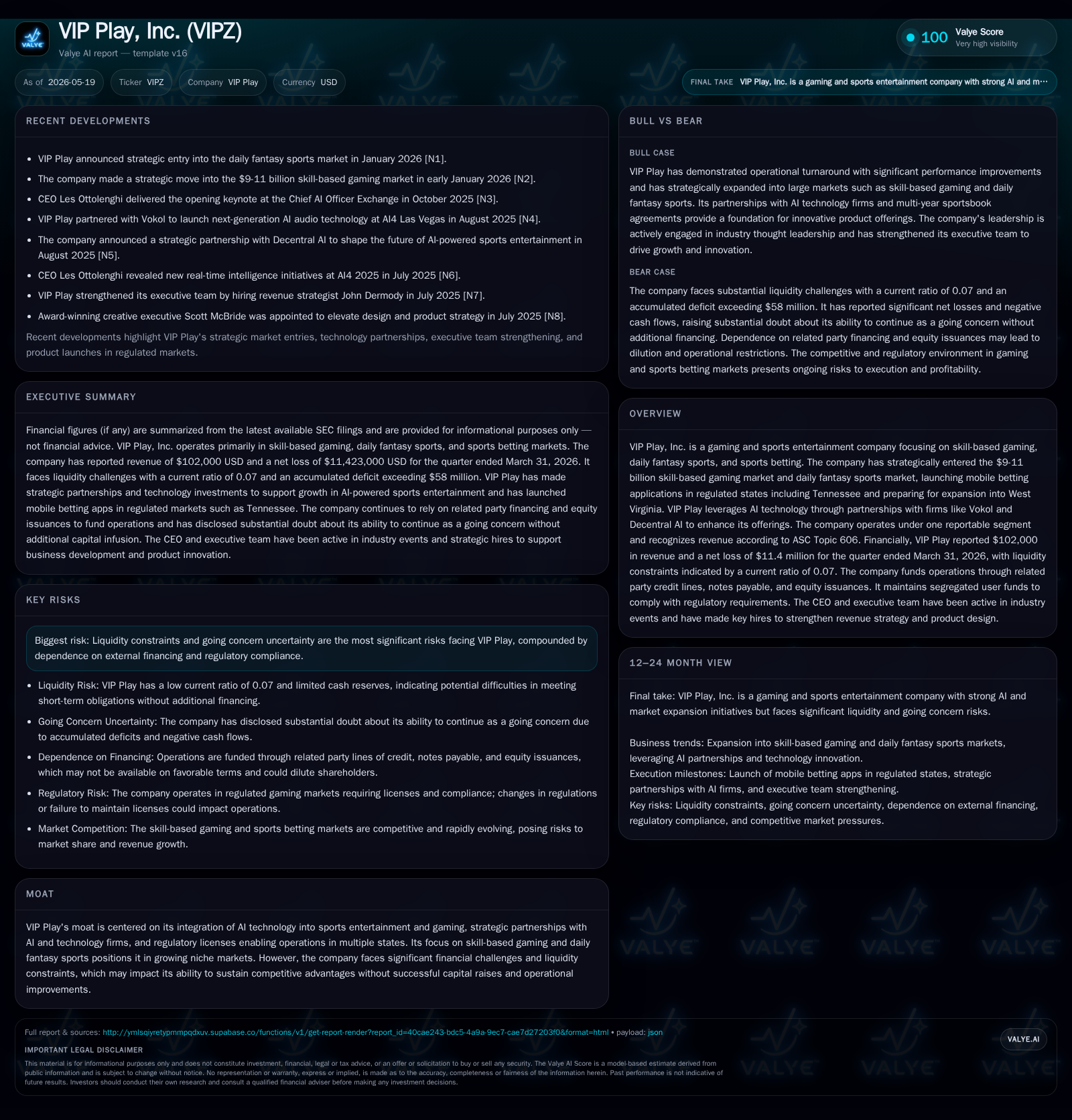
Alongside technological investments, the company candidly acknowledges looming liquidity constraints. The current ratio—current assets to current liabilities—is alarmingly low at approximately 0.07 as of March 31, 2026 [F1]. Current assets stand at roughly $2.8 million while current liabilities exceed $42 million [F1], underscoring substantial short-term funding pressure.
Operational cash needs continue to rely heavily on a discretionary convertible revolving line of credit arranged with Excel Family Partners, LLC—a related party controlled by the company’s board secretary—amounting up to $14 million but without committed draw rights [S3]. Management expresses uncertainty on future financing availability or terms yet maintains cautious optimism that shareholder equity infusions and new investors can bridge funding gaps necessary to sustain operations [S2]. This dual narrative of advancing AI capabilities while battling capital scarcity frames VIP Play’s immediate operating milieu.
Business Model Focus: Skill-Based Gaming and AI-Enhanced Offerings
VIP Play operates predominantly in skill-based gaming, daily fantasy sports, and sports betting via regulated mobile applications targeted at state-level markets such as Tennessee. Revenue is recognized following ASC Topic 606 across a single reportable segment primarily focused on licensing digital content and services tied to sports entertainment.
The company’s monetization model involves generating fees through user participation in daily fantasy contests and skill-based games where victory depends more on player ability than chance—a growing niche estimated at $9-11 billion annually in the U.S. market. Regulatory licenses enable VIP Play to legally offer these products across multiple states, creating non-trivial barriers for new entrants.
Strategic partnerships with AI-focused firms like Vokol and Decentral AI form part of VIP Play’s differentiation strategy. These alliances facilitate embedding machine learning algorithms into customer engagement platforms that optimize user experience through personalized game research views, dynamic odds setting in skill games, real-time contest adjustments, or enhanced marketing targeting.
This AI integration has potential structural advantages: increased user stickiness via tailored gameplay mechanics that heighten engagement duration and frequency; improved gross gaming revenue per user through optimized game design; and data-driven operational efficiencies that may lower scalability costs relative to competitors relying on static platforms.
However, monetization remains nascent—the reported $102K revenue for the latest period dwarfs operational expenses—and commercial traction is challenged by substantial upfront development costs plus continued licensing fees [F1]
Industry Context and Competitive Dynamics in US Skill Gaming
The U.S. skill gaming industry is characterized by a patchwork regulatory framework that varies significantly across state lines—a key driver shaping VIP Play’s strategic concentration on licensed markets such as Tennessee with imminent entry plans into West Virginia. This fragmented landscape necessitates focused compliance investment but also offers growth opportunities as states incrementally legalize or regulate skill-based formats distinct from traditional chance gambling.
Competitive dynamics hinge on licensed footprint breadth, technology platform quality, proprietary content depth, marketing capability, user acquisition efficiency, and pricing models that balance retention with sustainable unit economics.
Peer companies vary from entrenched larger operators with extensive state licenses (yielding higher brand recognition) to emerging tech-centric platforms pushing innovation curves similar to VIP Play’s focus on artificial intelligence. Switching costs can be moderate given digital delivery but are elevated by exclusive content deals or superior UX features driven by advanced analytics.
VIP Play’s integration of AI-enabled gaming experiences situates it potentially ahead of early-stage rivals who offer more commoditized skill contests without personalization layers. Nonetheless, lack of scale and ongoing funding bottlenecks dampen its ability to invest aggressively in marketing or content expansion needed for stronger market penetration.
Growth Drivers: Regulatory Expansion and Technology Integration
Growth trajectories align closely with two principal vectors: geographic regulatory expansion and deepening technology integration.
Regulatory-wise, entry into new states like West Virginia represents incremental addressable market expansion supported by distinct licensing endorsements visible in the near term,[S2],[S3]. Each jurisdiction unlocked could catalyze incremental revenue streams but requires tailored compliance overhead.
Technological growth drivers stem from enhancements in mobile betting platforms leveraging artificial intelligence features incorporated via acquired licenses such as the recent proprietary engagement app [S2]. These advances seek to improve user acquisition cost efficiency by increasing lifetime value through personalized game offerings and dynamic contest structures that keep users engaged longer.
The latest filing shows a stark current ratio near 0.07 driven by sizeable short-term liabilities dwarfing current assets [F1], highlighting acute working capital stress.
Accumulated deficits approximate $65.8 million with net losses exceeding $11 million just for the most recent quarter,[F1], signaling ongoing cash burn beyond near-term revenue receipts.
Dependence on discretionary credit facilities from related parties—while providing immediate operational runway—poses execution risk if funding availability tightens or terms become onerous [S3]. Additionally, prospective equity raises could dilute existing shareholders materially given limited alternative capital sources reported [S2].
Regulatory compliance complexity adds further operational risk; failure or delays in permits across target states could impede market entry timelines critical for anticipated revenue ramp-ups.
The company’s repeated disclaimers regarding going concern doubts underscore these vulnerabilities [S6],[S14], emphasizing that absent successful capital infusions or marked profitability improvement VIP Play faces existential uncertainty.
Key Milestones and What to Monitor Next
Key watchpoints over the coming quarters should concentrate around:
- Progress securing financing beyond existing related party lines including forms/funds raised or new equity placements announced explicitly.
- Regulatory approvals finalizing entry into West Virginia or other states targeted for expansion.
- Operational metrics tracking uptake of new digital engagement licenses post-launch such as active user counts or repeat play frequency enhancements.
- Assessment outcomes related to the useful life determination of intangible assets associated with technology licenses given potential amortization impacts on earnings.
- Quarterly revenue progression relative to cost trajectory developments indicating if scale benefits materialize sufficiently fast. These markers will serve as barometers of whether VIP Play can bridge its financial constraints while scaling its differentiated offerings.[S2],[S3]
Financial Overview: Current Capital Structure and Liquidity Status
As of March 31, 2026, VIP Play reported current assets totaling approximately $2.78 million against current liabilities of about $42.32 million producing an extremely low current ratio near 0.07—a clear signal of short-term liquidity distress [F1]. Cash balances were below FDIC insured limits at quarter-end but have not resulted in losses nor are perceived as significant credit risk exposures [S2].
Total debt is reported at approximately $1.13 million with net debt near $1.06 million after accounting for cash equivalents [F1]. The company utilizes a notable convertible revolving credit line up to $14 million from Excel Family Partners which remains a critical lifeline without firm commitment clauses [S3].
From an income perspective, reported revenues remain minimal (circa $102K) while net losses surged above $11 million during Q3 fiscal period end March 2026 underscoring ongoing expenses outpacing nascent commercialization efforts [F1]. Operating cash burn continues unabated requiring external financing support for business continuity [S2]. This precarious financial condition heightens operational risks amid aggressive technology investments aimed at medium-term growth adaptation rather than immediate profit generation.
Disclaimer: This analysis is based solely on publicly available SEC filings up to May 15, 2026, combined with permitted sector context analysis; it does not constitute investment advice or research views.
Disclaimer: This is research-only, informational analysis and not investment advice. It may include AI-generated interpretation and general industry context. Always verify important details using primary sources.

Comments