
TMD Energy Faces Demand Pullback and Strategic Transition After IPO
Following its NYSE American debut, TMD Energy contends with lower bunkering volumes and a tightening liquidity profile amid new board leadership.
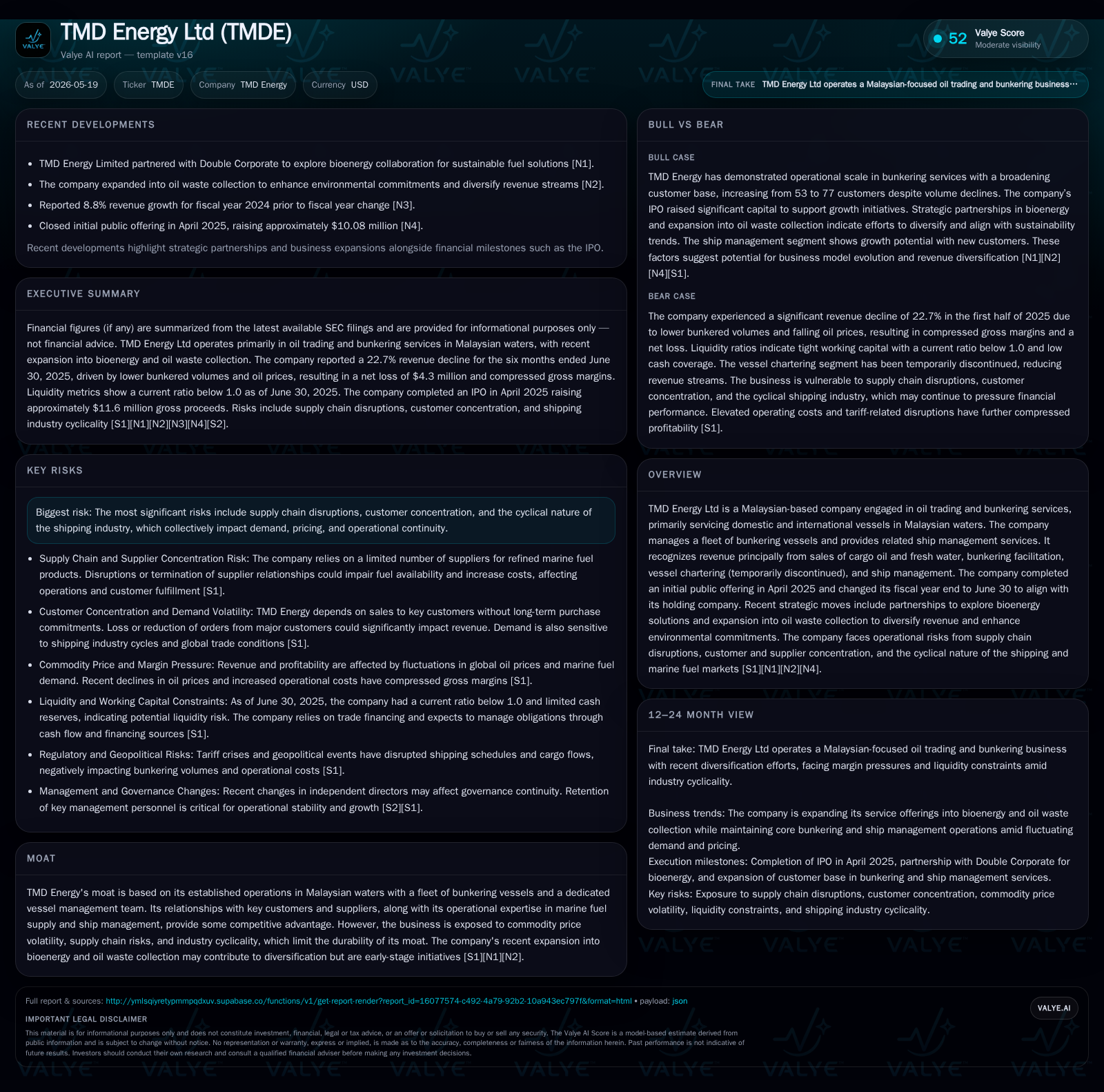
TMD Energy Ltd's latest quarterly disclosure reveals significant operational challenges, including a 22.7% drop in net revenues primarily due to subdued bunkering activity and tariff-related delays. The company recently replaced an independent director with a seasoned investment banking professional, signaling heightened governance focus. Its core marine fuel supply business, anchored in Malaysian waters via proprietary vessels and ship management services, encounters margin pressures from volatile commodity costs and limited pricing pass-through capabilities. While IPO proceeds bolster liquidity, ongoing customer concentration and supply chain risks temper the near-term outlook. TMD’s incipient diversification into bioenergy and waste collection could alleviate cyclicality but remain nascent.
Recent Operating Update
TMD Energy Ltd's latest quarterly filing dated February 17, 2026 [S2] primarily documents a board-level change with the resignation of Mr. Shin Yick Fabian from multiple key committees due to personal reasons. His replacement by Mr. Kwok On Tse injects substantial investment banking experience to the governance framework—a move possibly aimed at strengthening oversight amid an evolving strategy.
Earlier annual disclosures reaffirmed operational headwinds: for the six months ended June 30, 2025, total net revenues dropped sharply by 22.7% compared to the prior period (to approximately $276 million), reflecting diminished bunkering demand linked to tariff disruptions and logistical constraints [S23]. This revenue contraction was closely mirrored by a proportional decline in cost of revenues leading to gross profits shrinking by over 28%. The operating loss widened to nearly $1.94 million due to rising fixed general and administrative charges despite cost trims in selling expenses [S23].
Moreover, elevated accounts receivable — exacerbated by delayed cargo movements — highlight temporary liquidity pressures and longer payment cycles with customers [S1]. Despite this midyear softness, management’s control of trade facilities near $92 million [S3][S5] alongside available cash reserves of approximately $7.1 million as of June 30 reflect sufficient runway for working capital needs for the next twelve months.
Business Model
At its core, TMD operates an integrated marine fuel supply business focused on Malaysian territorial waters. The company's value proposition combines ownership of a fleet of bunkering vessels dedicated to supplying refined marine fuel products — predominantly oil cargo — to domestic and international vessels navigating these busy shipping lanes [S1]. This physical asset base is complemented by in-house vessel management teams that ensure operational readiness and regulatory compliance.
Revenue recognition follows principal-agent accounting rules with TMD acting as principal; it procures the bunker fuels from select suppliers—currently limited in number—and resells them at marked-up prices to maritime customers [S14]. Cash inflows are therefore directly linked to fuel volume sales multiplied by prevailing spot or negotiated prices without formal long-term volume contracts. In addition to bunkering facilitation fees, ancillary revenue streams include sales of fresh water onboard cargo vessels and ship management services, which contribute a stable if smaller gross profit component.
Pricing power is constrained: invoiced prices closely track volatile crude oil-based commodity prices; however, tariff-related delays impede timely cost pass-throughs to customers [S23]. Demand tends to be highly cyclical, impacted by global trade volumes and shipping sector health.
New vessel acquisitions or expansions require capital spending financed through a mix of operating cash flows supported by bank trade finance lines and vendor financing options [S17][S24]. Operating expenses are dominated by vessel maintenance costs, staff salaries for specialized marine crews/management teams, regulatory compliance costs, and administrative overhead.
Industry Structure and Competitive Position
TMD occupies a niche within the broader maritime bunker fuel supply ecosystem largely concentrated in Southeast Asia's strategic shipping corridors. Its fleet size relative to regional peers is modest but benefits from established local relationships with port authorities and shipping companies operating within Malaysian waters.
The company faces intense competition not only from other bunker providers within Malaysia but also regional players offering similar services throughout major ports such as Singapore or Port Klang. Customer concentration risk looms given limited long-term contractual commitments; major clients represent sizable revenue portions without binding purchase agreements [S1]
Supplier risk also persists due to reliance on few vetted suppliers capable of delivering low-sulfur marine fuels that meet IMO regulations [S1]. Regulatory compliance costs add complexity given increasing environmental scrutiny around marine emissions requiring cleaner fuels or alternative energy sources.
Growth Drivers
Despite recent revenue setbacks tied largely to external macro dynamics such as tariff disputes causing shipment delays [S23], TMD’s growth depends on several key drivers:
- Post-pandemic shipping recovery: As global trade stabilizes, bunker fuel demand may rebound proportionally across regional maritime hubs.
- Fleet expansion: Incremental addition of bunkering vessels or upgrades can increase delivered quantities per period pending financing availability.
- Regional geographic expansion: Management has expressed intent to extend operations beyond Malaysian waters capturing adjacent markets with similar service demands [S1].
- Service diversification: Early-stage entry into bioenergy solutions and oil waste collection seeks new revenue streams aligned with sustainability trends disrupting traditional fossil fuel dependency [N1][N2].
- Operational efficiency: Improved inventory controls introduced recently have started reducing working capital strain through better stock turnover rates [S23].
- Customer base expansion: Targeting new client segments or liners beyond current core customers could alleviate concentration risks.
Risks and Growth Constraints
Certain structural risks constrain TMD’s growth trajectory:
- Demand Cyclicality: Shipping volumes fluctuate with macroeconomic cycles affecting bunker consumption directly.
- Customer Concentration & Contractual Exposure: Lack of volume guarantees means revenue visibility is limited.
- Supply Chain Dependencies: Limited supplier network creates vulnerability particularly during geopolitical tensions or production hiccups.
- Commodity Price Volatility: Sharp shifts in crude prices impact margins unless effectively hedged or rapidly passed through which currently appears constrained.
- Regulatory Costs: Increasing IMO environmental regulations pressure costs upward requiring costly vessel retrofits or alternative fuels adoption.
- Working Capital Constraints: The current ratio of approximately 0.91 indicates tight liquidity necessitating continued prudent working capital management especially amid delayed customer payments [F1][S1].
- Early-stage New Business Ventures: Bioenergy initiatives remain immature with uncertain economics requiring upfront investment before scaled contribution materializes.
What to Watch Next
Key milestones that will shape near-term performance include:
- Quarterly updates on bunkering volumes reflecting recovery or further softness tied to global trade conditions.
- Progress in managing accounts receivable collections impacting liquidity dynamics given previously noted extended timelines [S1].
- Expansion announcements into regional markets outside Malaysia or formalization of strategic partnerships in bioenergy/waste sectors signaling diversification commitment.
- Fleet capacity changes through acquisition or decommissioning impacting operating leverage.
- Pricing environment updates reflecting ability to navigate tariff impacts or inflation-related cost pressures in procurement logistics.
- Any guidance revisions related to capital expenditure plans vis-à-vis IPO proceeds utilization priorities including potential financing needs should growth acceleration be pursued [S3][S5][S10].
Financial Profile Summary
As of June 30, 2025, TMD held cash and equivalents totaling approximately $7.06 million against total debt around $934 thousand resulting in a net cash position estimated close to negative $6.13 million when factoring current liabilities—reflecting tight but manageable liquidity conditions given strong supplier trade credit facilities exceeding $90 million (though only a fraction immediately available) [F1][S3][S5]
The company reported an operating loss near $1.94 million for the half year ending June 2025 corroborating margin pressures despite cost control efforts including reduced marketing expenses partially offsetting higher general & administrative outlays reflecting staff cost increases necessitated by operations scale maintenance [S23]. Net loss expanded negatively driven by both operational setbacks coupled with increased interest expenses from requisite borrowings [F1][S23]. Capital expenditures remained moderate ($2.1 million for six months), primarily invested in maintaining vessel operability rather than fleet expansion at this stage [S17][S24].
Overall financial stewardship appears cautiously calibrated—leveraging IPO funds judiciously while preserving access to institutional credit lines—but still vulnerable amid cyclical downturns or adverse customer payment trends.
This analysis synthesizes TMD Energy's recent filings and disclosures up to early 2026 without offering investment advice or predictions beyond factual interpretation of present data and stated corporate intentions.
Disclaimer: This is research-only, informational analysis and not investment advice. It may include AI-generated interpretation and general industry context. Always verify important details using primary sources.

Comments