
LFTD Partners Faces Regulatory Crossroads as Federal Ban Looms on Hemp Products
Recent quarterly filings reveal acute near-term revenue risks and operational impairments tied to impending federal restrictions on hemp-derived intoxicating products.
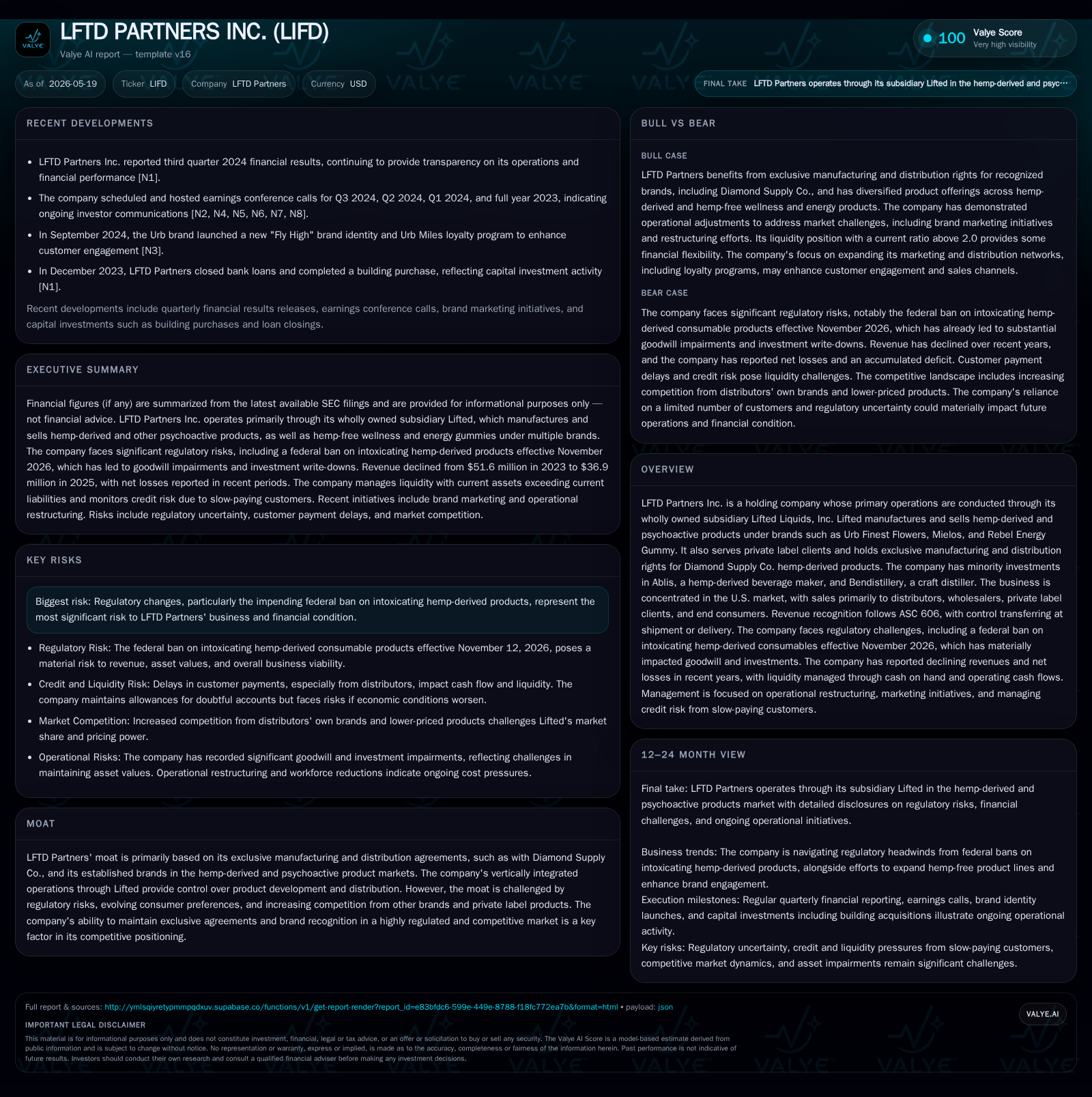
LFTD Partners' latest 10-Q filing underscores intensifying regulatory headwinds from a pending federal ban effective November 2026, imperiling over half its revenue which derives from hemp-derived products. The company has already recorded full goodwill impairments and anticipates escalating inventory write-offs and credit losses as distributors face mounting pressures. Despite a diversified product portfolio via its subsidiary Lifted Liquids—anchored by exclusive agreements with Diamond Supply Co. and minority stakes in targeted beverage and distillery ventures—significant challenges remain. Working capital management is strained by slow-paying customers, increasing liquidity risk. Future growth hinges on navigating the regulatory landscape, leveraging brand exclusivity, and potential diversification beyond hemp-derived offerings.
Latest Quarterly Operating Update: Impact of Regulatory Risks Intensifies
LFTD Partners’ 10-Q filed May 15, 2026 [S2] starkly highlights the near-term operational damage precipitated by looming federal restrictions on intoxicating hemp-derived products effective November 12, 2026. The Act drives an anticipated elimination of roughly 52% of Lifted's sales (the company's wholly owned operating subsidiary), representing an existential earnings threat. This near-term pain was foreshadowed in prior disclosures [S1], with the new quarterly update reiterating no alleviation in regulatory risk.
Most notably, LFTD recognized a full goodwill impairment charge reducing Lifted-related goodwill carrying value to zero as of December 31, 2025 [S1]. This massive write-down signals management’s consensus that revenue projections tied to hemp-derived products are no longer recoverable assets. Similarly, an impairment to their investment stake in Ablis has been recorded in prior filings [S1]. Inventory write-offs are forecast for the upcoming quarters as falling prices, overforecasting production due to market uncertainty, and mandated disposal after the ban take effect create large asset value erosion. Additionally, accounts receivable exposure is rising due to distributor financial stress reflected in slower payments and increasing doubtful account allowances [S1][S2].
The company's risk disclosures now identify significant ongoing revenue contraction risk alongside compound operational strains from impaired cash collections and inventory devaluation [S2]. This acute regulatory inflection demands swift strategic adaptations or else threatens continued financial distress.
Business Model Overview: Revenue Streams and Product Portfolio Quality
LFTD Partners operates primarily through its subsidiary Lifted Liquids Inc., which manufactures and markets psychoactive and hemp-derived products under proprietary brands such as Urb Finest Flowers (award-winning flower brand), Mielos (hemp-free wellness gummies), Rebel Energy Gummy (hemp-free energy gummies), along with private label client services [S4]. Lifted also holds exclusive manufacturing and worldwide distribution rights for Diamond Supply Co.’s line of hemp-derived products—an important differentiator anchoring part of its branded portfolio [S4].
Revenue recognition follows ASC 606 principles with control transferred at shipment or delivery [S1]. The customer base largely comprises distributors and wholesalers who incur extended payment terms generating notable receivables outstanding; end-user direct sales constitute a smaller portion but carry higher margin opportunities [S1][S4]. Lifted's vertically integrated model secures control over product innovation through distribution — allowing some operational agility despite regulatory tightening.
Further strategic positioning arises from minority stakes in Ablis (hemp-based beverages) and Bendistillery (craft distillery), both Oregon-based niche producers offering exposure outside Lifted’s core but still within regulated psychoactive subcategories [S4]. Notably Highlandia Inc., another wholly owned subsidiary of LFTD Partners, currently does not generate sales.
While product breadth spans intoxicating hemp derivatives to non-hemp wellness items, regulatory dependency renders over half revenue vulnerable post-ban [S1]. The private label manufacturing also diversifies client relationships but faces pressure amid stronger private-label competition.
Industry Context: Market Structure, Competitive Dynamics, and Supply Chain Considerations
The U.S. marketplace for hemp-derived psychoactive products remains fragmented due to uneven state regulations compounded by imminent federal prohibition of intoxicating consumables. This patchwork environment favors firms like LFTD that secure exclusive agreements (e.g., Diamond Supply Co.) but constrains broad geographic expansion.
Competition intensifies as more distributors launch their own private-label brands at lower price points challenging Lifted’s established branded offerings in price-sensitive states such as Florida, Texas, Illinois, and California [S1]. Pricing power is cyclical with heightened volatility stemming from regulators' unpredictability coupled with raw material costs driven by limited hemp supply chains.
Supply chain risks are material: uncertainties delay procurement forecasting; inventory aging becomes costly given mandated disposals; production capacity could be under-utilized; and distributor insolvencies elevate receivable collection risk [S22]. Customer concentration among a few distributors heightens dependence on their fiscal health
Despite these factors constraining growth scalability structurally in this segment until regulatory clarity emerges or bans are amended, strong vertical integration affords Lifted better cost controls versus fragmented peer producers reliant on third-party manufacturers.
Growth Drivers: Brand Strength, Exclusive Agreements, and Expansion Opportunities
Post-federal ban resilience pivots critically on non-hemp product lines such as Mielos’ hemp-free gummies offering potential organic growth avenues less encumbered by regulation [S4]. Continued leveraging of exclusive manufacturing/distribution rights—especially for Diamond Supply Co.—locks in differentiated offerings hard to replicate quickly by competitors.
Brand recognition within urban core markets through Urb Finest Flowers sustains consumer loyalty enabling premium pricing strategy where legal frameworks permit sales. Minority investments in Ablis and Bendistillery could form incremental upside if those businesses scale organically or via acquisition exits aligned with LFTD’s strategic pivot away from pure hemp-dependent revenues.
Geographic expansion efforts might target jurisdictions without immediate federal compliance constraints for non-intoxicating lines or broader psychoactive categories if legal landscapes shift favorably. KPI focus around exclusivity contract renewals value and retention rates will be crucial indicators of sustaining competitive moats.
Risks and Constraints: Regulatory Headwinds and Market Competition
The dominant existential risk remains the November 12, 2026 enactment of H.R. 5371 banning intoxicating hemp derivatives federally—a legislative reality that erases effectively over half the company's existing topline revenue [S1]. While the exact implementation or potential Congressional amendments remain uncertain, management’s conservative impairment actions reflect best-case anticipation of adverse outcomes.
Such sweeping regulation triggers cascading operational impacts: sizeable inventory markdowns/write-offs as unsellable stock accumulates; waning demand leading to fixed asset impairments; widespread distributor distress causing receivables defaults; pricing compression accelerated by proliferating private-label competitors seeking share with lower-cost products [S1]
Additional watchpoints include customer concentration risks as three customers represented over 10% each of gross accounts receivable at year-end 2025 [S22], magnifying vulnerability to slow-paying buyers. Management acknowledges liquidity strain exacerbated by late payments necessitating close working capital monitoring possibly requiring external financing or vendor negotiation adjustments [S1]. Competitive intensity grows structurally due to easier private brand entry amid tightening consumer spending behaviors impacted further by inflationary pressures noted previously [S15].
Outlook and Key Monitoring Points: Upcoming Milestones and Demand Signals
Attention pivots towards fiscal quarters leading into November 2026 for signs how congressional action may alter or reinforce the federal ban's shape; any legislative amendments would materially affect recovery prospects.
Tracking quarterly sales mix shift away from banned intoxicating products towards compliant/non-hemp lines will give early indication of adaptation progress.
Management’s capability to uphold exclusive manufacturing/distribution contracts such as Diamond Supply Co., progress new product rollouts within non-hemp wellness sectors, or forge partnerships leveraging minority investments represent critical growth-improving catalysts needing validation across upcoming reporting cycles.
Market response to inventory valuation write-offs or disposals will reveal operational resilience while further restructuring or cost containment measures might surface given ongoing net losses highlighted by recent financials [F1][S2].
Financial Profile Summary: Liquidity, Working Capital, and Cash Flow Implications
As of December 31, 2025 balance sheet data shows LFTD held approximately $1.77 million in cash equivalents with total current assets exceeding current liabilities roughly twofold—a current ratio around 2.26 indicating reasonable short-term liquidity buffer despite operational challenges [F1]. Total debt stands minimal at about $30k based on older metric data explicitly flagged as preliminary caution given lack of recent update though management reports having paid down higher working capital loans per filings [S3][S6].
However, dynamics surrounding working capital management present pronounced risks: slow payers have lengthened days sales outstanding creating pressure on cash conversion cycles; elevated bad debt expenses underscore growing credit loss exposure; inventory writedowns forecast as necessary given deleterious regulations will further erode gross margins unabatedly [S7][S13]
Operating income remains positive by just under $1 million at year-end 2025 but net loss deepened sharply into negative territory above $24 million driven mainly by impairment charges depressing bottom-line performance severely [F1][S7][S25]. These results betray a structural profitability gap reliant on radical business model shifts or regulatory reprieves for durable recovery.
In summary, while liquidity ratios offer moderate near-term runway cushioning immediate obligations clear challenges surface surrounding sustainable cash flows owing to elevated losses tied directly to regulatory disruptions affecting primary product lines.
Disclaimer: This analysis is based solely on information explicitly disclosed in LFTD Partners Inc.'s SEC filings up to May 15, 2026 ([S2], [S1]) and related company data ([F1]). No unverified assumptions have been made regarding future events beyond documented statements. This report does not constitute investment advice but aims to provide a detailed operating perspective grounded in factual disclosures.
Disclaimer: This is research-only, informational analysis and not investment advice. It may include AI-generated interpretation and general industry context. Always verify important details using primary sources.

Comments