
Picard Medical’s Product Progress and Capital Moves Shape Outlook Amid Listing Risks
Picard Medical advances its total artificial heart technology alongside a significant capital raise but confronts NYSE listing compliance challenges that cast uncertainty on near-term liquidity and market presence.
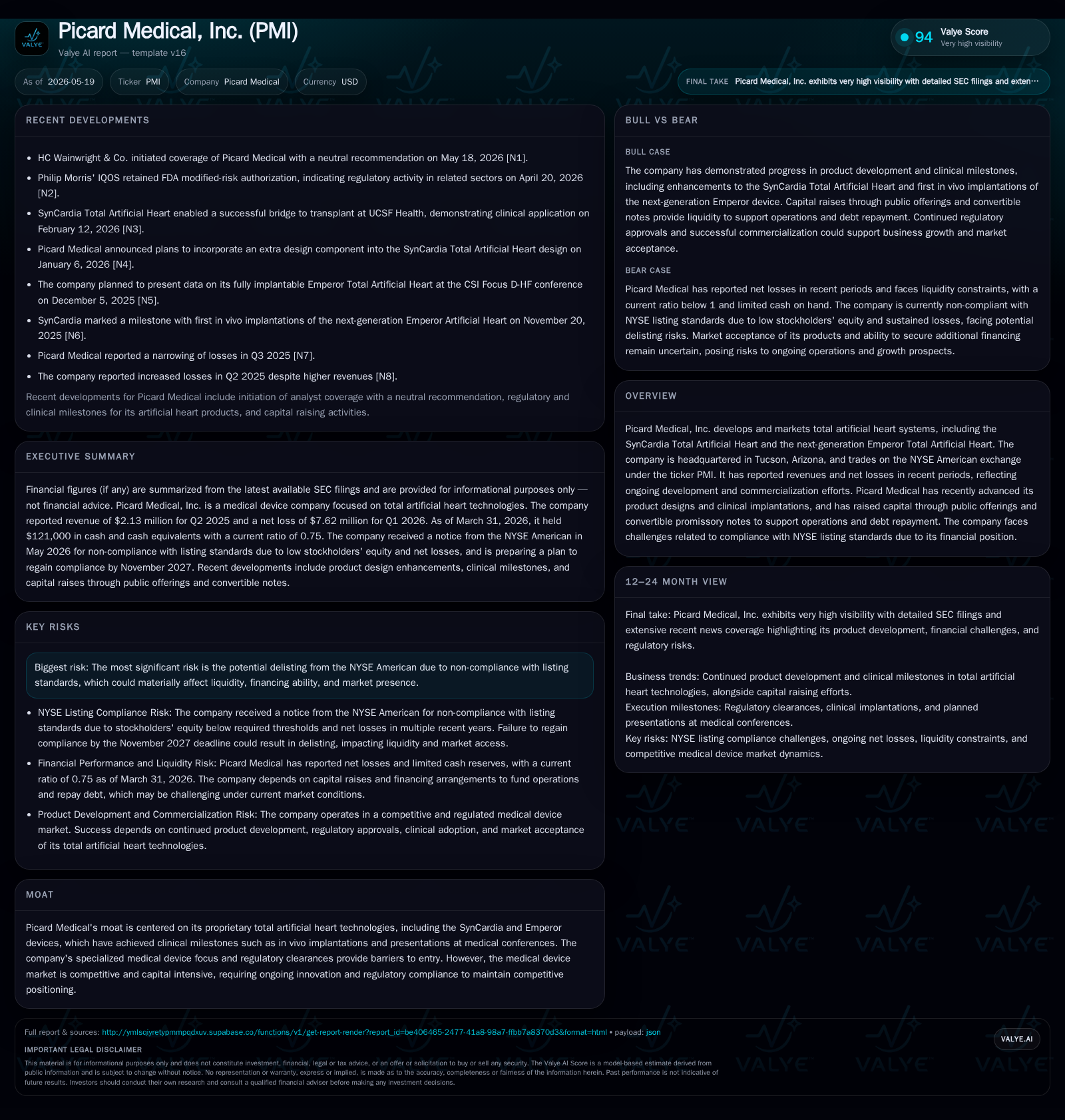
In its latest quarter ending March 31, 2026, Picard Medical reported ongoing product development and clinical implantation progress for its SynCardia and Emperor total artificial heart systems while also revealing a critical NYSE American non-compliance notice due to sub-$4 million equity and consecutive net losses. To bolster financial flexibility, the company completed a registered public offering in early May 2026 involving common stock and multiple warrant tranches grossing approximately $5 million. These developments underscore a dual narrative of technological advancement intertwined with pressing financial constraints as the firm aims to maintain NASDAQ listing standards and propel commercialization efforts.
Q1 2026 Operating Update: Product and Financial Highlights
Picard Medical’s latest quarterly report filed May 15, 2026 [S2] reveals advancing clinical traction with implantations of its next-generation Emperor Total Artificial Heart device alongside ongoing efforts related to the flagship SynCardia system. These clinical activities mark critical steps toward broader commercialization, emphasizing the company's focus on product innovation within total artificial heart systems. However, this operational momentum coincides with a significant regulatory challenge: on May 8, 2026, the NYSE American issued a formal notice indicating that Picard Medical was out of compliance with its continued listing standards due primarily to stockholders' equity dropping below the mandatory $4 million threshold and consecutive net losses over recent fiscal years [S3]. This notice triggers heightened scrutiny of the firm's financial health and market positioning.
Notably, the Company's common stock continues trading on the NYSE American exchange under ticker PMI but is now designated below compliance with a ".BC" suffix [S3]. This juxtaposition of technological advancement against financial compliance pressures underscores a pivotal inflection point in Picard Medical's near-term corporate trajectory.
Business Model Analysis: Technology and Market Position in Total Artificial Heart Systems
Picard Medical’s revenue derives mainly from sales of its proprietary total artificial heart systems — notably the SynCardia Total Artificial Heart program and the newer Emperor device [S1]. The business operates within an ultra-specialized medical device niche serving cardiovascular surgical centers that require highly regulated devices featuring demonstrated safety and efficacy profiles. Buyers are predominantly specialized hospitals and transplant centers that pay premium prices for replacement heart technologies critical in bridging patients to transplantation or as destination therapies.
The company’s technology advantage lies in its regulatory clearances combined with clinically validated implantation milestones which establish switching costs for adopters wary of therapy-disruptive alternatives. Product mix improvements come from iterative upgrades exemplified by Emperor’s design enhancements aimed at improving patient outcomes and procedural ease [S1]. These factors collectively foster a sustainable moat based on innovation barriers notwithstanding industry capital intensity.
Industry Dynamics and Competitive Stance
The total artificial heart device market is characterized by limited participants due to formidable regulatory hurdles and complex clinical pathways [S1]. Picard operates in a niche where establishing market share depends heavily on clinical evidence generation, surgeon adoption curves, and securing favorable reimbursement rates — factors that inherently slow scaling speed.
Capacity constraints exist not only in manufacturing specialized components but also in training medical teams capable of performing implantations. Moreover, reimbursement frameworks tied closely to transplant eligibility criteria restrict immediate volume growth. While exact competitor data is not detailed here, this sector typically features few firms with fully FDA-approved total artificial heart platforms. This dynamic gives Picard an advantage if it can sustain innovation cycles but mandates continual investment in R&D and compliance.
Growth Catalysts: Clinical Momentum and Capital Strategy
Growth drivers crystallize around successful rollouts of next-generation products like the Emperor device demonstrated through recent implantations [S2], which serve as crucial clinical validation points accelerating surgeon adoption. Presentations at major medical conferences further build brand credibility among thought leaders and payers.
On the capital front, Picard Medical executed a registered public offering closing May 6, 2026, issuing roughly 16.7 million shares accompanied by Series A and B warrants plus pre-funded warrants intended to generate gross proceeds approaching $5 million before expenses [S3]. The offering's combined pricing near $0.30 per share/warrant bundle reflects strategic price setting designed to balance dilution concerns against urgent funding needs.
This fundraising injection supports ongoing R&D investments and working capital requisites including debt repayment — critical given limited cash on hand relative to liabilities [F1]. The scale of this raise underscores both investor interest contingent on operational milestones and persistent funding constraints characteristic of cutting-edge medtech enterprises.
Risk Factors: NYSE Compliance and Financing Constraints
The foremost risk reported centers on NYSE American’s notice about non-compliance stemming from stockholders’ equity at approximately $3.8 million as of December 31, 2025 — below the mandated minimum — amidst recurring net losses over three out of four recent years [S2]. Failure to regain compliance by November 8, 2027 could trigger delisting processes adversely impacting liquidity channels.
Potential consequences include restricted market quotations limiting trading depth, dampened analyst visibility reducing institutional engagement, and decreased access to capital markets complicating refinancing or expansion plans [S2]. Stockholder dilution is another concern given concurrent securities offerings designed to bolster balance sheet strength but introducing additional share supply pressure [S3].
Moreover, current working capital metrics reveal tension: cash balances of just over $120,000 against nearly $12.7 million in current liabilities produce a sub-1 current ratio (~0.75), flagging short-term liquidity tightness [F1]. The sizeable outstanding debt near $1 million amplifies leverage risks requiring disciplined cash management going forward.
Upcoming Milestones and Investor Considerations
Key forthcoming dates revolve around mandated regulatory deliverables tied directly to exchange compliance: specifically a planned submission of a remediation plan addressing listing standards by June 7, 2026 [S2]. This plan must convincingly detail scheduled actions targeting re-qualified equity levels above $4 million by November 8, 2027.
Simultaneously, tracked clinical indicators such as incremental implantation counts for Emperor systems or expanded clinical trial data releases provide measurable demand signals influencing physician adoption curves [S1,S2]. Advances in regulatory approvals or distribution network expansions would supplement growth narratives if disclosed.
Investors monitoring Picard should prioritize these definable checkpoints due to their direct linkage to sustaining NYSE listing privileges along with validating commercialization progress in an otherwise capital-constrained environment.
Financial Summary: Liquidity, Capital Raise, and Balance Sheet
At March quarter-end (Q1 2026), Picard Medical held approximately $121 thousand in cash and equivalents alongside current assets totaling around $9.5 million versus current liabilities exceeding $12.6 million leading to a current ratio of roughly 0.75 — signaling notable short-term liquidity stress [F1]. Total debt outstanding is estimated at $1 million with net debt (debt less cash) near $879 thousand reflecting leverage placed against thin cash reserves [F1].
The registered public offering completed May 6 injected fresh equity capital of about $5 million gross before commissions/fees [S3], intended principally for working capital support and debt repayment. Despite this infusion easing some near-term financing pressures, absolute cash remains scant post-deal requiring careful management.
Summarily, Picard Medical presents a dichotomous profile: advancing key product innovations positioning it favorably within an exclusive medtech subsector while simultaneously navigating critical financial headwinds tied to exchange listing criteria compliance that will demand sustained operational discipline moving forward.
This analysis synthesizes publicly available SEC filings through mid-May 2026 without incorporation of external opinion or investment advice. It aims solely to provide an informed overview based on current disclosed data regarding Picard Medical’s operational status, industry context, growth prospects, risks, and financial condition.
Disclaimer: This is research-only, informational analysis and not investment advice. It may include AI-generated interpretation and general industry context. Always verify important details using primary sources.

Comments