
CASI Pharmaceuticals Targets Growth with New Leadership and Financing Amid Product Challenges
Recent management changes and a convertible note financing seek to stabilize CASI amidst regulatory hurdles and operational losses.
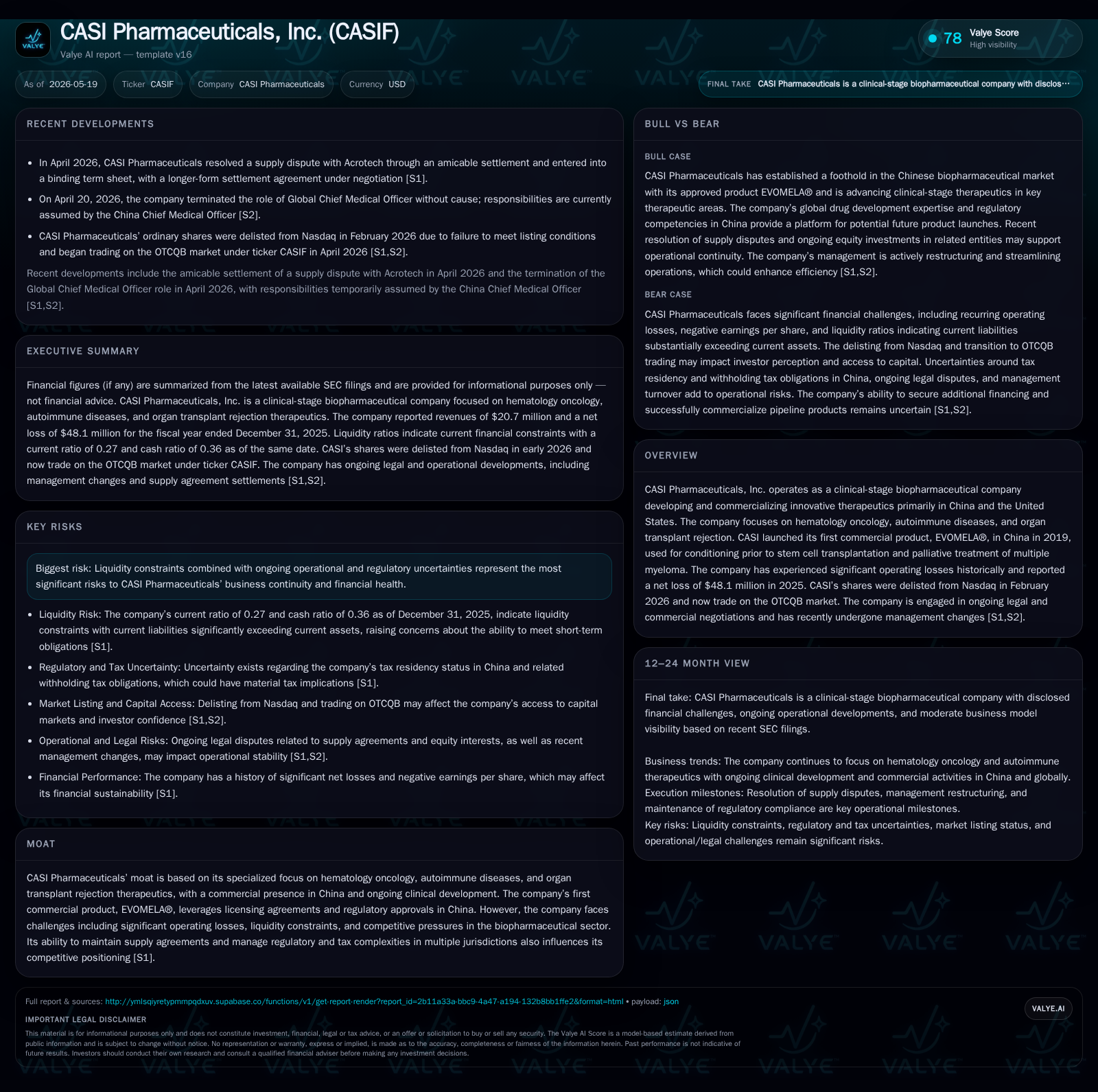
CASI Pharmaceuticals reported the termination of its Global Chief Medical Officer and is actively searching for a replacement, temporarily reallocating clinical oversight to its China Chief Medical Officer. Concurrently, the company closed the final tranche of a $20 million convertible note financing, providing near-term liquidity but introducing dilution risks. CASI's business centers on hematology oncology and autoimmune therapeutics, balancing licensed commercial products like EVOMELA® with its clinical-stage pipeline candidate CID-103. Regulatory setbacks, including license withdrawal of FOLOTYN in China, and ongoing supply disputes have constrained growth. The firm remains challenged by negative operating cash flow and low liquidity despite efforts to advance domestically produced alternatives and pipeline progress.
Recent Operating Update: Strategic Leadership Transition and Capital Raise
CASI Pharmaceuticals' latest quarterly disclosures highlight significant organizational shifts coupled with strategic financing actions as it attempts to manage near-term operational pressures. The company terminated its Global Chief Medical Officer (GCMO), Dr. Alexander Zukiwski, effective April 20, 2026, signaling a restructuring of clinical leadership against broader streamlining efforts in its U.S. operations [S2]. Until a suitable replacement is found, critical GCMO responsibilities are absorbed predominantly by Dr. Junping Chen, MD, PhD — CASI's existing China Chief Medical Officer — suggesting an interim consolidation that emphasizes its growing focus on Chinese regulatory and market priorities.
Alongside these leadership changes, CASI completed issuance of the final $5 million tranche under a $20 million convertible note purchase agreement with ETP Global III Fund LP controlled by Executive Chairman Dr. Wei-Wu He [S3]. These notes bear a high coupon rate at 12% per annum over a 36-month tenure and carry conversion rights into ordinary shares at prevailing volume-weighted average prices capped between $1-$2 per share. While this financing infusion alleviates some immediate cash constraints, it raises future dilution risks reflecting ongoing funding challenges intrinsic to their clinical-stage biotech model.
Business Model and Service Offering: Hematology Oncology and Autoimmune Focus
CASI operates primarily as a clinical-stage biopharmaceutical enterprise targeting hematology oncology indications alongside autoimmune disease and organ transplant rejection therapeutics [S1]. Revenue generation currently stems from commercial licensing contracts and sales within China focused on therapies like EVOMELA® (melphalan for injection). Marketed since its 2019 launch approval in China for conditioning prior to stem cell transplantation and palliative treatment of multiple myeloma patients, EVOMELA® was originally licensed from Spectrum Pharmaceuticals but supply transitioned nominally to Acrotech Biopharma following Spectrum’s portfolio sale in 2019.
Despite this commercial foothold, CASI has faced complexities around supply agreements culminating in disputes with Acrotech starting December 2024, which were amicably settled through term sheet agreements in April 2026 [S1]. Beyond licensed products, CASI’s internal innovation pipeline features CID-103 — an anti-CD38 monoclonal antibody under development targeting organ transplant rejection and associated autoimmune syndromes—revealing strategic emphasis on late-stage proprietary assets that could underpin longer-term value creation if regulatory approvals progress favorably.
Complementing these offerings is CASI’s domestically manufactured MAFALAN®, a generic melphalan product approved by China’s NMPA in May 2025 for similar indications as EVOMELA® [S1]. Produced within CASI’s own cGMP-certified Wuxi facility, MAFALAN® aims at substituting imported drugs through cost competitiveness allied with local production quality standards—an increasingly important proposition amid evolving Chinese pharmaceutical policies favoring indigenous manufacturing capabilities
Industry Context: Biopharmaceutical Competitive Pressures and Regulatory Nuances
Operating within the highly regulated biopharmaceutical specialty drug sector exposes CASI to intense competitive dynamics marked by stringent approval processes and complex supply chain contractual dependencies. The withdrawal of the Import Drug Registration License for FOLOTYN® (pralatrexate), an approved therapy for peripheral T-cell lymphoma (PTCL) both in the U.S. FDA and China's NMPA markets hinders revenue diversification despite ongoing permitted clinical trials within China [S1]. This license denial reflects regulatory enforcement stringency affecting foreign-originated specialty drugs dependent on import registrations.
Additionally, supply management intricacies are exemplified by the transition from Spectrum Pharmaceuticals to Acrotech as suppliers of EVOMELA®, requiring adept contract negotiations amidst shifting ownership structures—a common challenge in licensing-dependent biotech commercialization models.
Separately, China's taxation landscape introduces material considerations wherein PRC resident enterprise definitions trigger worldwide income tax implications contrasting with non-resident enterprise passive income withholding taxes [S1]. Compliance with evolving Chinese corporate tax regulations impacts effective profitability for entities domiciled or operating extensively within mainland jurisdictions
Capacity-wise, owning a local cGMP manufacturing facility distinguishes CASI positively within greater China’s pharmaceutical ecosystem—offering potential scale benefits and supply reliability amid competitors reliant solely on imports or third-party manufacturers.
Growth Drivers: Pipeline Advances and Domestic Manufacturing Initiatives
CASI’s growth trajectory rests principally upon advancing CID-103 through clinical trials while securing timely regulatory milestones critical to commercialization pathways for autoimmune and transplant patient populations [S2,S1]. Successful trial enrollment acceleration coupled with data readouts will constitute key inflection points validating this pipeline asset.
Parallel expansion of domestic product lines through MAFALAN® showcases vertical integration benefits aimed at reducing cost bases relative to imported competitors like EVOMELA®. This shift responds both to local government incentives prioritizing indigenous drug production and healthcare system demand for accessible specialty pharmaceuticals under tightening reimbursement controls.
The recent resolution of supply contract disputes with Acrotech removes impediments to EVOMELA® availability in China’s market—the binding term sheet agreement lays groundwork for sustained product distribution pending full settlement documentation finalization [S1].
In addition to commercial scale-up potential within Greater China markets leveraging regulatory familiarity and established sales infrastructure, there is latent opportunity for CID-103 development leveraging global trials anchored by the company’s U.S. presence—although execution here faces typical biotech uncertainties related to FDA engagement timelines and competitive monoclonal antibody landscapes.
Risks and Constraints: Regulatory Setbacks, Liquidity Stress, and Market Competition
Material risks confronting CASI arise firstly from regulatory setbacks exemplified by failure to renew FOLOTYN®’s import license across Chinese authorities effectively ceasing product sales despite patent protections; this imposes substantial revenue pressure and complicates market positioning strategies [S1]
Liquidity constitutes another critical constraint; as of end-2025 CASI exhibited only approximately $5.6 million cash equivalents against current liabilities totalling nearly $49.7 million resulting in a severely depressed current ratio of about 0.27 [F1]. Sustained operating losses exceeding $48 million in the same year demand recurrent capital raises increasing shareholder dilution risk despite short-term bridging via convertible notes carrying onerous interest terms [F1,S3].
Competitive landscape intensity within hematology oncology specialty pharmaceuticals also pressures pricing power owing to multiple global firms advancing novel antibody therapies or generics challenging older molecules such as melphalan-based products.
Legal uncertainties remain due to ongoing negotiations around finalized supply settlement terms with Acrotech notwithstanding progress reported recently; unresolved aspects may pose execution risk around inventory continuity or margins [S1]. Finally comparison of listed trading venues reveals reputational pressure associated with Nasdaq delisting early this year transitioning stock trading onto OTCQB milieu potentially reducing institutional investor appeal [S6].
What to Watch Next: Management Hiring, Legal Settlements, Product Approvals
Key executable catalysts revolve around recruiting a permanent Global Chief Medical Officer capable of setting unified clinical development strategy beyond interim coverage; prompt appointment would provide clarity over pipeline prioritization especially relating to CID-103 advancement timelines [S2].
Completion of definitive settlement documentation resolving Acrotech disputes will be crucial to stabilizing EVOMELA® supply chains ensuring durable revenue streams from existing marketed assets while enabling strategic alignment among parties involved [S1]
Monitoring the status of FOLOTYN®’s potential re-approval efforts or alternative commercialization avenues shapes near-term upside visibility though outcomes remain uncertain given past regulatory stance.
Additional signposts include quantifiable metrics such as new IND filings or trial initiations related to autoimmune indications targeted by CID-103; likewise expanding market penetration metrics for MAFALAN® within Chinese provinces spotlight execution effectiveness against domestic competitors.
From a financial perspective any incremental equity or debt financings coupled with improvements in liquidity ratios will serve as confidence markers regarding sustainability until inflection points emerge from pipeline maturation or market expansion.
Financial Overview: Cash Position, Debt Structure, and Operating Losses
At fiscal year-end December 31, 2025, CASI held approximately $5.6 million in cash equivalents against total current liabilities approaching $49.7 million reflecting ongoing working capital deficits that constrain flexibility on operational expenditures or investment initiatives [F1]. Total debt outstanding was last reported at about $38.1 million as of December 31, 2023; net debt remains elevated when adjusting for limited cash reserves underscoring leverage concerns amid chronic negative earnings trends [F1].
Newly issued convertible notes adding $20 million principal since late 2025 carry annual interest rates at 12%, reflecting lender compensation for elevated credit risk while embedding equity conversion options mitigating outright repayment obligations but introducing shareholder dilution upon conversion[S3]. Net loss recorded during 2025 was approximately $48.1 million driven primarily by R&D expenses associated with clinical pipeline development plus commercial costs linked to product launches alongside incremental legal provisions related to supply disputes [F1,S1,S14].
Liquidity pressures have been partially managed via equity injections including prior private placements totaling nearly $15 million gross proceeds during mid-2024 but recurring cash burn necessitates close monitoring on capital adequacy linked directly to execution on growth vectors described earlier [S6,S14]
Disclaimer: This analysis is based solely on publicly available SEC filings dated up to May 19, 2026. It does not constitute investment advice or endorsement of any corporate actions discussed herein.
Disclaimer: This is research-only, informational analysis and not investment advice. It may include AI-generated interpretation and general industry context. Always verify important details using primary sources.

Comments