
Intuitive Machines Accelerates Lunar Infrastructure with Strategic Acquisitions and Robust Backlog
The latest quarter highlights Intuitive Machines' push from mission execution toward sustained lunar infrastructure through acquisitions and contract expansion.
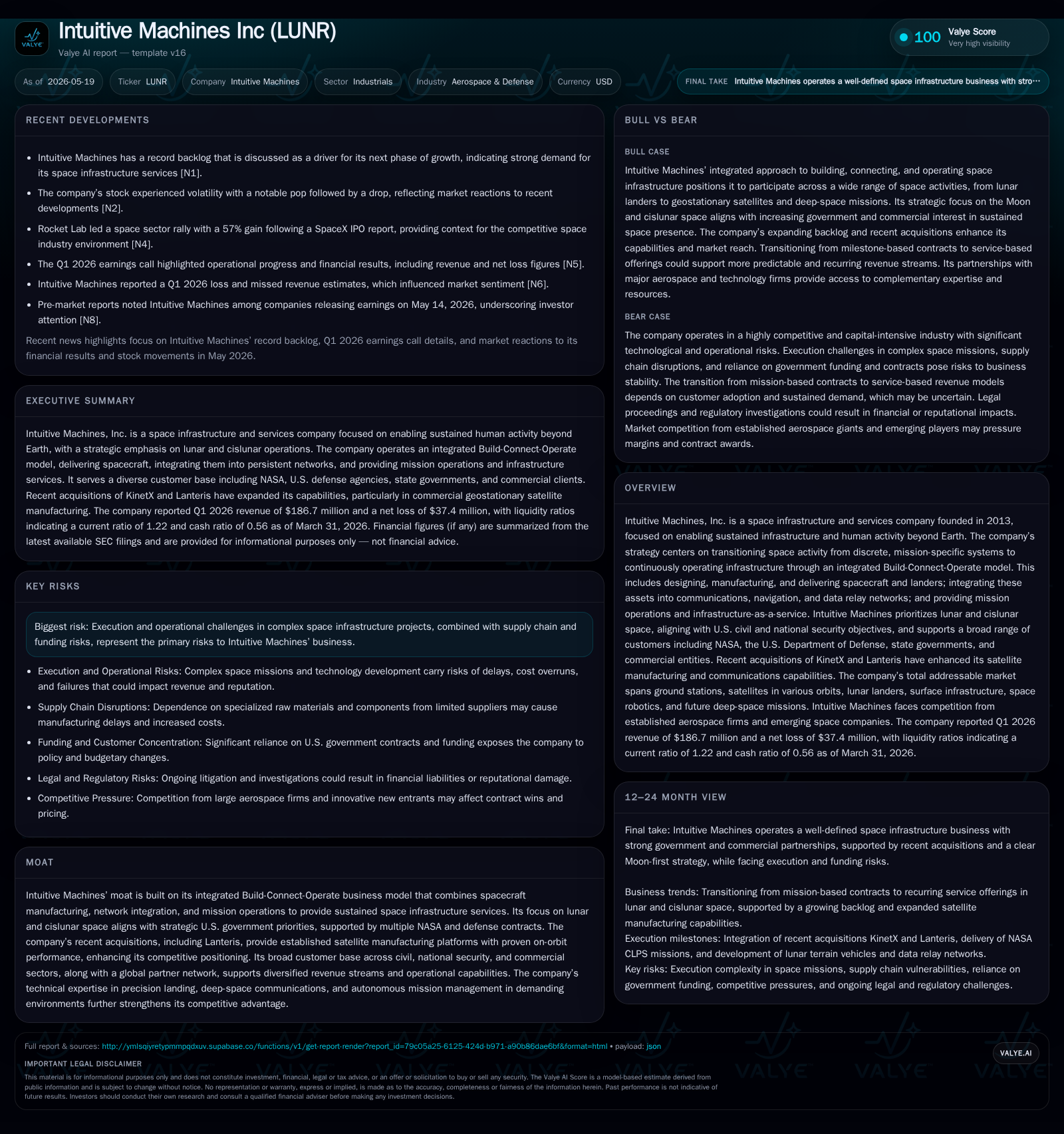
Intuitive Machines reported record quarterly backlog and revenue in Q1 2026, driven by its Build-Connect-Operate model focused on lunar and cislunar space. The company solidified its integrated space infrastructure position by acquiring Goonhilly Earth Station to enhance ground communication capabilities, complementing prior acquisitions of KinetX and Lanteris. Its diversified customer base spans NASA, the U.S. Department of Defense, state governments, and commercial clients, supporting a broad addressable market. Execution complexities, supply chain risks, and regulatory investigations linked to recent acquisitions present ongoing watchpoints as Intuitive Machines aims to transition from episodic missions to continuous space operations.
Recent Operating Update
In the first quarter of 2026 (ending March 31), Intuitive Machines posted record quarterly revenue alongside gross margin improvement and achieved positive adjusted EBITDA – milestones signaling maturation of its infrastructure-oriented business model [S2]. The record $1.1 billion backlog underscores strong demand across its Build-Connect-Operate offerings targeting lunar and cislunar markets. On May 14, 2026, the company announced a material definitive agreement to acquire Goonhilly Earth Station Limited, a UK-based ground station and satellite communications provider critical for persistent space communication networks. Completion depends on regulatory approvals including UK National Security clearance and FCC approval for U.S. properties transfer [S3][S24]. This strategic move complements October’s acquisition of KinetX (navigation services) and January’s acquisition of Lanteris Space Holdings (satellite manufacturing) strengthening vertical integration within its end-to-end space infrastructure platform [S1].
Business Model Overview
Intuitive Machines operates under an integrated Build-Connect-Operate framework designed to transcend episodic space mission delivery by establishing continuous infrastructure support:
- Build: Design and production of spacecraft including lunar landers, satellites (LEO/GEO/cislunar), surface mobility platforms, propulsion systems, avionics, leveraging proprietary technology such as pump/tank advancements to improve efficiency [S1][S13].
- Connect: Integration of deployed assets into communication and navigation networks that offer data relay capabilities enabling persistent command/control beyond Earth orbit; recent moves like Goonhilly acquisition expand ground segment coverage [S3][S21].
- Operate: Mission operations including hosted payload data services, autonomous system management, navigation/timing solutions delivered as infrastructure-as-a-service aimed at generating recurring service revenue streams from government and commercial clients alike [S1][S15].
This vertically integrated value chain supports diversified revenue sources across civil space exploration (NASA Artemis programs), national security space domain awareness & missile defense efforts (Space Development Agency - SDA), state government initiatives building local space economies, plus commercial ventures engaged in lunar cargo delivery or geostationary telecommunications satellite services via the Lanteris platform [S14][S19][S21]
Industry Structure & Competitive Positioning
The aerospace & defense sector for lunar/cislunar infrastructure is marked by a dual competitive landscape:
- Incumbent aerospace giants like Lockheed Martin or Boeing pursue large-scale crewed lunar missions or complex system contracts but may lack nimbleness.
- Next-generation entrants such as Astrobotic, Firefly Aerospace focus on lunar cargo delivery or small satellite constellations.
Intuitive Machines distinguishes itself through:
- An integrated approach from hardware production through network connectivity to operations,
- Focus on Precision Landing technologies enabling access to challenging lunar south pole terrain,
- Progression toward long-duration service contracts transitioning beyond milestone-driven mission deliveries,
- Broad partnerships with global aerospace firms (Boeing, Northrop Grumman) combined with proprietary technical know-how,
- Proven track record with multiple NASA CLPS contracts delivering lunar cargo payloads since 2024,
- Ownership of world-leading commercial GEO satellite bus platforms via Lanteris enhances competitive presence in communications satellite manufacturing alongside incumbents like Airbus or Thales Alenia Space [S14][S16][S21]
Growth Drivers
Several drivers underpin Intuitive Machines’ growth trajectory:
Expanding Lunar & Cislunar Demand
U.S. civil government policy increasingly frames the Moon as a strategic domain requiring sustainable infrastructure services encompassing surface power systems (Fission Surface Power), cargo delivery landers under CLPS initiative (4 missions underway with sequential successes), Lunar Terrain Vehicle development for mobility platforms—all supported by consistent contract awards from NASA [S16][N1].
Distributed Satellite Constellations & Deep-Space Data Relay Networks
The company’s involvement in SDA’s proliferated warfighter architecture builds on multi-tranche contracts awarded to build hundreds of small satellite buses for missile detection/space domain awareness applications demonstrating reliance by defense customers on their spacecraft platforms. Concurrently, Near Space Network Direct-to-Earth relay constellation projects establish persistent communications links essential for growing commercial & national-security orbital architectures [S19].[N6]
Recurring Services & Infrastructure-as-a-Service Transition
From single-mission spacecraft builds to operating long-term data services leveraging hosted payloads or timing/navigation channels marks strategic evolution promising less volatile revenues with higher margin potential as adoption expands across multiple sectors including international partners via agreements with Leonardo/Telespazio in Europe [S15][S26]
Technological Enhancements & Portfolio Expansion
Ongoing R&D investments targeting vehicle survivability (“survive the night”), pump/tank efficiency improvements in lander designs underpin new capability introductions making platforms accessible across wider customer segments. The Lanteris satellite bus modernization program further strengthens competitiveness in commercial high-throughput satellite domains serving broadband & mobile backhaul needs globally [S13][N6].
Risks & Watchpoints
Despite the optimistic outlook associated with backlog growth and acquisitions integration, several operational risk factors remain prominent:
- Execution complexity: Multi-domain projects involving spacecraft production combined with network deployment & operations require rigorous program management; delays or quality issues can cascade affecting contract milestones.
- Supply chain vulnerabilities: Dependence on limited qualified suppliers for key avionics components or propulsion materials expose scheduling risk heightened by geopolitical/regulatory uncertainties impacting sourcing flexibility [S25]
- Litigation & Regulatory risks: Ongoing Department of Justice civil investigative demand linked to Lanteris regarding alleged False Claims Act violations related to cybersecurity compliance on federal contracts underscores legal uncertainties despite indemnification provisions; separate Delaware Chancery litigation also contends over convertible stock share conversions without current accruals recorded pending resolution [S4][S6].
- Regulatory approvals required: Acquisitions like Goonhilly Earth Station depend on multiple jurisdictional clearances including U.K.’s National Security review and FCC approvals introducing timing risk before full consolidation benefits accrue [S3][S24].
What to Watch Next
Looking forward through the remainder of 2026:
- Timing and success in securing all regulatory approvals to finalize Goonhilly acquisition will be crucial.
- Execution progress against Artemis-funded lunar cargo delivery milestones serving NASA south pole ambitions.
- Expansion pace of recurring infrastructure service contracts demonstrating early-stage adoption traction across civil-defense-commercial sectors.
- Outcome of investigations surrounding Lanteris acquisitions impacting contingent liabilities or governance oversight.
- Supply chain stability indicators particularly lead times for critical spacecraft subsystems given industry-wide constraints.
Financial Profile Snapshot
As of March 31, 2026 the company held approximately $232 million in cash equivalents with no recorded debt indicating a strong liquidity position supportive of ongoing capital investment into growth initiatives including R&D scale-up and integration of newly acquired entities [F1][S2]. Operating losses persist reflecting substantial upfront R&D expense outlays typical for aerospace launch-phase firms as they build infrastructure capacity towards more predictable recurring revenue streams. Current ratio stands at a modest 1.22 suggesting working capital coverage but requiring ongoing monitoring given lengthened project cycles characteristic in space systems development [F1].
Disclaimer: This analysis is based exclusively on publicly available SEC filings dated up to May 15, 2026 () and verified financial data ([F1]). It does not constitute investment advice but aims to provide an informed business perspective rooted in documented operating facts.
Disclaimer: This is research-only, informational analysis and not investment advice. It may include AI-generated interpretation and general industry context. Always verify important details using primary sources.

Comments