
Pulmatrix Advances Merger Plans While Managing Cash and Clinical Priorities
Pulmatrix’s latest quarterly update highlights merger progress, strategic leveraging of its iSPERSE™ platform, and liquidity challenges amid paused clinical development.
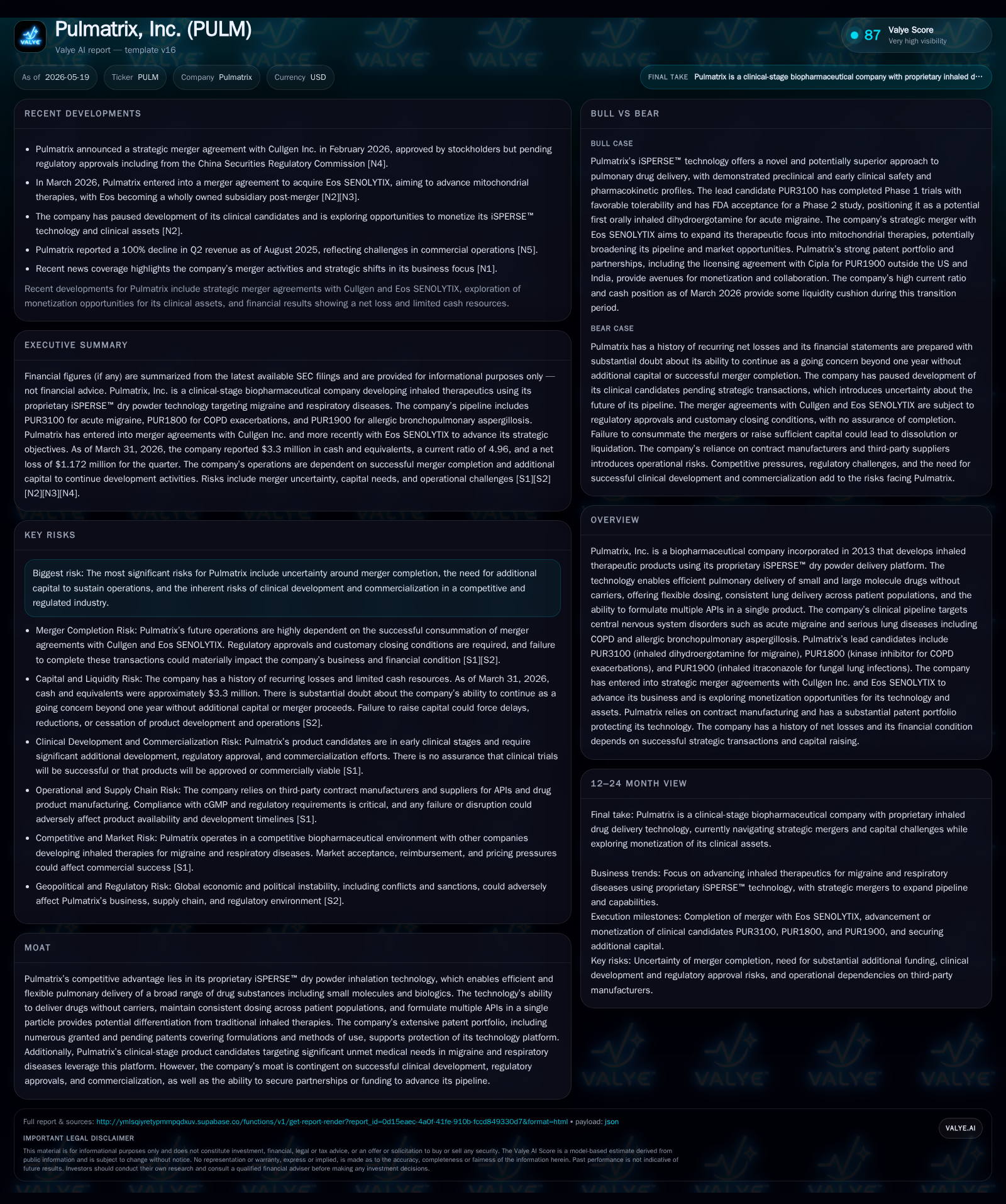
In its May 2026 10-Q, Pulmatrix reported approximately $3.3 million in cash and restricted cash as of March 31, 2026, sufficient to fund operations through the anticipated closing of its strategic merger with Cullgen and Eos SENOLYTIX. The company’s proprietary iSPERSE™ inhalation technology underpins its pipeline targeting acute migraine and severe respiratory diseases, though clinical development is currently paused pending transaction closure. Execution risks include merger completion uncertainty and financing needs, with upcoming regulatory approvals and clinical milestones key for de-risking and growth.
Latest Quarterly Update and Merger Status
Pulmatrix’s May 15, 2026 Form 10-Q filing reveals a pivotal phase for the company. As of March 31, 2026, Pulmatrix held approximately $3.3 million in cash along with $0.7 million in restricted cash, supported by a strong current ratio near 4.96 reflecting manageable short-term liabilities [F1]. Management indicates this liquidity is expected to fund operations only through the anticipated closing of its strategic merger with Cullgen Inc. and Eos SENOLYTIX [S2]. The company operates under going concern considerations due to forecasted negative cash flows absent the transaction's completion.
The proposed merger is central to extending operational runway and unlocking value from Pulmatrix’s proprietary inhalation platform. However, significant delays remain in securing crucial regulatory approvals from the China Securities Regulatory Commission (CSRC) related to overseas securities offerings and Nasdaq’s approval for listing shares issued in connection with the deal [S4][S5]. While mutual waivers have extended termination-related deadlines under the merger agreement, there remains no certainty regarding timing or successful completion [S5]. Failure to close the transaction could necessitate alternative strategic actions including potential dissolution given constrained standalone funding options.
Business Model: Proprietary iSPERSE™ Dry Powder Inhalation Platform
Founded in 2013 as a Delaware corporation, Pulmatrix develops inhaled therapeutic products leveraging its patented iSPERSE™ dry powder delivery technology [S1]. This platform differentiates itself by engineering small dense particles capable of efficient dispersal into lung airways without reliance on traditional lactose carrier powders common in pulmonary drug formulations.
This design facilitates higher drug payloads per dose while maintaining consistent delivery across diverse patient populations. The platform supports multiple dry powder inhaler devices and accommodates both small molecule drugs such as kinase inhibitors as well as biologics—potentially enabling precise dosing with reduced systemic side effects compared to existing inhaled therapies [S1].
Pulmatrix’s strategy involves advancing proprietary drug candidates targeting significant unmet medical needs including acute migraine (PUR3100), acute exacerbations of COPD (PUR1800), and allergic bronchopulmonary aspergillosis/fungal lung infections (PUR1900) [S1]. The business model contemplates clinical validation followed by potential licensing or partnership leveraging the platform's formulation advantages.
Industry Context: Regulatory Complexity and Competitive Positioning
The respiratory therapeutics sector is characterized by rigorous FDA post-approval compliance requirements such as current Good Manufacturing Practices (cGMP) alongside complex reimbursement landscapes that increasingly emphasize cost-effectiveness [S1][S6]
Many established dry powder inhalers use lactose carriers that dilute active pharmaceutical ingredients reducing delivered drug load per actuation; furthermore, patient variability in inhaler technique impacts pulmonary delivery efficiency. Pulmatrix’s iSPERSE™ aims to overcome these limitations by enabling higher potency doses with reliable lung deposition.
Patient adherence challenges persist due to chronic therapy demands; success requires balancing ease-of-use, dosing frequency, tolerability profiles alongside evolving payor pricing controls focused on value [S9][S10]. The ability to co-formulate multiple APIs within single particles could enable combination therapies attractive for inflammatory or infectious lung diseases.
Growth Drivers: Clinical Pipeline Highlights
Key growth drivers depend on advancing clinical milestones across lead candidates:
PUR3100: An inhaled dihydroergotamine product targeting acute migraine currently positioned for Phase 2 trials following FDA Investigational New Drug (IND) acceptance in September 2023 [S7][S12]. Phase 1 results showed rapid time to maximum concentration (~5 minutes) with fewer gastrointestinal side effects versus intravenous comparators—signaling promising differentiation if efficacy is confirmed in larger studies
PUR1800: A kinase inhibitor formulation aimed at acute COPD exacerbations demonstrated safety and tolerability without adverse signals in Phase 1b studies but is currently paused pending strategic review; monetization or out-licensing remain possibilities based on program potential [S12][S15].
PUR1900: An inhaled itraconazole formulation for fungal pulmonary diseases including ABPA was partnered outside the U.S. with Cipla. Following pandemic-related enrollment challenges leading to Phase 2b cessation, Pulmatrix is exploring U.S.-specific monetization opportunities [S14]
Monetization strategies broadly encompass licensing post-merger or selective continuation contingent on capital availability. The platform’s multi-API capability may facilitate pipeline expansion through combination therapies.
Risks and Operational Constraints
Recent filings underscore substantial execution risks:
- Merger completion remains uncertain; failure or delay could threaten operational continuity given liquidity constraints [S2][S5].
- Share issuance associated with the merger introduces dilution concerns potentially impacting shareholder value post-transaction [S9][S10].
- Without additional capital beyond the merger framework, Pulmatrix may face significant cutbacks or dissolution despite a valuable intellectual property portfolio [S2].
- Compliance burdens including cGMP manufacturing standards could constrain scale-up speed or increase costs unexpectedly post-approval [S17].
- Pricing pressures driven by U.S. healthcare reforms such as Medicare drug price negotiations may compress future revenue potential even if commercialization succeeds [S21].
- Clinical development risks such as trial enrollment delays (exemplified by PUR1900), protocol uncertainties, or adverse events remain critical hurdles not mitigated solely by technological advantages.
Key Milestones to Monitor
Near-term indicators of progress include:
- Regulatory clearance from CSRC necessary for overseas securities offerings integral to merger timing remains outstanding [S3][S4].
- Nasdaq approval for listing new shares tied to the transaction influences market trading dynamics post-merger.
- Updates on Phase 2 trial initiation or data readouts for PUR3100 will be pivotal for re-rating pipeline prospects beyond technology validation.
- Progress on licensing deals or platform monetization would validate alternative revenue pathways.
- Quarterly cash burn relative to disclosed guidance will indicate urgency of financing needs.
Financial Overview
As of Q1 2026, Pulmatrix exhibits a clean balance sheet devoid of debt liabilities with cash plus restricted cash totaling about $4 million supporting current liabilities near $905K—yielding a current ratio near five times indicating sound short-term liquidity management despite limited absolute resources [F1]
Operating losses continue amid minimal headcount focused on administrative functions rather than active clinical trials currently paused pending strategic developments [F1][S2]. The financial outlook relies heavily on completing the merger which is expected to provide necessary capital for pipeline advancement or corporate transformation under Cullgen governance. Absent this transaction or successful fundraising alternatives, Pulmatrix faces difficult decisions involving further dilutive capital raises or substantial operational scaling back.
This analysis reflects information solely from publicly available SEC filings referenced herein and does not constitute investment advice.
Disclaimer: This is research-only, informational analysis and not investment advice. It may include AI-generated interpretation and general industry context. Always verify important details using primary sources.

Comments