
Ascend Wellness Holdings Advances Flagship Store Expansion Amid Regulatory Rescheduling Uncertainty
Latest Q1 filings highlight strategic retail growth and operational scale while navigating federal cannabis law shifts.
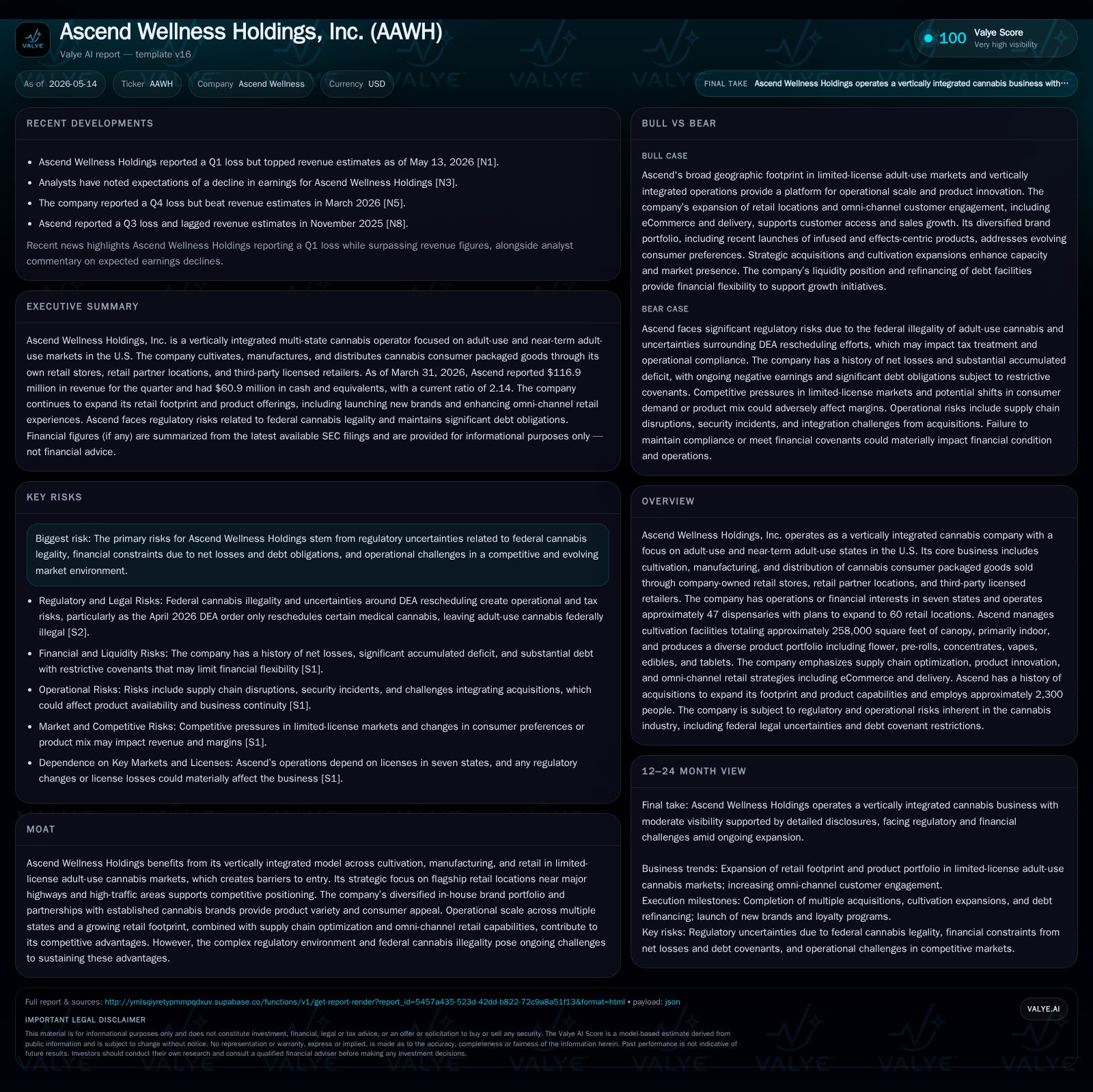
Ascend Wellness Holdings, Inc. (AAWH) reported its most recent quarterly results emphasizing its ongoing expansion of flagship retail locations and supply chain optimization across limited-license adult-use cannabis markets. The company operates a vertically integrated model with cultivation, manufacturing, wholesale distribution, and retail channels spanning seven states and currently manages 47 dispensaries with plans to grow to 60. The April 2026 federal DEA rescheduling order creates potential pathways for medical cannabis but leaves adult-use cannabis federally illegal, maintaining regulatory risk. Ascend leverages disciplined M&A strategy and operational scale to strengthen market positions, while facing challenges from intense state-level competition and federal legal uncertainty.
Recent Operating Update
Ascend Wellness Holdings' latest quarterly filing on May 13, 2026 [S2] reveals progress toward expanding its footprint within the competitive adult-use cannabis sector. Despite reporting a net loss consistent with prior periods driven by ongoing expansion costs, the company surpassed revenue estimates signalling demand resilience [N1][S3]. A key immediate development is Ascend’s navigation of the U.S. Department of Justice’s April 23, 2026 order that reschedules certain medical cannabis products to Schedule III [S2]. While this adjustment opens a new regulatory path potentially easing tax burdens on medical cannabis operations via relief from IRC Section 280E limitations, it explicitly excludes adult-use cannabis which remains federally illegal. Since Ascend's revenue mix includes both segments—with only some states permitting adult-use—the full benefit of this rule change is likely muted for the company relative to pure-play medical operators.
The DEA’s broader administrative hearings on fully rescheduling all cannabis products introduce further uncertainty; outcomes could materially alter compliance landscapes or financing structures but are not expected imminently. Ascend is evaluating whether to pursue DEA registration as per the April order though approval timing or terms remain uncertain.
Business Model
Ascend Wellness Holdings operates a vertically integrated multi-state cannabis enterprise anchored in seven U.S. states: Illinois, Maryland, Massachusetts, Michigan, New Jersey, Ohio, and Pennsylvania—all states where it holds cultivation licenses or retail interests [S1][S10]. By combining seed-to-sale control—including cultivation facilities totaling approximately 258,000 square feet primarily in indoor environments—manufacturing extraction capabilities (hydrocarbon and ethanol based), wholesale distribution networks, and company-owned retail outlets (47 dispensaries as of Q1 2026 with plans for up to 60), Ascend aims for margin capture across the value chain [S14][S21].
Revenue stems mainly from sales of branded consumer packaged goods including flower, pre-rolls (notably through partnerships such as Lowell Smokes), concentrates, vapes focused on emerging live/resin formulations, edibles, and tablets sold through owned stores plus licensed third-party retailers [S10][S21]. Approximately half the product portfolio sold in their stores comprises proprietary or partner brands enabling better margin retention versus relying solely on wholesale third-party brands.
Customer acquisition/retention hinges on omni-channel approaches comprising online eCommerce platforms like letsascend.com with pick-up-in-store functionality (over 85% customer usage), delivery services in key metro areas (e.g., Boston and New Jersey suburbs), curbside pickup options, digital consultations via mobile app enhancements launched in late 2025 including loyalty rewards "Ascenders Club," and real-time chat support driving basket size growth and repeat business [S13][S14]. Retail store placement favors high-visibility "flagship" locations near major highways or urban retail corridors such as Rochelle Park NJ on Route 17 near Garden State Plaza or downtown Boston near TD Garden—locations creating natural consumer foot traffic advantages difficult for competitors to replicate [S18].
The company's disciplined capital deployment focuses heavily on acquiring underperforming single-state operators or assets prior to or shortly after new adult-use market legislations emerge. These acquisitions enable rapid scale-ups by implementing standardized operating technology systems, SOPs for cultivation/manufacturing quality assurance across states ensuring consistency while leveraging procurement scale to reduce cost. This expansion-by-acquisition strategy exploits regulatory entry barriers prevalent in limited-license states while avoiding longer path dependence on lottery licenses or greenfield developments [S1][S18].
Industry Context & Competitive Position
The regulated U.S. cannabis industry remains fragmented along state lines with stark differences between open-access versus limited-license markets. Ascend strategically targets late-stage medical programs transitioning into adult-use regimes in restricted-license states which naturally limit entrant pool size but support sustainable margins once scale is reached due to supply cap-induced scarcity dynamics [S1][S22].
Ascend enjoys competitive advantages including operational scale across six vertically integrated states providing synergy benefits—such as supply chain optimization realized by supplier rationalization strategies—and access to capital markets facilitating acquisition-fueled growth that smaller single-state operators (SSOs) struggle to match in funding capability or M&A expertise [S6][S22]. Their flagship site strategy grants locational differentiation favored by consumers seeking convenience near well-established retailers like Trader Joe's or Starbucks.
Nonetheless, the industry faces mounting challenges: increased competition from both incumbent multi-state players aggressively expanding footprints and local SSOs defending entrenched market share; presence of pharmaceutical synthetic cannabinoid alternatives threatening demand for organic flower-based cannabis products; evolutionary pressures from labor union organization affecting about one-third of Ascend’s workforce potentially raising operating costs; stringent product liability exposures combined with evolving state-by-state regulations raising compliance complexity; plus persistent Federal legal ambiguity constraining access to banking services or favorable tax treatments like those enjoyed by federally compliant industries [S20][S16][S26].
Growth Drivers
- Retail Footprint Expansion: Aggressively adding dispensaries toward goal of 60 total locations leverages tested playbook focused on premium real estate selection coupled with high transaction volume enhancements via eCommerce integration [S18][S14].
- Brand Portfolio & Product Innovation: Diversifying offerings with multiple price points targeted at demographics alongside new-category emphasis such as infused flower pre-rolls should boost per-customer spend over time leveraging partner brands’ cachet [S10][S21].
- Operational Efficiency: Standardizing manufacturing processes and expanding extraction capacity with advance hydrocarbon/ethanol tech increases yields lowering unit production costs improving margins [S21]. Automation initiatives like cartridge filling machines further reduce labor intensity.
- Regulatory Developments: Potential federal rescheduling progress could incrementally ease restrictions around taxation and interstate commerce primarily benefiting medical cannabis sales where Ascend has exposure—though adult-use remains unaffected currently [S2].
- Omni-channel Engagement: Enhanced digital platform capabilities supporting online orders plus delivery builds recurring revenue channels tapping evolving consumer purchasing behaviors accelerating structural adoption beyond physical store visits [S13][S14].
- M&A Capability: Continued disciplined acquisitions in tightly regulated markets presenting attractive valuations can accelerate geographic expansion while delivering synergies associated with centralized management efficiencies.
Risks & Watchpoints
- Federal Legality & Regulatory Uncertainty: Adult-use cannabis remains Schedule I federally creating persistent operational risk exposure including IRC Section 280E tax burdens limiting deductibility of expenses leading to profitability pressure despite growing sales. Any invalidation of DEA’s Schedule III Order portion could trigger retroactive tax liabilities or compliance revamps affecting cash flow forecasts [S2].
- Capital Intensity & Leverage: Maintaining balance between growth investments funded via debt against cash flow generation is crucial given elevated net debt near $245 million levels constrains financial flexibility during downturns if profitability lags expectations [F1][S7].
- Licensing Caps & Market Saturation: Limited license markets restrict new entrants but can also bottleneck long-term expansion unless additional licenses are granted or existing facilities expanded—operational scaling outside current footprint faces regulatory hurdles.
- Competition & Pricing Pressure: Intensifying competition among major MSOs plus SSOs risks margin erosion especially if oversupply conditions develop post-adult use legalization transitions impacting wholesale prices adversely in some states.
- Labor & Operational Risks: Collective bargaining agreements covering about one-third of workforce might increase wage costs or restrict flexibility impacting margins as unionization advances within industry labor pools [S20].
- Product Liability & Compliance Costs: Regulatory scrutiny over quality standards creates potential recall risks or litigation leading to reputational damage requiring insurance coverage which is expensive impacting operational robustness [S16][S26].
What To Watch Next
- Progress updates regarding DEA broader rescheduling administrative proceedings affecting overall regulatory environment for adult-use products.
- Quarterly operational metrics around same-store sales growth at flagship dispensaries coupled with eCommerce adoption rates signaling omni-channel execution success.
- M&A activity announcements illustrating continued disciplined acquisition approach critical for hitting medium-term expansion targets.
- Cultivation yield improvements or capacity additions driven by automation investments indicating cost control efficacy vital for margin enhancement.
- Regulatory developments per each state regarding license availability changes impacting Ascend’s ability to add stores organically.
- Financial covenant compliance indicators linked to debt agreements reflecting Ascend’s leverage management amidst sizable capital expenditures.
Financial Profile (Q1 March 31, 2026)[F1]
Latest financial snapshot
| Metric | Value | Period |
|---|---|---|
| Cash & equivalents | $61mm | |
| 2026-03-31 | ||
| Current assets | $189mm | |
| 2026-03-31 | ||
| Current liabilities | $88mm | |
| 2026-03-31 | ||
| Current ratio | 2.14x | |
| 2026-03-31 |
Source: SEC companyfacts cache [F1].
While liquidity remains adequate with a healthy current ratio above two indicating coverage of short-term obligations comfortably amid expansion phases, Ascend carries significant net debt reflective of capital-intensive vertical integration investments and M&A funding strategies that require careful covenant monitoring against EBITDA progression.
Disclaimer: This report is an analytical overview based on publicly available SEC filings and news sources as of May 14, 2026. It does not constitute investment advice or recommendation. Readers should conduct independent due diligence before forming financial decisions related to Ascend Wellness Holdings Inc.
Disclaimer: This is research-only, informational analysis and not investment advice. It may include AI-generated interpretation and general industry context. Always verify important details using primary sources.

Comments