
Twenty One Capital’s Strategic Moves in Bitcoin Accumulation and Services
The latest quarterly filings reveal evolving acquisition pursuits and strategic expansions as Twenty One Capital positions itself in Bitcoin finance.
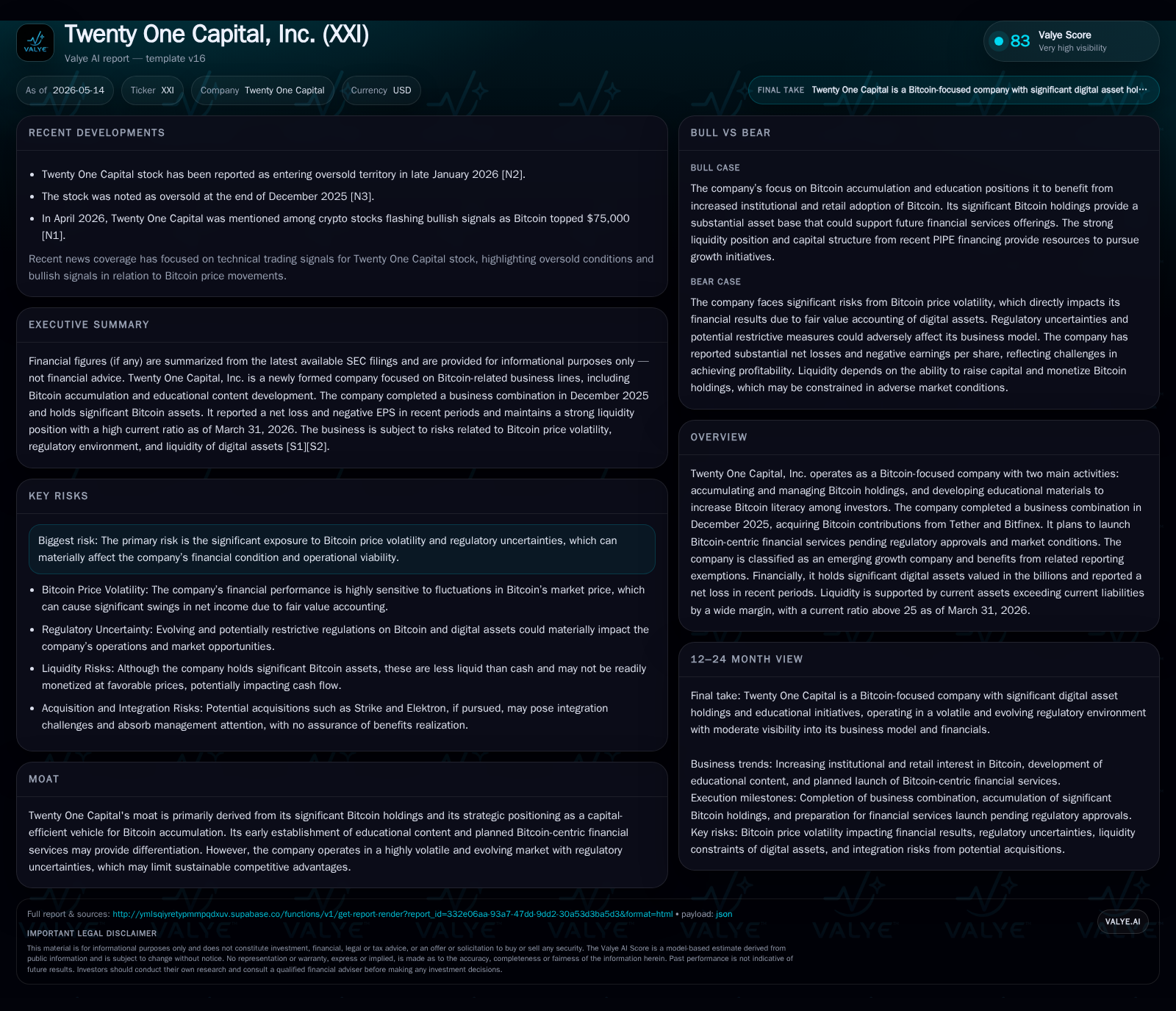
Twenty One Capital’s May 2026 quarterly report highlights potential acquisitions of Strike and Elektron, aiming to deepen market footprint in Bitcoin financial services and mining. The company’s business model combines significant Bitcoin holdings with educational initiatives to foster investor literacy, while preparing to launch integrated Bitcoin-centric services contingent on regulatory approvals. Challenges include governance concerns related to related-party transactions, execution risk from unconsummated deals, and exposure to Bitcoin price volatility. Liquidity remains robust with a current ratio exceeding 25, supported by sizeable digital assets despite ongoing operational losses.
Latest Quarterly Developments: Strategic Initiatives and Market Position
Twenty One Capital's latest Form 10-Q filed May 13, 2026 [S2] marks a pivotal juncture in its growth trajectory as management publicly disclosed intentions to potentially acquire Strike, a leading Bitcoin financial services company, and Elektron, a global-scale Bitcoin mining platform [S3]. These initiatives aim to vertically integrate Twenty One Capital's existing Bitcoin accumulation strategy with operational capabilities in both financial services distribution and low-cost mining infrastructure.
However, these pursuits remain exploratory with no binding agreements or board approvals as of this filing. Furthermore, the CEO's dual role as founder and CEO of Strike introduces explicit conflicts requiring rigorous governance review under related person transaction policies [S2]. Similarly, Director Raphael Zagury's executive position at Elektron's management services firm heightens the need for conflict mitigation.
These potential acquisitions signify Twenty One Capital's strategic shift beyond passive Bitcoin treasury management toward an integrated platform combining asset accumulation with recurring revenue streams from service offerings. Yet execution remains uncertain given lack of approvals or definitive terms [S2]. Pending successful governance clearance and market conditions, these deals could materially reshape the company's scale and competitive scope.
Business Model and Product Quality: Bitcoin Accumulation Meets Education
Established initially as a capital-efficient vehicle for accumulating and managing large-scale Bitcoin holdings, Twenty One Capital provides investors an indirect method to gain exposure to the digital asset through public equity markets [S1]. Its business model hinges on proprietary accumulation strategies that balance discretionary investment thesis execution with active portfolio management subject to evolving macroeconomic factors.
Complementing its asset-centric approach is a growing initiative developing branded educational materials aimed at enhancing institutional and retail investor literacy around Bitcoin fundamentals and market dynamics. This dual focus aims not only to grow adoption but also to build a community aligned with long-term value creation anchored by digital asset appreciation.
The company's planned rollout of consolidated Bitcoin-centric financial services represents a logical evolution from these foundations. Leveraging amassed Bitcoin as collateral or economic underpinning, these forthcoming products seek to offer innovative financial tools replacing legacy systems with solutions native to the Bitcoin ecosystem. Success depends critically on favorable regulatory frameworks and capital raising capabilities.
Competitive Landscape and Industry Dynamics in Bitcoin Finance
Operating within a rapidly evolving industry characterized by intense competition across capital vehicles, financial service providers, and mining platforms, Twenty One Capital's sizable Bitcoin treasury offers it a notable competitive advantage amid peers primarily focused on either holding or servicing segments exclusively.
The emerging attempt to incorporate Strike’s established payment infrastructure and Elektron's low-cost hashrate mining capacity would further differentiate Twenty One Capital by creating synergistic integration points spanning asset accumulation to service delivery while optimizing cost structures internally.
Moreover, regulatory ambiguity surrounding crypto financial products tempers rapid expansion ambitions industry-wide [N1]. The company's educational programs may partially offset such headwinds through fostering investor confidence.
Drivers of Growth: Acquisitions, Service Expansion, and Market Adoption
Near-term growth vectors pivot on three fronts: potential accretive acquisitions (Strike and Elektron), scaling educational outreach for broader market penetration, and launching revenue-generating financial services hinged on regulatory green lights [S2][S3].
Successful acquisition integration could provide immediate scale uplift in core competencies—payment distribution networks through Strike's platform alongside operational efficiencies via Elektron's mining operations—potentially transforming Twenty One Capital's revenue profile from asset revaluation drivers toward sustainable recurring income.
Educational initiatives underpin longer-term adoption curves which could expand the customer base for upcoming products while deepening market understanding ultimately reflected in trading volumes or service subscriptions. Management emphasizes flexibility in pursuing capital raises timed with market conditions to fund these ambitions.
Risks and Constraints: Volatility, Regulatory Environment, and Strategic Execution
The company's largest systemic risk resides in its concentrated exposure to fluctuations in Bitcoin pricing which materially influence asset valuations reported on balance sheets as well as realized operational gains or losses [S1]. Such volatility complicates forecasting.
Regulatory uncertainties present an equally formidable challenge—approval processes for new financial products remain opaque with timelines potentially elongated or outcomes unfavorable impacting twenty one’s launch schedule [S1][S2]. Compliance costs may escalate further introducing margin pressure.
On corporate governance front, potential conflicts arising from senior leadership’s overlapping interests in target acquisition companies highlight execution risks including transaction delays or shareholder dissatisfaction over related party dealings [S2]. Additionally, limited prior experience conducting mergers amplifies integration uncertainties that may impede expected synergies.
Upcoming Catalysts: What Investors Should Monitor
Investors should track developments including formal Board reviews and approvals pertaining to the proposed Strike and Elektron acquisitions. Progress toward finalizing transaction terms would represent key milestones indicating strategic commitment beyond preliminary disclosures [S2][S3].
Regulatory feedback concerning the launch readiness of Twenty One Capital’s planned suite of Bitcoin-centric financial products will serve as another critical barometer measuring market viability.
Quarterly earnings updates capturing shifts in operating leverage as product lines mature or adjustments in digital asset valuations will further illuminate trajectory toward profitability objectives.
Finally, metrics reflecting expansion in educational program reach such as user engagement or content licensing could signal successful demand stimulation efforts complementing core business lines.
Financial Overview: Current Liquidity and Profitability Snapshot
Latest financial snapshot
| Metric | Value | Period |
|---|---|---|
| Current assets | $123mm | |
| 2026-03-31 | ||
| Current liabilities | $5mm | |
| 2026-03-31 | ||
| Current ratio | 25.22x | |
| 2026-03-31 |
Source: SEC companyfacts cache [F1].
As of March 31, 2026, Twenty One Capital maintained current assets totaling approximately $122.7 million against current liabilities near $4.9 million yielding an exceptionally strong current ratio of 25.22 [F1]. This liquidity cushion underscores substantial short-term solvency bolstered primarily by digital assets rather than cash equivalents which were reported at zero as of September 30, 2025 [F1].
Operational losses remain pronounced with net income at negative $217 million for the period ending December 31, 2025 reflecting ongoing investments into growth initiatives including marketing/education programs alongside general administrative expenses [F1][S1].
No explicit debt metrics are reported for the latest quarter outside historical convertible notes referenced in annual disclosures; however absence of new debt commentary implies stable leverage conditions currently [S2][F1].
Overall, while Twenty One Capital’s balance sheet exhibits robust liquidity principally supported by sizeable Bitcoin holdings valued in billions per prior filings, profitability depends on eventual monetization success via planned financial product launches coupled with disciplined cost control amidst volatile digital asset markets.
This analysis is based solely on information available up to May 14, 2026 including SEC filings dated through May 13, 2026. It does not constitute investment advice but serves as an internal industry review focusing on recent developments affecting Twenty One Capital’s strategic positioning within the evolving bitcoin-oriented finance sector.
Disclaimer: This is research-only, informational analysis and not investment advice. It may include AI-generated interpretation and general industry context. Always verify important details using primary sources.

Comments