
Palatin Technologies Bolsters Biopharmaceutical Pipeline Through Boehringer Ingelheim Collaboration
Latest 10-Q details collaborative R&D funding, milestone payments, and solid liquidity supporting Palatin’s strategic growth in retinal disease therapeutics.
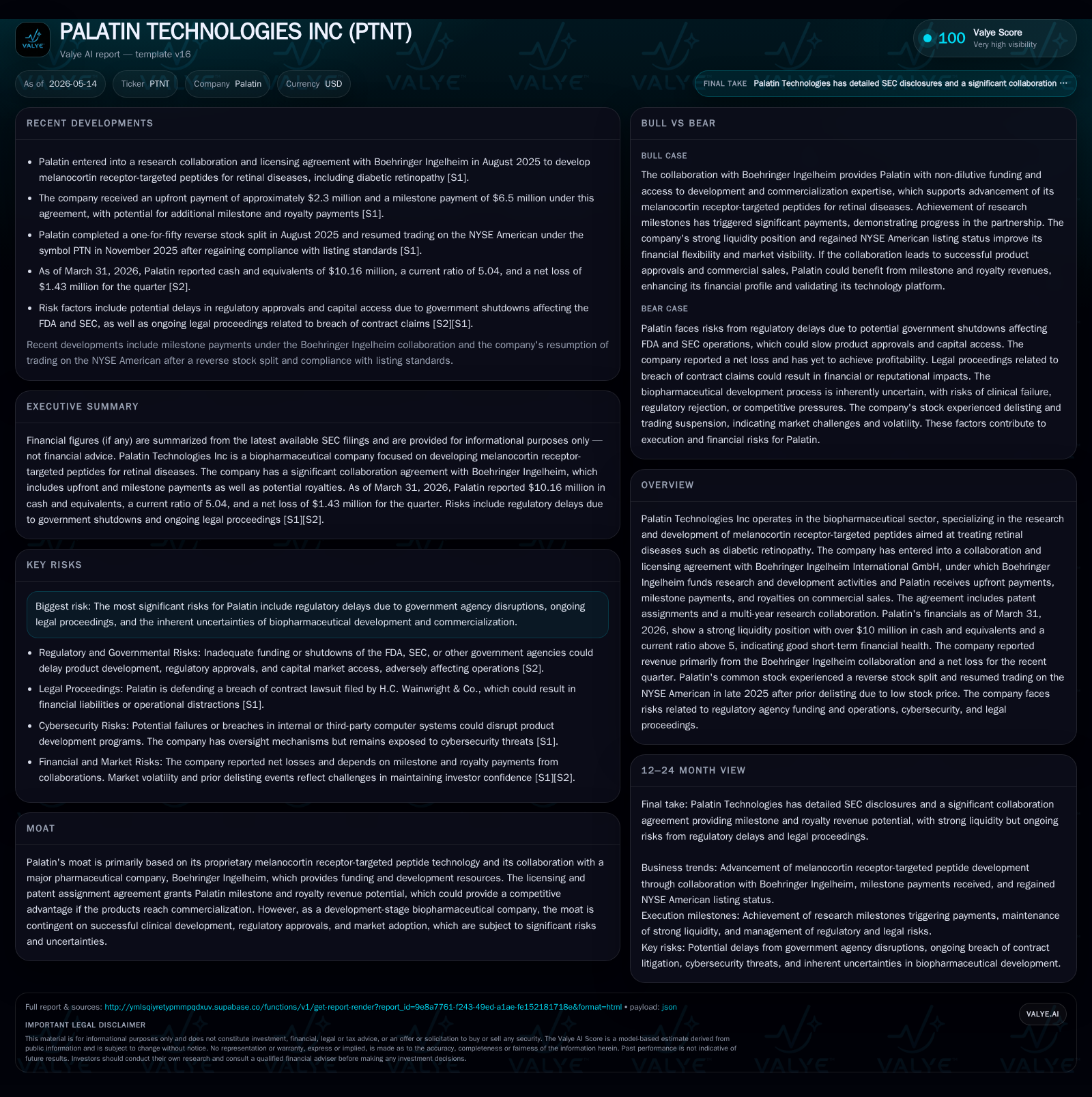
Palatin Technologies' most recent quarterly filing highlights continued advancement in its melanocortin receptor-targeted peptide development for retinal diseases such as diabetic retinopathy. The pivotal collaboration and licensing agreement with Boehringer Ingelheim provides Palatin a steady revenue stream through upfront, milestone, and royalty payments while funding R&D efforts. The company maintains a strong liquidity position, underpinned by over $10 million in cash and a current ratio above 5 as of Q1 2026. Palatin’s future growth hinges on regulatory milestones, successful clinical progress, and effective leveraging of its tech partnership amid inherent biotech sector risks including regulatory delays and legal challenges.
Recent Operating Update
Palatin Technologies’ latest quarterly report filed on May 13, 2026 ([S2]) underscores several critical developments shaping its near-term outlook. First, the company's financial health remains strong with cash and equivalents of approximately $10.16 million as of March 31, 2026, and a current ratio exceeding 5.0, reflecting prudent liquidity management supported by recent fundraising efforts ([F1]). Most notably, Palatin continues advancing its melanocortin receptor-targeted peptide platform through a robust collaboration with Boehringer Ingelheim International GmbH established in August 2025 ([S10]). This partnership involves patent assignments to Boehringer Ingelheim alongside a structured research collaboration backed by upfront payments (€2 million) plus tiered milestone incentives — exemplified by a €5.5 million ($6.5 million) milestone triggered in Q3 2025—plus potential royalties tied to downstream commercialization ([S16],[S10]).
The Boehringer Ingelheim deal represents Palatin’s primary revenue avenue given that the company remains in development stage without product sales ([F1]). This arrangement not only creates near-term inflows but also aligns incentives toward successful clinical translation of peptides targeting retinal pathologies like diabetic retinopathy—a disease segment poised for growth owing to increasing diabetes incidence globally.
Business Model
Palatin operates as a biopharmaceutical developer focusing on melanocortin receptor-targeted peptides for ocular indications representing underserved therapeutic needs. Revenue flows are predominantly milestone- and royalty-based arising from license agreements with pharmaceutical partners such as Boehringer Ingelheim. Under this construct, Palatin assigns certain intellectual property rights yet continues collaborative research funded externally while retaining rights to milestone payments linked to clinical achievements and eventual commercial sales royalties ([S10],[S16]).
This model facilitates access to capital resources otherwise inaccessible at an early stage while mitigating direct development cost burdens—critical given biopharma's capital intensiveness. However, it ties future earnings tightly to partner-driven development progress and regulatory approvals.
Industry Structure and Competitive Position
Within the broader ophthalmology therapeutics sector, firms are competing intensely to develop novel treatments for diabetic retinopathy—a leading cause of vision impairment. Peptide-based approaches hold appeal due to specific receptor targeting potentially offering differentiated efficacy or safety profiles relative to existing modalities such as anti-VEGF therapies.
Palatin’s competitive moat is derived from proprietary melanocortin receptor technology coupled with an alliance involving Boehringer Ingelheim’s extensive research capabilities and commercial infrastructure (, analysis). Despite this advantage, success depends significantly on navigating regulatory pathways efficiently while differentiating therapeutics enough to capture meaningful market share post-approval.
Growth Drivers
Key growth drivers include:
- Partner-funded R&D: Provides non-dilutive capital supporting rapid clinical progress without immediate capital strain on Palatin.
- Milestone Payments: Near-term research milestones (e.g., recent €5.5 million payment) validate pipeline advancement financially.
- Royalties: Potential long-term upside from commercial sales if products obtain regulatory approval.
- Retinal Disease Demand: Growing diabetic populations worldwide elevate market opportunity for innovative treatments.
- Capital Markets Access: Recent equity raise (~$18M gross proceeds) post-reverse stock split fortifies cash runway enabling sustained operations ([S21],[S7]).
Risks / Watchpoints / Growth Constraints
While prospects appear promising, several risk factors warrant attention:
- Regulatory Delays: Prolonged FDA review times possibly exacerbated by federal funding lapses or government shutdowns threaten timeline predictability ([S9],[S24]).
- Development Risk: Clinical failure or adverse findings could undermine entire programs given reliance on successful trial outcomes.
- Legal Proceedings: Ongoing litigation with H.C. Wainwright & Co., alleging breach of contract related to engagement agreements introduces legal uncertainties ([S25]).
- Dependency on Partner: Heavy reliance on Boehringer Ingelheim for development progress may restrict strategic flexibility.
- Market Listing Stability: Prior delisting issues resolved post reverse split nonetheless underscore equity trading volatility risks ([S10],[S7]).
What to Watch Next
Investors should monitor key milestones including:
- Progression updates from ongoing melanocortin peptide clinical trials under collaboration.
- Milestone achievement announcements tied to licensed programs triggering further payments from Boehringer Ingelheim.
- Regulatory steps such as FDA Investigational New Drug (IND) filings or acceptance dates relevant to pipeline compounds [implicit from warrant terms in S21/S22].
- Impact of any legal developments stemming from ongoing lawsuits.
- Company updates on capital position ensuring sustained operational runway beyond mid-2020s horizon.
Financial Profile Summary
Latest financial snapshot
| Metric | Value | Period |
|---|---|---|
| Cash & equivalents | $10mm | |
| 2026-03-31 | ||
| Current assets | $13mm | |
| 2026-03-31 | ||
| Current liabilities | $3mm | |
| 2026-03-31 | ||
| Current ratio | 5.04x | |
| 2026-03-31 |
Source: SEC companyfacts cache [F1].
Palatin’s operating history reflects net losses typical of early-stage biopharmaceutical companies investing heavily in R&D without product revenues. As of the latest quarter ending March 31, 2026:
The robust current ratio reflects conservative liabilities management supported by cash inflows from recent public offerings coupled with collaboration revenues ([F1],[S7],[S21]). Operating losses remain substantial reflecting ongoing investment in pipeline progression though offset partially by external funding arrangements.
This analysis does not constitute investment advice or recommendation but aims to provide a detailed business overview based on publicly available filings through May 2026. Readers should consider inherent biopharmaceutical industry risks including developmental uncertainty, regulatory complexity, and dependence on partnerships when assessing company prospects.
Disclaimer: This is research-only, informational analysis and not investment advice. It may include AI-generated interpretation and general industry context. Always verify important details using primary sources.

Comments