
Lumentum's Q3 Momentum Accelerates Amid Optical Component Demand Shifts
Lumentum’s latest quarterly results reveal evolving customer demand patterns and operational adaptability amidst supply chain and geopolitical pressures.
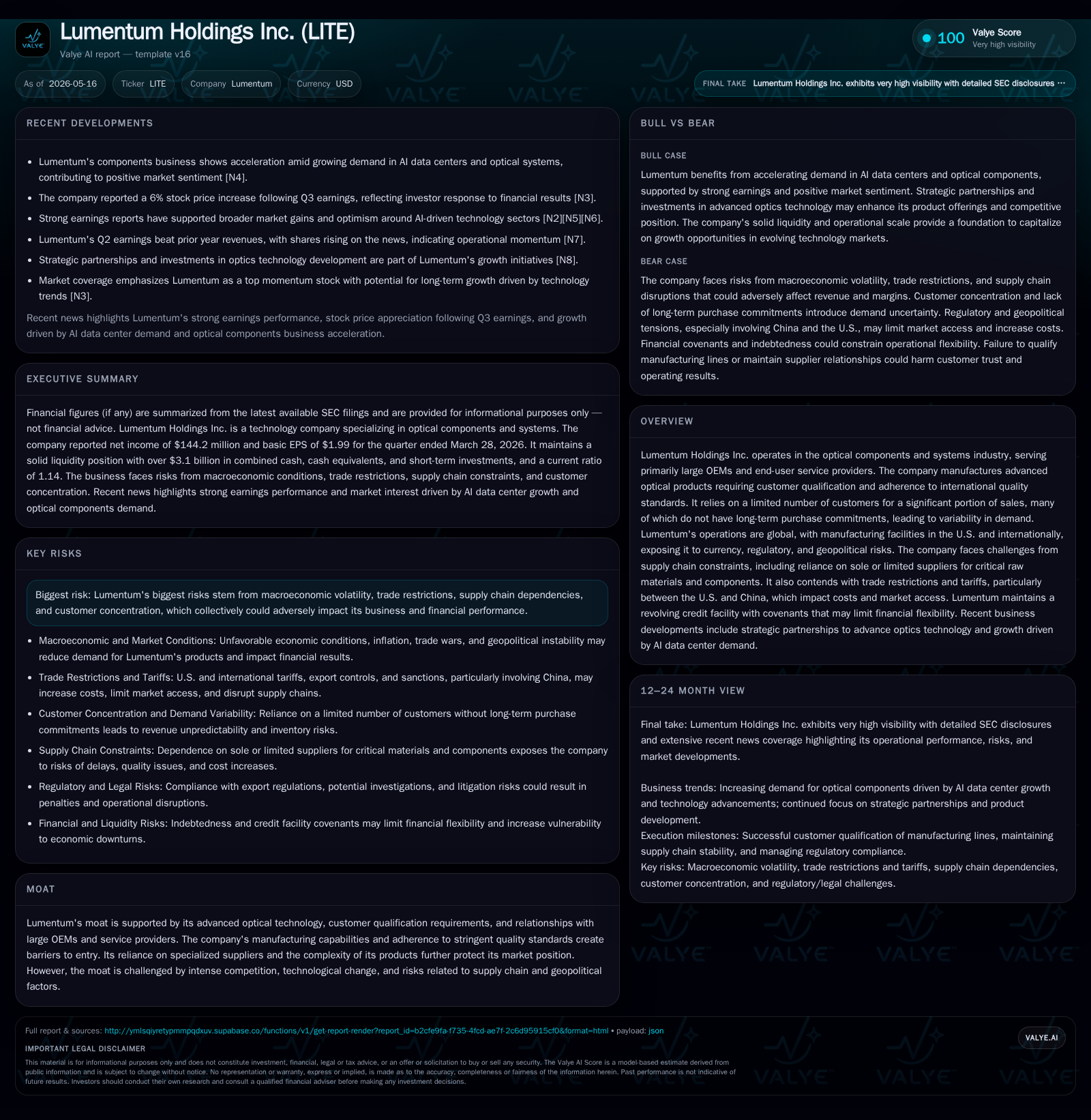
In Q3 fiscal 2026, Lumentum Holdings Inc. reported mixed demand across its optical components portfolio, underscored by variability in key customer orders and supply chain constraints. The company’s competitive positioning remains anchored in complex product qualification hurdles and advanced manufacturing capabilities, although it faces risks from concentrated customer relationships and persistent macroeconomic headwinds. Growth prospects are shaped by expanding AI-driven data center deployments and cloud infrastructure upgrades, balanced against exposure to trade restrictions and supply dependencies. Financially, Lumentum maintains a strong liquidity position with robust cash reserves relative to low debt, supporting ongoing investments despite margin pressures.
Q3 2026 Operational Highlights: What Changed and Why It Matters
Lumentum's fiscal third quarter ended March 28, 2026 presented a nuanced operating picture characterized by sustained demand volatility among its core customers. The company explicitly noted challenges related to customers' ongoing focus on cash preservation and tighter inventory controls, which led to fluctuations in order timing with cancellations or delays impacting backlog reliability [S2]. Despite these variations, Lumentum underscored resilience by adapting its manufacturing cadence without significant capacity underutilization.
Notably, segment disclosures reveal that while certain product lines connected to emerging applications like AI data centers experienced accelerated orders, other more established markets saw softness or deferred projects [S2][S3]. This bifurcation in demand underscores the company's exposure to cyclical spending patterns alongside structural growth trends. Additionally, the quarter's risk disclosures emphasized supply chain constraints deriving from sole or limited supplier relationships for critical raw materials—dynamics that have intermittently challenged throughput and cost control [S2].
The event filing dated May 5 reinforced these dynamics through updated commentary on operational flexibility and highlighted the launch of new optical technologies poised to meet evolving customer specifications [S3]. These advancements align with Lumentum’s strategic intent to capitalize on expanding AI infrastructure investments.
Business Model and Product Differentiation in Optical Systems
Lumentum operates predominantly as a specialized manufacturer of complex optical components serving large original equipment manufacturers (OEMs) and end-user service providers globally. Customers typically engage under purchase orders without long-term volume guarantees, injecting inherent unpredictability into revenue streams.
A key pillar of Lumentum's competitive edge rests upon rigorous customer qualification processes demanding extensive testing for quality assurance—a safeguard that acts as a substantial barrier to entry for newcomers due to product complexity and integration into client systems. This dynamic fosters pronounced switching costs, ensuring sustained ties with established clients despite episodic purchasing adjustments.
Manufacturing excellence is integral; facilities spread across the U.S., Asia-Pacific, and Europe must meet stringent industry standards during geographic diversification that introduces currency exposure and regulatory complexity. However, reliance on specialized suppliers for unique raw materials elevates operational risk.
Revenue flows depend largely on volume fluctuations combined with pricing nuances navigated carefully alongside customers who exert significant bargaining power due to their scale. The company balances pricing power between innovative product lines commanding premiums and mature products subject to competitive cost pressures [S9][S16].
Industry Drivers and Competitive Positioning in Optical Components
Lumentum situates itself within an optical communications ecosystem experiencing rapid transformations fueled by data center expansions driven by AI workloads—as detailed in broader industry coverage referencing peers navigating similar demand inflections [N7]. The intensifying 'AI supercycle' propels structural upgrades in network infrastructure requiring advanced photonic components such as those manufactured by Lumentum.
Nonetheless, the optics space remains fiercely competitive with continuous innovation eroding technological moats over time. To maintain differentiation, Lumentum invests aggressively in R&D aimed at improving component performance while striving to streamline costs amidst input price fluctuations exacerbated by global supply chain fragilities [N7].
Pricing power appears segmented: cutting-edge technologies enjoy premium valuation whereas legacy products face margin compression due to commoditization [S9]. Supply chain constraints stemming from limited key suppliers—especially for rare earth minerals—impact capacity utilization rates industry-wide affecting product availability timelines for Lumentum’s customers.
Growth Catalysts: Emerging Markets and Technology Trends
The most tangible near-term growth drivers emanate from surging AI-driven data center construction spurring demand for high-performance optical transceivers and components. Analyst commentary highlights material increases in order sizes reflecting this trend alongside rising cloud infrastructure investments upgrading network capabilities [N6][N9].
Lumentum’s strategic acquisition endeavors also feature prominently as avenues to broaden technological scope—particularly the Cloud Light acquisition referenced within risk narratives signifies an intent to deepen market penetration in next-generation optics solutions capable of sustaining long-term revenue growth [S2][N9].
Market adoption of 5G networks further complements demand expansion through propagated needs for enhanced optical backhaul capacities. Together these vectors underpin a measurable uplift in booked business supporting key performance indicators such as backlog growth (adjusted for customer variability), higher contract renewals among OEMs focused on future-ready configurations, and margin-positive product mix shifts.
Key Risks: Customer Concentration, Supply Chain Constraints, and Geopolitical Factors
Despite strategic opportunities, Lumentum confronts an array of risks detailed meticulously in its latest filings. Paramount among these is dependency on a small set of large customers responsible for a significant share of sales without guaranteed long-term purchase commitments—compounding forecasting difficulty amid volatile procurement patterns primarily influenced by their internal spending priorities [S9].
Supply chains remain vulnerable given sole-source arrangements for critical inputs; disruptions here may result in halted production or elevated costs impinging gross margins [S2][S19]. Moreover, escalating trade tensions between the U.S. and China continue weighing heavily; tariff impositions have increased input costs while export controls restrict sales opportunities notably highlighted by business cessation with Huawei impacting revenues negatively since 2019—an ongoing constraint with uncertain duration [S19][S21].
Legal exposures including intellectual property disputes contribute additional uncertainty along with regulatory compliance mandates particularly around data privacy laws spanning multiple jurisdictions that could inflate expenses or delay product delivery cycles if not managed effectively [S20][S27][S28]. Lastly inflationary pressures compound operational cost challenges alongside financing covenants embedded within credit agreements potentially curtailing tactical financial agility should macroeconomic conditions deteriorate further [S4][S5].
Watchlist: Upcoming Milestones, Earnings Guidance, and Order Visibility
Looking ahead, primary investor focal points will converge on order flow clarity post-Q3 given historical backlog unreliabilities tied to customer behavior variability [S2][N4]. Monitoring any positive shifts in booking consistency or contract stabilization will provide better visibility into sustainable revenue trajectories.
Additionally, integration progress of recent acquisitions such as Cloud Light—and concurrent capital expenditure aimed at bolstering manufacturing scalability—are milestones that merit evaluation as indicators of execution discipline supporting growth ambitions [S3]. Further quarterly earnings releases expected through calendar 2026 will shed light on evolving margin profiles influenced by mix shifts between legacy mature products versus more profitable new offerings.
The company’s ability to navigate geopolitical headwinds effectively while maintaining compliance frameworks amid changing export regulations remains critical watchpoints influencing both top-line expansion potential and operating cost containment strategies.
Latest Financial Snapshot: Liquidity, Capital Structure, and Profitability Overview
As of March 28, 2026 quarter-end ([F1]), Lumentum maintained approximately $2.62 billion in cash against modest total debt near $43 million yielding a strong net cash position supportive of operational flexibility despite sector headwinds.
This robust liquidity base equips Lumentum to withstand transient macroeconomic shocks while continuing investments aligned with its strategic roadmap.
This analysis focuses strictly on operating developments drawn from publicly filed SEC disclosures up through the third quarter fiscal 2026 period and select nascent market observations; it does not constitute investment advice or recommendations.
Disclaimer: This is research-only, informational analysis and not investment advice. It may include AI-generated interpretation and general industry context. Always verify important details using primary sources.

Comments