
AMD’s Quarterly Growth Underpinned by AI Expansion and Strategic Capital Management
AMD’s latest quarterly filing reveals continued strength in product demand and liquidity amid intensified AI-driven semiconductor competition.
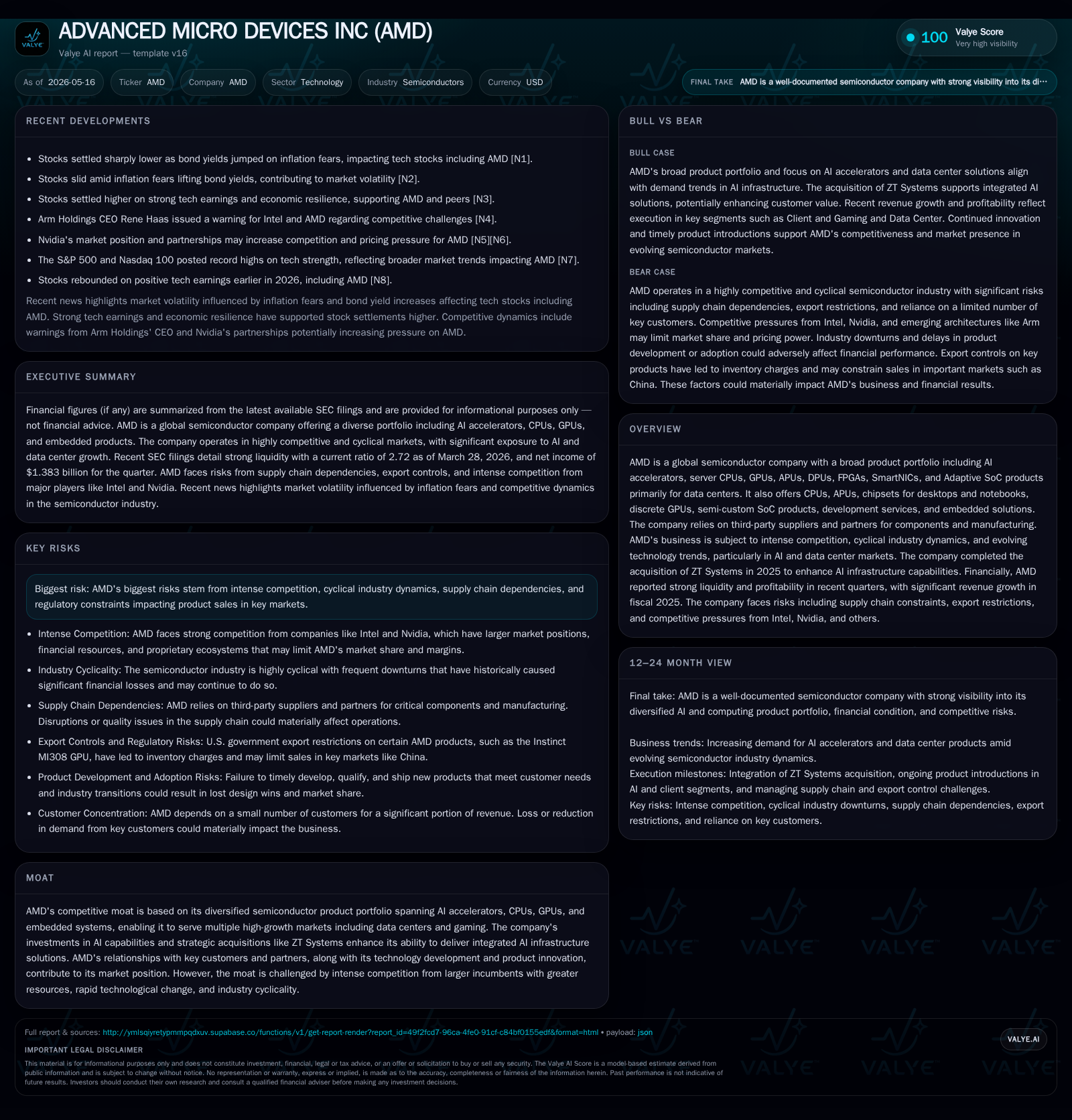
Advanced Micro Devices Inc (AMD) reported robust operational momentum in its first quarter of 2026, driven by strong demand in Data Center and Client and Gaming segments. The company's strategic acquisition of ZT Systems enhances its AI infrastructure offerings, complementing a diversified portfolio that spans CPUs, GPUs, and adaptive SoCs. While AMD's competitive positioning benefits from innovation and strategic partnerships, ongoing supply chain risks and intense industry rivalry pose challenges. Recently expanded credit facilities and a solid cash position bolster AMD’s financial flexibility as it pursues growth in high-value markets.
Recent Operating Update: Q1 2026 Performance
Advanced Micro Devices Inc (AMD) reported its first-quarter results for fiscal 2026 ending March 28 in its May 6, 2026 Form 10-Q [S2], revealing sustained revenue growth driven primarily by strong performances across its Data Center and Client & Gaming segments. This momentum builds on previous quarters where elevated demand for AMD EPYC CPUs and Instinct GPUs fueled expansion. Notably, AMD continues to navigate export constraints that affected earlier inventory valuations related to the Instinct MI308 Data Center GPU [S11].
On the financial front, AMD bolstered its liquidity framework through a material definitive agreement announced on May 15, establishing a new unsecured five-year revolving credit facility totaling $5 billion, effectively replacing the prior agreement and increasing available financing capacity [S3]. Concurrently, AMD raised the ceiling on commercial paper issuance from $3 billion to $5.5 billion under an existing program to enhance treasury management flexibility [S3].
The company also received shareholder approval for an amendment to its 2023 Equity Incentive Plan allowing an increase of authorized shares by 65 million plus administrative updates, signaling commitment toward talent retention amid competitive pressure in the semiconductor industry [S3].
Business Model: Revenue Mechanics and Strategic Strengths
AMD generates revenue primarily through sales of semiconductor devices including CPUs (especially its Ryzen and EPYC series), discrete GPUs under Radeon branding, semi-custom system-on-chip (SoC) products used in gaming consoles, adaptive SoCs aimed at data center acceleration including DPUs and FPGAs, as well as embedded processors tailored for industrial applications. Its design-centric model relies heavily on third-party foundries such as TSMC for manufacturing.
The integrated product portfolio enables AMD to serve diversified end markets: data centers requiring high-performance AI accelerators; client computing with desktop/mobile processors; gaming platforms relying on both semi-custom chips and discrete GPUs; plus embedded systems demanding specialized SoCs.
Revenue is influenced by multiple drivers: unit shipments tied to OEM/ODM contracts; average selling prices reflecting product mix shifts toward higher-margin next-gen chips; technology leadership enabling premium pricing; and a growing software ecosystem facilitating stickiness. Margins benefit when new architectures (e.g., Zen 5 for CPUs) gain traction rapidly.
Recent R&D expense increases underscore aggressive investments into AI capabilities and future architectures aligned with market transitions toward data-intensive workloads [S11,S13]. Meanwhile, semi-custom SoC sales underpin steady gaming-related income whilst enhancing customer lock-in.
Industry Structure and Competitive Position
The semiconductor industry is characterized by rapid technological change, high capital intensity, and cyclical demand patterns sensitive to macroeconomic conditions. AMD competes principally with Intel in CPUs and with Nvidia primarily in GPUs but also increasingly overlaps with companies like Broadcom in specialized acceleration hardware.
AMD's moat stems from its diversified chipset ecosystem spanning general-purpose CPUs, GPUs optimized for graphics or compute workloads, programmable logic devices (FPGAs), data path units (DPUs), SmartNICs, and adaptive SoCs—a breadth that few rivals match comprehensively. The strategic acquisition of ZT Systems bolsters AMD’s capability to provide end-to-end AI infrastructure solutions combining hardware design with deployment-scale manufacturing assets while divesting non-core manufacturing operations streamlines focus [S6].
However, the competitive environment remains intense with larger competitors wielding deeper resources. Rapid adoption cycles for AI technologies necessitate continuous innovation. AMD also faces geopolitical risks including export controls affecting its ability to ship certain GPU models internationally—a key challenge documented extensively in recent filings [S1,S2].
Customer concentration is significant since a handful of large cloud service providers represent substantial portions of data center CPU/GPU demand, amplifying exposure to contract variability [S1,S2]. Software collaboration—such as maintaining compatibility with Microsoft Windows ecosystems—is critical given the hardware-software interplay that drives adoption among enterprise users.
Growth Drivers
AI Infrastructure Expansion
AI workloads are creating unprecedented demand for heterogeneous compute solutions combining CPUs with purpose-built accelerators. AMD’s expanded product lineup in this sphere—including the Instinct MI350 GPU series and adaptive SoCs augmented through ZT Systems acquisition—positions it well to capture growth in cloud data centers optimizing AI training/inference throughput.
Next-Generation CPUs and GPUs
The rollout of “Zen 5” Ryzen processors has spurred Client segment growth through higher ASPs driven by stronger performance per watt/price metrics supporting premium positioning among OEM partners [S11,S14]. Similarly, EPYC processors see uptake supported by server refresh cycles and hyperscaler expansion needs.
Semi-Custom SoCs & Gaming Consoles
Semi-custom products supplied to major gaming consoles continue fueling Client & Gaming revenue streams alongside rising discrete GPU sales under Radeon branding. The combined segment exhibited strong operating income growth reflecting favorable volume/mix dynamics over recent quarters [S8,S14].
Strategic M&A Integration
The acquisition of ZT Systems completed in early 2025 delivers tangible synergies through technological breadth extension into AI hardware/software stacks while retaining core design IP post-divestiture of manufacturing assets. This vertical integration supports holistic solutions favored by cloud customers seeking turnkey setups.
Risks / Watchpoints / Growth Constraints
- Supply Chain Vulnerabilities: Dependence on third-party fabs exposes AMD to capacity constraints or disruptions impacting timely delivery.
- Export Controls: Regulatory restrictions have impaired international sales of certain GPU products leading to inventory impairments [$800 million charge noted] [S11,S15].
- Competition: Aggressive moves by incumbents Intel and Nvidia may compress market share or force margin concessions.
- Demand Cyclicality: Semiconductor end markets historically exhibit volatility influenced by industrial cycles or consumer spending shifts.
- Customer Concentration: Revenue highly weighted toward limited major cloud/data center clients increases bargaining power risk.
- Technology Adoption Timing: Success depends on fast innovation pace coupled with ecosystem support ensuring software compatibility.
- IP Protection & Cybersecurity: Breaches could erode competitive advantage or impose costly remediation burdens [S1,S2].
- Economic Uncertainty: Macro conditions affecting capital expenditure patterns among enterprise customers can dampen order flows.
What To Watch Next
- Announcements around new AI accelerator products or enhanced EPYC processor generations signaling roadmap execution.
- Quarterly backlog/order metrics providing insight into whether supply chain normalization supports volume expansion.
- R&D spend trajectories reflecting investment balance between near-term cycles versus long-term innovation strategies.
- Progress integrating ZT Design Business IP into cohesive AI infrastructure offerings targeting hyperscale customers.
- Updates on regulatory environment especially changes impacting exports or shifting trade policies relevant to semiconductor industry players.
- Capital allocation moves including the pace of stock repurchases tied to cash flow generation trends [S26].
- Customer contract renewals or partnerships announcements indicative of sustained commercial momentum.
Financial Profile: Recent Snapshot Contextualization
As of March 28, 2026 quarter-end ([F1],[S2],[S3]), AMD maintains a strong liquidity position:
- Cash & equivalents: $5.585 billion
- Total debt: approx. $3.25 billion
- Net debt position is negative at roughly -$2.335 billion reflective of robust cash reserves
- Current assets stand at approximately $28.63 billion versus current liabilities at $10.51 billion yielding a current ratio near 2.72 indicating solid short-term financial health
Latest Financial Snapshot Table:
Latest financial snapshot
| Metric | Value | Period |
|---|---|---|
| Cash & equivalents | $5.6bn | |
| 2026-03-28 | ||
| Total debt | $3.3bn | |
| 2025-12-27 | ||
| Net debt | $-2.3bn | |
| 2025-12-27 | ||
| Current assets | $28.6bn | |
| 2026-03-28 | ||
| Current liabilities | $10.5bn | |
| 2026-03-28 | ||
| Current ratio | 2.72x | |
| 2026-03-28 |
Source: SEC companyfacts cache [F1].
| Metric | Value | Period End |
|---|---|---|
| Cash & Equivalents | $5.585B | |
| 2026-03-28 | ||
| Total Debt | $3.25B | |
| 2025-12-27 | ||
| Current Assets | $28.63B | |
| 2026-03-28 | ||
| Current Liabilities | $10.51B | |
| 2026-03-28 | ||
| Net Income (FY) | $4.335B | |
| 2025-12-27 | ||
| Operating Income(FY) | $3.694B | |
| 2025-12-27 | ||
| Current Ratio | ~2.72 | |
| 2026-03-28 |
Analysis Summary: AMD’s latest quarterly performance reiterates solid execution across high-growth markets especially those leveraging artificial intelligence computation demands while maintaining sound financial health via disciplined capital management initiatives including liquidity enhancement through credit facilities renewal coupled with active share repurchase programs funded from strong operational cash flows. Its business model adaptability—pivoting towards integrated AI solutions empowered by ongoing acquisition-driven intellectual property enrichment—constitutes a core element supporting sustainable competitive positioning despite cyclical pressures and regulatory headwinds prevalent within semiconductor industry dynamics.
This analysis reflects information publicly disclosed by Advanced Micro Devices Inc as of May 16, 2026 based on SEC filings cited herein combined with sector-specific interpretive context.
Disclaimer: This is research-only, informational analysis and not investment advice. It may include AI-generated interpretation and general industry context. Always verify important details using primary sources.

Comments